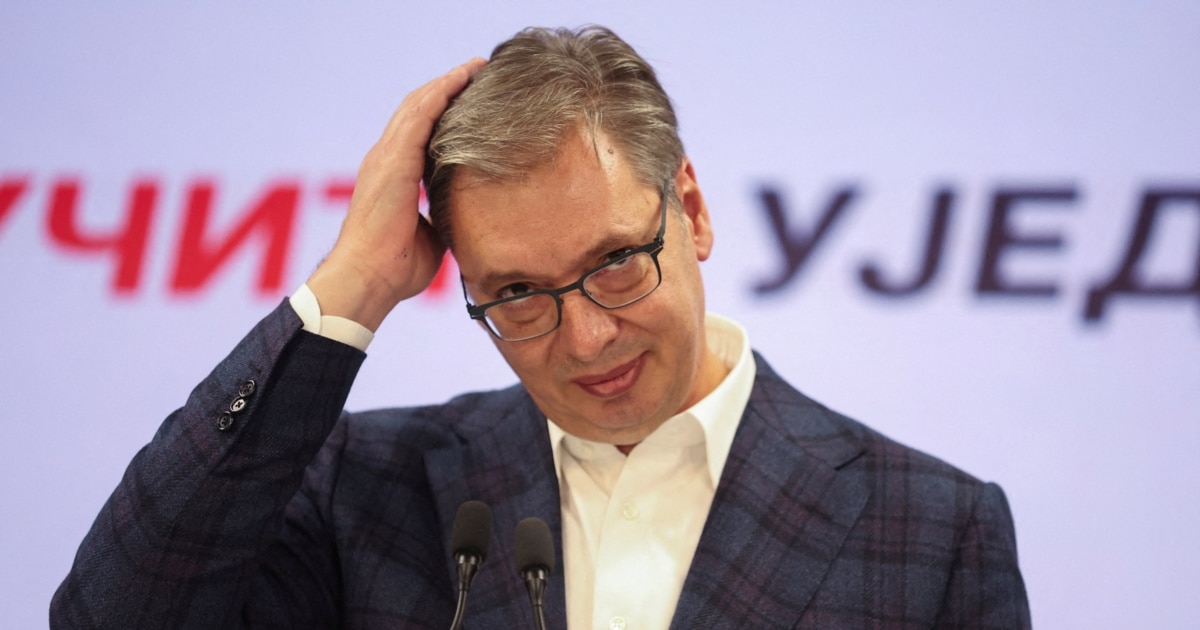
Former President Aleksandar Vučić Concedes as Student-Led Opposition Wins Majority in Serbia’s Early Parliamentary Vote
Aleksandar Vučić, who resigned the presidency to lead his party into early parliamentary elections, acknowledged defeat after preliminary results handed a majority to a Student List backed by two years of mass protests. The outcome signals a potential sea change in Serbian politics amid accusations of corruption linked to a deadly infrastructure collapse and heated disputes over the country’s future foreign-policy alignment.
By Christopher Manley
1,155 views
Former Serbian president Aleksandar Vučić has conceded defeat after early parliamentary elections that appear to hand a majority in the 250-seat National Assembly to an opposition coalition known as the Student List. Preliminary results released after voting showed Vučić’s Serbian Progressive Party winning 105 seats, while the Student List secured at least 135 seats, comfortably surpassing the threshold needed for a parliamentary majority.
The elections, held on October 25, were marked by unusually high turnout: authorities reported that 69.1% of registered voters cast ballots within Serbia (the turnout figure excluded the diaspora). A total of 18 political forces competed, but the campaign — and the political energy behind it — was dominated by a contest between Vučić’s party and the Student List, which emerged from two years of mass demonstrations.
The Student List was formed through discussions among activists involved in the protests, though prominent protest leaders themselves did not stand as candidates. Instead, the list put forward professionals and public figures — scientists, doctors, cultural workers and civil-society activists — as candidates. The list is led by cardiologist Ilija Srdanovic.
The protests began in December 2024 after a catastrophic structural collapse at the railway station in Novi Sad that killed 16 people. Student activists and allied groups blamed corruption and negligence by state authorities for the disaster and demanded the resignation of Vučić and the removal of his Serbian Progressive Party from power. The movement drew broad support across ideological lines, uniting liberal and nationalist critics around demands for accountability and institutional reform.
Vučić resigned the presidency on September 27 in order to top his party’s ticket in the snap parliamentary vote. Under Serbia’s political structure, the prime minister wields the day-to-day executive authority, while the presidency is largely ceremonial; Vučić’s decision to seek the premiership was widely viewed as an effort to retain control over government policy.
Throughout the campaign, Vučić and his supporters accused the student movement of attempting a foreign-backed “color revolution,” alleging outside financing and undue foreign influence. Vučić also repeatedly warned that a victory for his opponents could lead to sanctions or other pressure on Russia. The Student List has not called for sanctions on Russia as a central demand; its platform has focused principally on governance, public safety and anti-corruption measures.
Pre-election polls had suggested a close race, with both Vučić’s camp and the opposition polling above 40% support in various surveys. With the preliminary seat allocation showing a decisive advantage for the Student List, the election appears to reflect a significant shift in public sentiment after months of street demonstrations and public outcry over accountability for the Novi Sad tragedy.
The result has major implications for Serbia’s domestic politics and for regional and international relations. A Student List majority would allow those aligned with the protest movement to pursue legislative and administrative changes aimed at addressing corruption, improving public safety standards, and curbing the influence of the ruling party. It also raises questions about Serbia’s foreign-policy orientation, given the rhetoric during the campaign linking electoral outcomes to the country’s stance toward Russia.
As these are preliminary results, final tallies and the formal allocation of seats will determine the exact shape of the new parliament and the coalition-building that follows. For now, Vučić’s concession marks the culmination of a contentious campaign in which public anger over a tragic collapse and allegations of systemic corruption translated into electoral success for a movement born in the streets and organized by professionals and civic activists.