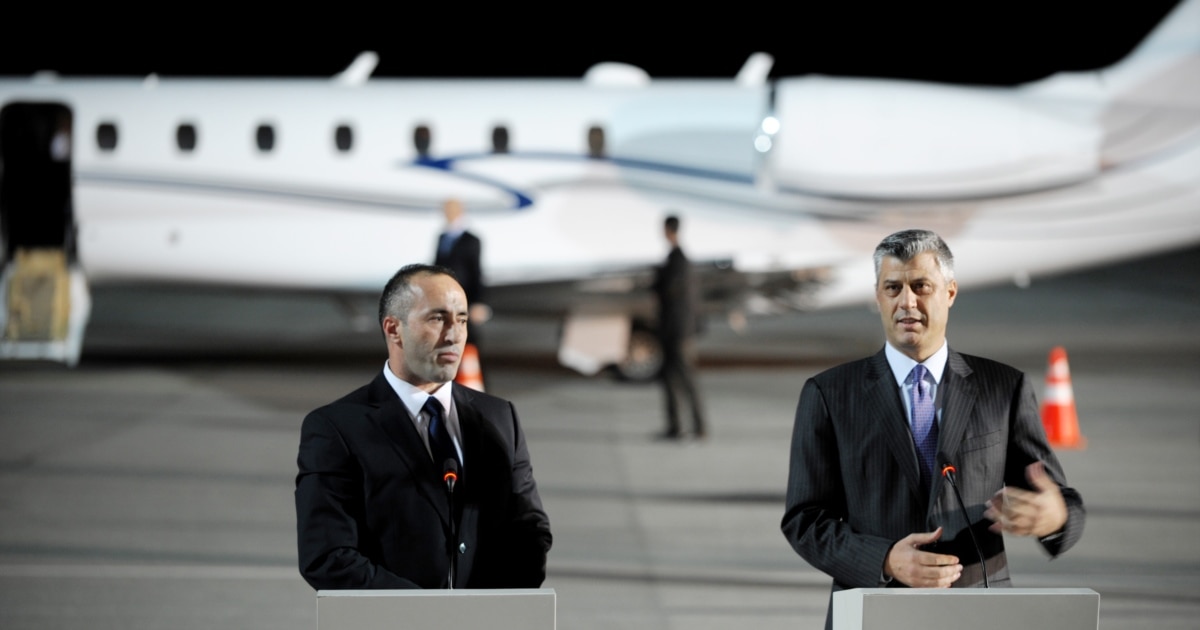
Former PM Ramush Haradinaj Proposes Detained Ex-President Hashim Thaçi for New Term
Ramush Haradinaj has called for the 11th legislature of Kosovo to restore Hashim Thaçi to the presidency, describing it as an honour and framing the move as a corrective to what he called an unlawful removal of Thaçi’s mandate. Thaçi remains in pre-trial detention at the Kosovo Specialist Chambers in The Hague on charges of war crimes and crimes against humanity and is due to learn the verdict in that case on Sept. 16.
By Clémence Desjardins
1,035 views
A proposal from Ramush Haradinaj, a member of the Alliance and a former prime minister of Kosovo, to reinstate ex-president Hashim Thaçi has added a contentious element to the debate over the formation of Kosovo’s new institutions following June elections. Haradinaj said it would be "nder" (an honour) for deputies in the 11th legislature to return Thaçi to the presidency, arguing the move would rectify what he described as the stripping of the former president’s mandate by an "intervention" and serve as a national response to Kosovo’s perceived adversaries.
Hashim Thaçi has been held in pre-trial detention at the Kosovo Specialist Chambers in The Hague for nearly six years, charged with war crimes and crimes against humanity allegedly committed during and after the 1998–99 conflict. Thaçi and three other former Kosovo Liberation Army (UÇK) leaders — Kadri Veseli, Jakup Krasniqi and Rexhep Selimi — have pleaded not guilty. A Trial Panel is scheduled to deliver its decision in that case on Sept. 16, according to court records cited in the Assembly statement.
Haradinaj framed his proposal as separate from party loyalties, saying the reinstatement would be "në nderin tonë si shqiptar, si komb, jo për shkak të ndonjë afërsie partiake a politke, por për shkak të një kundërpërgjigje të armiqve të Kosovës që kurrë nuk flenë, që t’ia vazhdojmë mandatin." He also criticised Prime Minister Albin Kurti, head of the ruling Lëvizja Vetëvendosje (LVV), accusing him of attempting to delay the constitution of state institutions and suggesting that there were other options rather than letting Kosovo be held "hostage." Haradinaj’s remarks were made in a media statement from inside the chambers of the Assembly of Kosovo.
Support for a renewed mandate for Thaçi has also been voiced by members of his former party, the Democratic Party of Kosovo (PDK). PDK deputy Arian Tahiri told reporters on Aug. 21 that the party expects the accused former officials to be acquitted on Sept. 16 and said "Presim që më 16 shtator, ai dhe çlirimtarët të vijnë të lirë dhe do t’i presim të gjithë. Andaj është mundësi e mirë, edhe pse jo, të gjitha forcat politike të japin mbështetje për presidentin Thaçi që të vazhdojë punën aty ku e ka lënë."
The interventionist proposal comes amid ongoing negotiations between LVV and the Lidhja Demokratike e Kosovës (LDK) over reaching a consensus candidate for the largely ceremonial but symbolically important presidency. Prime Minister Kurti has pushed for a political agreement on the presidential nominee before proceeding with the full constitution of the Assembly and the swearing-in of a new government after the June elections. LVV has enough mandates — when combined with votes from non-majority minority parties — to constitute the Assembly and elect a government, but the procedure to elect a president requires a quorum of 80 deputies in the 120-seat parliament for the vote to be valid.
Complicating the political calculations, Thaçi has previously stated in a written interview from detention that he would not return to active electoral politics if he is released. He is also facing a separate indictment related to alleged obstruction of justice before the Specialist Chambers. The Hague court has indicated that it will be for the judge handling the obstruction case to determine whether Thaçi could be released from detention if he were acquitted in the main war crimes case.
Haradinaj’s proposal places the disputed issue of Thaçi’s legal status at the centre of Kosovo’s immediate political calendar and highlights the tensions between legal accountability for alleged wartime abuses and nationalist appeals to restore a former leader’s mandate. With a significant court decision looming on Sept. 16 and political negotiations continuing between major parties, the coming weeks could determine both the legal fate of high-profile suspects and the shape of Kosovo’s new institutional leadership.
Radio Free Europe/Radio Liberty’s Kosovo service provided the reporting on which this account is based, citing statements made in the Assembly and by party officials, as well as the Specialist Chambers’ public schedule. No new legal outcomes have been reported as of this publication.