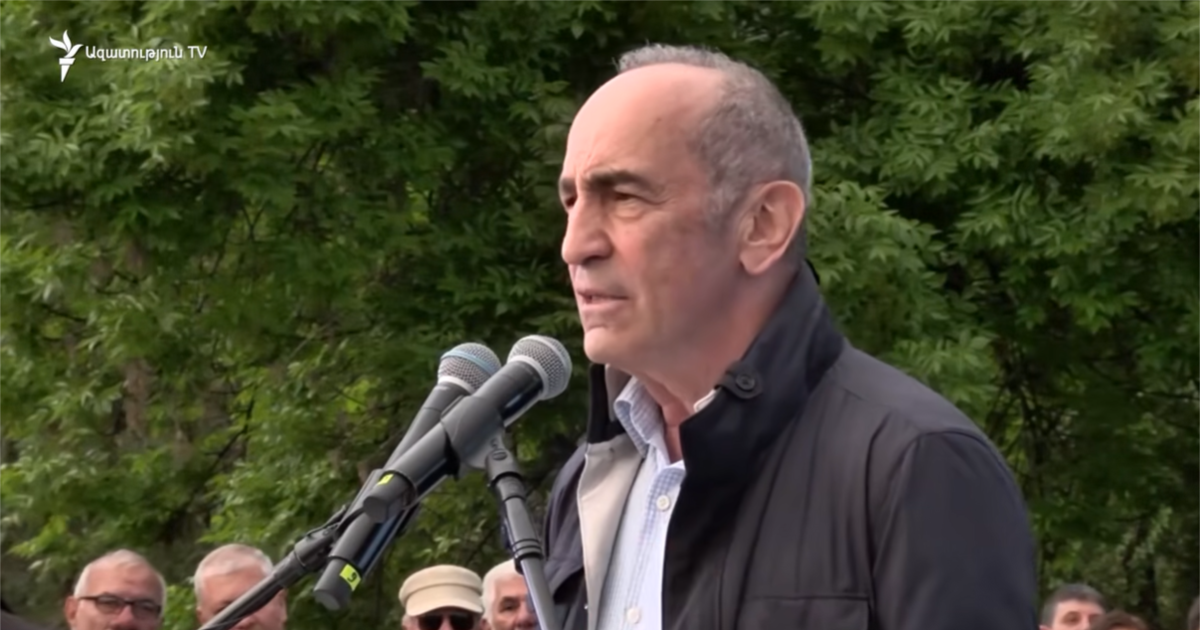
Former Armenian President Robert Kocharyan Arrested on Corruption Charges; Son Among Six Detained
Armenian police have detained former president Robert Kocharyan on allegations of abuse of power, money laundering and bribery, in a case that names 14 suspects and has already led to six arrests including his elder son. The move comes amid accusations from opposition figures that the judiciary is being used to intensify pressure on political opponents, and forms part of a wider bulletin of urgent human-rights and security developments across the region.
By Alexander Walter
1,115 views
Armenian authorities have arrested former president Robert Kocharyan on charges alleging misuse of power, money laundering and accepting bribes, officials said. The investigation alleges that during his presidency Kocharyan used his office to transfer or acquire state property for the benefit of himself and close associates and then took steps to conceal the origins of those assets. The case names 14 people as suspects and has resulted in six arrests; among those detained is his eldest son, Sedrak Kocharyan (سدراک کوچاریان).
The arrest of the 71-year-old Kocharyan — who served as Armenia’s president from 1998 to 2008 and now leads the opposition bloc "ائتلاف ارمنستان" — came a day after public criticism of Prime Minister Nikol Pashinyan by Kocharyan’s other son, Levon Kocharyan (لوون کوچاریان), who is also a member of the opposition. Opposition figures have described the prosecution as part of a broader pattern of increasing judicial pressure on opponents of the government, a contention that risks deepening political polarization in Yerevan.
The charges and the involvement of family members make the case politically sensitive. Supporters of Kocharyan have in the past decried prosecutions as politically motivated; meanwhile, authorities argue that the rule of law requires accountability for alleged corruption at the highest levels. How the courts handle the case, and whether the detentions lead to wider crackdowns or protests, will shape perceptions of judicial independence and democratic norms in Armenia.
Beyond Armenia, the news roundup from the same dispatch highlights a number of urgent human-rights, security and accountability stories across the region. The U.S. State Department’s "برنامۀ پادش برای عدالت" announced rewards of $8 million and $10 million for information leading to the capture of two leaders of Islamic State’s Khorasan Province (ISIS-K): ثناءالله غفاری مشهور به شهاب المهاجر, described as the current leader of ISIS-K, and a second leader identified as عبیدالله and responsible for financial and operational matters. The program said the group has organized attacks that killed hundreds of civilians at protests, music venues, airports and other locations in Afghanistan and elsewhere.
In Syria, Damascus announced the full dissolution and incorporation of the U.S.-backed Syrian Democratic Forces into the Syrian army. The SDF’s commander, مظلوم عبدی, said the alliance will no longer operate as an independent military force after the completion of the integration process. The United States welcomed the move as a step toward forming "یک اردو، یک حکومت و یک کشور" — a single army, a single government and a single country — while analysts warn the change could mark a significant blow to aspirations for Kurdish autonomy in north‑east Syria.
The dispatch also reports a deadly hospital fire in Islamabad: at least 14 newborns died after a blaze swept through the neonatal ward of the state-run Pakistan Institute of Medical Sciences, authorities and media said. Initial reports blamed a malfunction or explosion in the air-conditioning system. Pakistan’s Prime Minister Shahnawaz Sharif (شهباز شریف) expressed condolences and demanded identification of those responsible, while police and authorities opened an immediate investigation. The incident revived concerns about fire safety standards and enforcement at large public buildings across Pakistan.
Regional security matters were further underscored by Iran’s statements on the Strait of Hormuz. Tehran and Muscat said they are in talks on a phased framework for a temporary joint shipping corridor and a mine‑clearing project to allow the resumption of safe passage for ships. At the same time, Iran’s deputy foreign minister, کاظم غریب آبادی, warned that no foreign military vessel will be permitted to transit the strait, and said the waterway would remain closed until the United States ended what he described as its hostile economic measures.
The bulletin also includes developments related to Afghanistan’s humanitarian and human-rights situation under Taliban rule. The Taliban government’s minister for industry and trade, نورالدین عزیزی, said roughly 100,000 Afghans work in the country’s jewelry trade and inaugurated a national gold and jewelry fair in Kabul. Separately, UNICEF warned that approximately one million Afghan children suffer from severe acute malnutrition and face life‑threatening risk without urgent treatment, while a further 3.7 million children are affected by undernutrition. The UN body quoted تاجالدین اویواله as sounding an urgent alarm about the scale of the crisis.
Human‑rights organizations also reported an increase in corporal punishment under the Taliban. The Canada‑based Afghanistan Human Rights and Democracy Organization said it recorded 593 instances of flogging in 2024, rising to 1,074 in 2025, and 553 cases by April of the current year. UNAMA’s mid‑year report similarly recorded 137 public lashings from April through June, raising concerns among rights groups about violations of human dignity and international standards.
Other items included confirmation by U.S. officials to Radio Free Europe/Radio Liberty that John Ratcliffe (جان راتکلیف), identified in the dispatch as head of the U.S. Central Intelligence Agency, made an unannounced trip to Moscow; officials declined to comment on meeting partners or subject matter. And German authorities reported returning 23 Afghan nationals to Kabul — individuals the interior ministry said were convicted of serious crimes including sexual assault, beatings and grievous bodily harm — bringing total returns to 228 since the current German government took office last year.
Taken together, these developments reflect an array of pressing concerns across Eurasia: contentious prosecutions and questions of political accountability in Armenia; counter‑terrorism efforts against ISIS-K; shifts in Syria’s military balance with implications for Kurdish autonomy; recurring civilian tragedies tied to weak safety standards in Pakistan; and mounting humanitarian and human‑rights crises in Afghanistan. Each raises separate legal, political and humanitarian questions for governments, international organizations and human-rights monitors to track in the weeks ahead.