Florida Agency Agrees to $485,000 Settlement in First Amendment Case After Firing Over Instagram Post About Charlie Kirk
A Florida state agency will pay $485,000 to resolve a lawsuit by a former employee who was fired after reposting satirical Instagram content related to remarks by conservative commentator Charlie Kirk. The settlement includes compensation, attorneys' fees, a neutral reference and limited future access to agency staff for conservation work, while the plaintiff has resigned and released her claims.
By Eugene Volokh
1,153 views
A Florida state agency has agreed to pay a total of $485,000 to resolve a First Amendment lawsuit filed by a former biologist it fired over a social-media repost about the death of conservative commentator Charlie Kirk. The plaintiff, Brittney Brown, had spent roughly seven years at the Florida Fish and Wildlife Conservation Commission (FWC), studying shorebirds and seabirds at the Tyndall Air Force Base Critical Wildlife Area near Panama City, before her September 2025 termination. Under the settlement, the agency will pay $235,000 in compensatory damages, $40,000 in back pay and $210,000 in attorneys' fees and costs; Brown has resigned and released her claims in exchange. The deal averted a federal trial that had been scheduled for June.
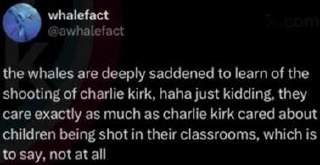
The litigation grew out of an Instagram story the plaintiff reposted from an account that posts satirical commentary from the perspective of a whale; the post referenced public remarks by Charlie Kirk suggesting that an armed citizenry entails "some gun deaths" as part of the price of protecting Second Amendment rights. That repost was widely circulated on other social-media platforms, including by the account "Libs of TikTok," which shared a screenshot alongside Brown's LinkedIn profile and called for her firing, and led to sustained public criticism directed at the employee's employer, the FWC. The agency fired the employee the following day — issuing a public statement that her actions were "not in line" with its values and mission — and she sued, seeking a preliminary injunction to be reinstated.
In an earlier stage of the case, U.S. District Judge Mark Walker denied the plaintiff's motion for a preliminary injunction. The court's legal analysis focused on the well-established framework for speech claims by government employees: protection applies if (1) the speech is made as a private citizen and not pursuant to official duties, (2) the speech concerns a matter of public concern, and (3) the employee's interest in speaking outweighs, under the Pickering balancing test, the government's interest in efficient and effective public service.
Judge Walker found that the first two elements were satisfied and that the determination was "not a close call"—reposting third-party content on an employee's personal social-media account qualifies as the employee's own speech, and satirical or controversial comments can address matters of public concern. Nevertheless, the court concluded on the record before it that the plaintiff had not carried her burden to show that her First Amendment interests outweighed the FWC's interest in avoiding disruption. The court relied in part on an unchallenged declaration from an FWC official, identified in the litigation as Ms. Tucker, which described a swift and largely negative public reaction that purportedly "disrupted agency operations, required diversion of staff resources to manage responses, and raised legitimate concerns about the agency's credibility and public trust."
The court criticized the plaintiff for not pursuing expedited discovery that could have tested the factual assertions in the declaration and observed that "the government's legitimate interest in avoiding disruption does not require proof of actual disruption. Reasonable possibility of adverse harm is all that is required." The court left open the possibility that further discovery or trial could show a lesser degree of disruption and shift the Pickering balance in the plaintiff's favor, but for the preliminary relief sought, the court found the record insufficient.
That opening proved decisive. As the case proceeded, discovery undercut the factual basis for the firing: the plaintiff's side maintained, and the agency was unable to substantiate, the central claims that the post had generated hundreds of public complaints and meaningfully disrupted operations. In May 2026, the U.S. District Court for the Northern District of Florida entered an order imposing sanctions both on the FWC official who had submitted the disruption declaration and on the agency's outside law firm, finding that the official's affidavit was false and that the firm had engaged in vexatious litigation. Those findings reframed the Pickering analysis that had earlier gone against Brown, since the third prong had turned on disruption claims the record no longer supported, and they preceded the settlement that followed.
Legal observers and the litigants have pointed to the case as an example of the way government-employer First Amendment doctrine can effectively allow public outcry to shape employment outcomes. As the court and commentators noted, while the government generally may not silence speakers in the public square because listeners threaten disruption, the employment context permits firings where the employer demonstrates that controversial speech imposes a sufficient burden on its operations or public trust. Commentators also drew a comparison to the Supreme Court's 1987 decision in Rankin v. McPherson, which protected a public employee's far more provocative remark about a presidential assassination attempt, in arguing that a satirical repost should fall comfortably within protected speech on a matter of public concern. The ACLU Foundation of Florida represented the plaintiff; counsel listed for Brown include Carrie McNamara, Daniel Boaz Tilley, Michelle Morton, and Samantha Jo Past. Gary S. Edinger & Assocs., with attorney Gary Edinger, represented other interests in the case. The settlement ends this chapter of litigation while leaving open broader questions about how courts and public employers should balance controversial speech and government operational interests.