Finland's rewilding challenge: Restoring nature in a timber economy
As the EU pushes ahead with ecosystem restoration, a French ecologist's work in eastern Finland reveals the tensions between biodiversity and commercial forestry, alongside an unexpected connection with national defence.
By Martin Bertrand
1,189 views
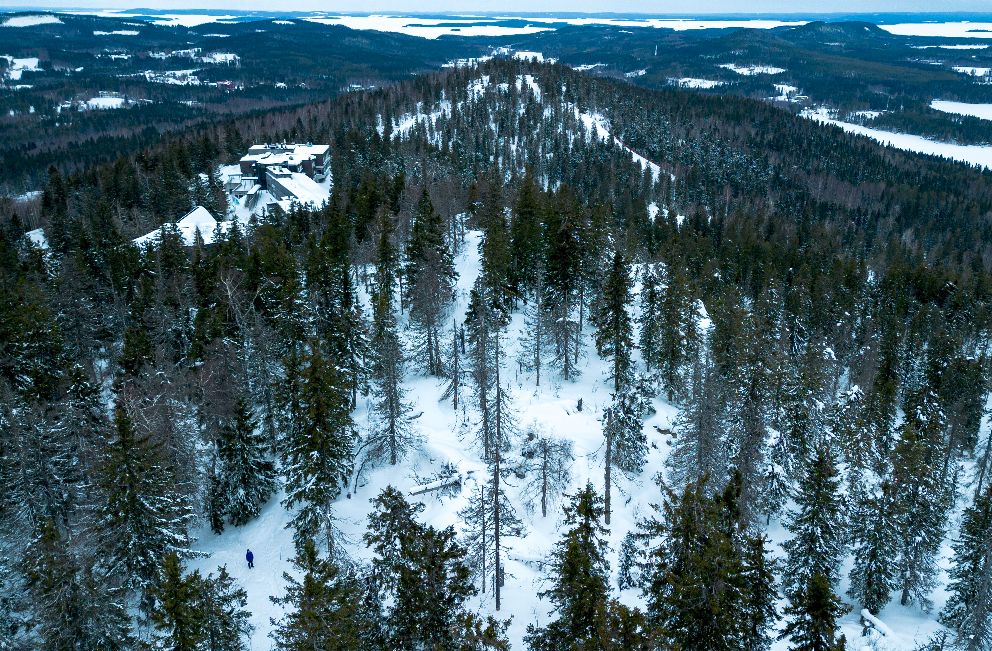
Photo: Natural forest landscape with trees and snow with the frozen lake Pielinen (Pielisjarvi) of Koli National Park in Joensuu in North Karelia in Finland on 14th of March 2025. Joensuu is known as Europe s forestry capital thanks to its natural forest heritage and its forestry and forest bioeconomy innovation centres and companies including the European Forest Institute. Photo by- Martin Bertrand
The European Union's Nature Restoration Regulation, adopted in 2024, sets an EU-wide target for restoration measures across at least 20% of its land area and 20% of its sea area by 2030, with measures for all ecosystems in need of restoration by 2050. Member states were required to submit draft national plans by 1 September 2026. But the legislation is not a blanket instruction to abandon forestry, nor is ecological restoration always the same as rewilding, which seeks to restore natural processes and allow ecosystems to develop with less human intervention.
Few places reveal those tensions as clearly as North Karelia, in eastern Finland, along the Russian border. According to a European Forest Institute regional profile, forests cover 89% of its land area, while 96% of that forest is classified as commercial. Joensuu, the regional capital, is a centre for forestry research and timber-related industries. More than half of the region's forests are privately owned, making timber revenue a direct concern for landowners.
"When I arrived in Finland, I moved to the countryside and thought I was surrounded by forest, in the middle of wild nature," says French ecologist Antoine Scherer. "Over time, I realised I was mainly surrounded by very straight, homogeneous plantations." After first studying rewilding in Portugal, Scherer joined the Jukajoki Restoration Project run by Snowchange Cooperative in 2017. He later settled in Joensuu, where his doctoral research examines how rewilding could work across Finland's boreal landscapes.
For Scherer, rewilding is "a comprehensive, large-scale approach" to restoring functioning ecological processes. Unlike conventional forest management, it looks beyond individual plots towards entire watersheds, connecting forests, rivers and wetlands. "The aim is to let nature guide its own trajectory," he explains.
Restoring the water beneath the trees
The most urgent intervention is often beneath the forest floor. Across Finland, drainage ditches were cut into wetlands and peatlands to enable forestry or other production. On degraded sites, rows of similarly aged pines or spruces stand over dried soils, with little understory vegetation or deadwood. "The heart of the problem in Finland is very often the massive drying of soils through an extremely dense drainage network," Scherer says.
Restoration teams block or fill ditches, sometimes with excavators, sometimes by hand. Water levels can recover within weeks, though the forest's ecological transformation takes decades. Over time, more diverse vegetation can return, while dead trunks provide habitats for fungi, insects and birds. "The biggest part of the rewilding process in boreal forests is accomplished by nature itself," Scherer says. "Our duty is to let it happen as much as possible, while protecting it."
Some interventions challenge established ideas of what a healthy forest looks like. Scherer recalls a commercial forest damaged by a lightning-triggered fire. Rather than clear the burned area and replant it, an NGO acquired the site, allowing researchers to observe natural regeneration. A three-toed woodpecker, associated with burned forests, appeared. For Scherer, the example shows why deadwood and natural disturbances should not automatically be treated as losses.
That ecological debate carries economic consequences. Preliminary figures from Statistics Finland show that the country's land-use sector was a net source of 9.4 million tonnes of CO2-equivalent emissions in 2025. Forest land itself was also a net source, at 1.3 million tonnes. The figures complicate Finland's aim of carbon neutrality by 2035 and show the pressure on its carbon sinks, although restoration alone cannot reverse the effects of logging, soil emissions and warming temperatures.
Scherer argues that progress is possible without closing the timber industry. More mixedspecies stands, longer rotations, buffer zones and protected wetlands could coexist with productive forests. Land that has been drained for poor-yielding plantations offers a particularly practical starting point for agreements between companies and conservation groups. Yet he sees a fundamental limit: "As long as clear-cutting remains at the heart of the economic model, it will be difficult to imagine significant long-term progress."
An environmental project on a strategic border
A second argument for restoration has emerged from Finland's security concerns. In June 2026, a joint environment and defence working group identified at least 180,000 hectares of mires in eastern and northern Finland where restoration could also serve national defence. Rewetting those landscapes could create natural obstacles to military movement. The report favours opportunities on state-owned land and voluntary participation by private owners. It is an assessment of potential, not evidence that all those hectares will be restored.
"Wetlands are very effective natural obstacles against tanks," Scherer observes. There is an irony: Finland voted against the EU law in 2024, citing disproportionate costs, but its ministries now see environmental and strategic interests overlapping. Financing and prioritisation remain unresolved.
For Scherer, the long-term ambition is a mosaic: forests still supplying timber, but managed differently, alongside restored areas left to evolve without logging. His vision rests on changing the scale of decision-making from individual properties to connected landscapes. On Europe's eastern frontier, the future of rewilding may ultimately depend as much on forestry economics and public policy as on what happens when the drainage ditches are finally blocked.