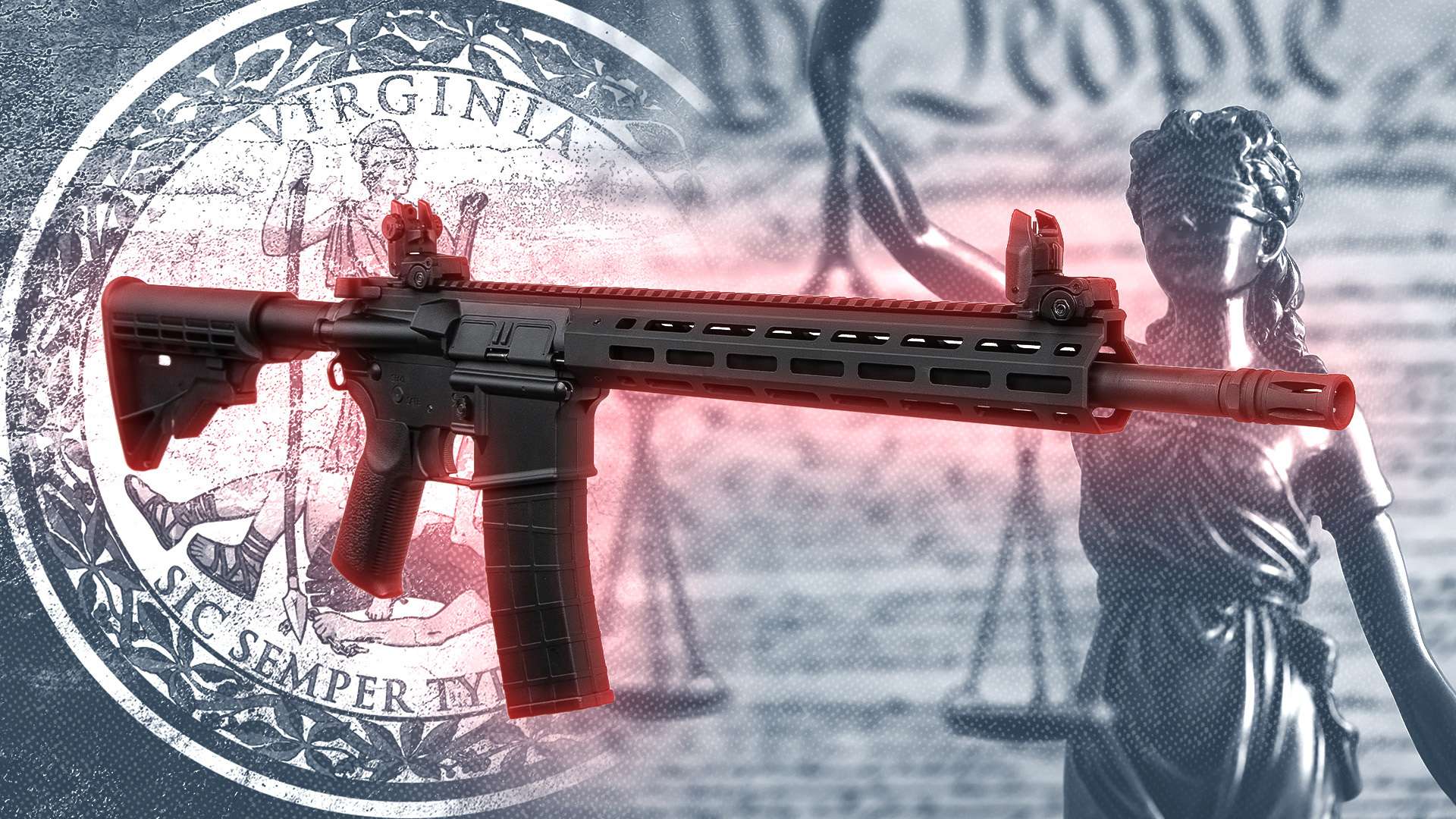
Federal lawsuit contends Virginia's new 'assault firearm' and magazine bans violate Second Amendment
A coalition led by the Firearms Policy Coalition has sued to block Virginia's recent ban on so-called 'assault firearms' and 15-round magazine cap, arguing the law criminalizes weapons that are in common use for legitimate purposes such as self-defense, hunting, and target shooting. The complaint, filed in the U.S. District Court for the Eastern District of Virginia, says the statute cannot survive the Supreme Court's Bruen framework because the state cannot point to historical analogues that would justify banning ordinary semiautomatic arms.
By Jacob Sullum
999 views
A coalition of Second Amendment groups has filed a federal lawsuit seeking to overturn Virginia's newly enacted ban on so-called "assault firearms" and magazines holding more than 15 rounds, contending that the measure is "plainly unconstitutional." The suit, McDonald v. Katz, was brought by the Firearms Policy Coalition together with the National Rifle Association and the Second Amendment Foundation, joined by two individual gun owners — Justin McDonald and Anthony Groeneveld — and was filed on May 14 in the U.S. District Court for the Eastern District of Virginia. It names as defendants Virginia State Police Superintendent Colonel Jeffrey Katz along with several county commonwealth's attorneys and sheriffs charged with enforcing the law, and seeks a permanent injunction barring enforcement. The challenge came almost immediately after Gov. Abigail Spanberger signed the legislation, which made Virginia the 12th state to enact an "assault weapon" ban. The 24-page complaint argues that the firearms swept up by the statute "are, in all respects, ordinary semiautomatic firearms," including the AR-15 — described in the filing and by the groups as the most popular rifle in America — and that arms owned by tens of millions of law-abiding citizens cannot be the "dangerous and unusual weapons" the Supreme Court has said fall outside constitutional protection.
Plaintiffs also cite crime statistics to argue that the banned rifles are not the primary weapons used in homicides. According to FBI statistics cited in the complaint, rifles of any type were used in an average of 380 homicides per year from 2014 through 2023, compared with 7,044 homicides annually involving handguns. "Even if every one of those homicides had been committed with an AR-15-style or other semiautomatic rifle, that would mean that over 99.99% of them were not used in homicide in a given year," the suit says, a point the plaintiffs use to underscore that prevalence among lawful owners distinguishes those arms from the "dangerous and unusual weapons" the Supreme Court has said can be regulated. The argument turns the state's public-safety rationale on its head: if a class of weapon figures only marginally in violent crime yet is held by millions for lawful purposes, the plaintiffs contend, its commonality is precisely what places it within the Second Amendment's protection rather than outside it.
The complaint responds to the state's selection of targeted features by describing legitimate, non-criminal purposes for each. Virginia's statute defines an "assault firearm" largely by reference to a list of disfavored characteristics — features such as collapsing or folding stocks, pistol grips, threaded barrels, and flash suppressors — an approach the plaintiffs characterize as arbitrary feature-based line-drawing rather than a judgment about a weapon's actual lethality. Folding and adjustable stocks, plaintiffs say, "ease carriage over long distances while hunting" and allow safe transport in constrained spaces; they also can improve maneuverability and storage for home defense. Pistol grips and protruding grips are said to stabilize the firearm and reduce stray shots, and flash suppressors, the suit argues, can reduce the chance a defender's location is revealed and protect against temporary blindness when firing in low light. The complaint notes that grenade launchers are already regulated under the National Firearms Act as destructive devices, implying their inclusion in the ban is legally redundant. The groups argue these features, far from making the firearms more dangerous, generally make them safer and easier to use for lawful purposes.
The suit also challenges the magazine cap, citing an NSSF report that more than 400 million rifle magazines of 30-plus round capacity were purchased in the United States between 1990 and 2021. The 2021 National Firearms Survey, plaintiffs say, found that 21.6% of firearm owners—approximately 18 million people—have owned handgun magazines exceeding 15 rounds. Plaintiffs argue that prevalence and common lawful use are central to the Supreme Court's test for protected arms, and note that standard-capacity magazines exceeding 15 rounds ship as factory equipment with many of the most widely sold firearms in the country. The Virginia law generally grandfathers firearms and magazines lawfully owned before its effective date of July 1, 2026, but the plaintiffs argue that a prohibition on future sales and transfers is still a ban — one that, as the Second Amendment Foundation's Alan Gottlieb put it, simply falls on the next generation of Virginians who reach adulthood.
Legally, the complaint frames its argument under Heller and the more recent 2022 decision in New York State Rifle & Pistol Association v. Bruen, which directs courts to assess whether modern firearm regulations are "consistent with this Nation's historical tradition of firearm regulation." The filing contends Virginia cannot carry its burden to show a historical analogue for banning commonly owned, ordinary semiautomatic firearms or routinely used magazines. "Arms that are in common use—as the firearms and magazines Virginia has banned unquestionably are—cannot be unusual," the complaint states. The plaintiffs lean heavily on the framework laid out in Heller and reinforced in Bruen, under which the government, not the gun owner, bears the burden of justifying a restriction by pointing to a well-established historical tradition rather than to contemporary policy judgments about public safety.
The challenge in McDonald v. Katz mirrors litigation around similar bans in other jurisdictions. The Justice Department's Civil Rights Division has recently filed suits contesting comparable laws in the District of Columbia and Colorado, and several Supreme Court justices have signaled interest in considering the constitutionality of assault-weapon-style bans. Those federal suits, brought through a newly created Second Amendment Section under Assistant Attorney General Harmeet Dhillon, targeted the District of Columbia's registration-based ban as well as Denver's "assault weapon" ordinance and Colorado's statewide 15-round magazine limit, arguing in each case that the laws restrict arms owned by tens of millions of Americans. Federal appeals courts have so far been largely unreceptive to such claims — by one Denver city attorney's count, all six circuits to consider assault-weapon or large-capacity-magazine prohibitions since Bruen have upheld them — but the Supreme Court may prove more sympathetic. Justices Brett Kavanaugh (in his earlier D.C. Circuit dissents), Clarence Thomas, Samuel Alito, and Neil Gorsuch have all indicated a willingness to weigh such issues, suggesting the Supreme Court could ultimately be asked to resolve the broader legal question.
For now, the case puts Virginia's new statute before a federal trial court and raises the prospect of protracted litigation over the scope of the Second Amendment, the reach of state regulation, and how courts should apply historical-analogue reasoning to modern firearms and accessories. With the Virginia challenge now joining parallel fights in Washington and Colorado, and with the federal government itself in court on the same side of the question, the issue appears increasingly likely to reach the justices who have already hinted they are prepared to take it up.