Fear of War Drives NATO Member Finland's Attention towards Defence as Plan to Cut Healthcare Spending Sparks Internal Debate
As Finland raises defence spending against a long-term Russian threat while cutting healthcare and social services, the trade-off has divided the country and left voters facing an unasked question: how much security is enough, and what are they willing to give up for it?
By Klaudjo Jonuzaj
856 views
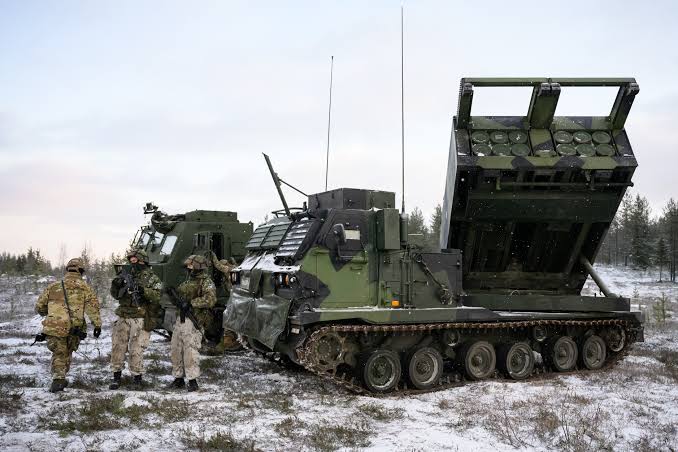
Photo: Finnish Defence Forces, Leon Neal/Getty Images
Finnish citizens are expected to pay more for health services in the near future as the government plans to boost defence spending. The planned cuts to healthcare and social spending have divided experts in the Nordic country.
Finland, which shares a 1,340-kilometre border with Russia, is expected to raise defence spending to 3.2% of gross domestic product (GDP) from an estimated 2.4-2.5% in 2025. The government plans to cut other spending to make up for it. Health centre fees are expected to rise by 20%, and health and social care face savings of about 240 million euros, according to government forecasts.
For two decades, from 2000 to 2020, Finland spent less than 1.5% of GDP on defence. Russia's invasion of Ukraine and fear of a future direct threat to Finland have since driven more spending on military recruitment, refresher courses for reservists, drone defence and explosives production, data from the Finnish Ministry of Defence show.
The government's latest plan moves Finland toward NATO's target of 3.5% for core defence by 2035. The cuts come on top of earlier austerity, with public debt projected to breach 90% of GDP in 2026, according to data from the European Commission's country report on Finland.
The government's case rests on Russia. Supo, the security service, argues that Russia has fundamentally changed Finland's security environment, with no improvement in sight. It also warns that the end of the war in Ukraine would free Russian resources for hybrid operations across Europe, the Helsinki Times reported.
Yet officials are careful about the timeline. Finnish Prime Minister Petteri Orpo has said there is no immediate military threat, but that Russia poses a long-term danger to all of Europe. The Defence Forces' 2026 intelligence review considers an immediate military threat to Finland unlikely this year, and says Russian defence reforms have not significantly increased its capability near Finland.
On the other hand, the Left Alliance was the only parliamentary party to dissent from a cross-party defence report. It agrees that Finland must invest in defence, but argues that spending beyond NATO's target must be weighed against healthcare, mental health services and social welfare. Its group chair, Aino-Kaisa Pekonen, called for a broad parliamentary and citizen debate before committing billions, Helsinki Times has reported.
Political scientist Heikki Patomäki goes further. In an exclusive interview for The Liberty Bulletin, he criticised the rapid increase in defence spending and the militarisation of Finland, noting that "they are part of an escalation process that can lead to open conflict, even if only as part of a wider war. This is one example of how anticipations help realise the future they anticipate."
According to Patomäki, the conflict between Russia and NATO or the West has been escalating in stages for well over 20 years and Finland's security cannot be separated from this broader context. However, he noted that "what is proportionate to the threat Finland faces from Russia depends on the state of Finnish-Russian relations."
"During the Cold War, Finland was perhaps the lowest military spender among states facing the Soviet Union and the Eastern bloc. In the post-Cold War era until the late 2010s, the GDP ratio was around 1.2%. The main idea used to be that security is primarily a political issue, and only secondarily a military one," Patomäki said, adding that "although many parties are involved in processes that generate insecurity, what is proportional also depends on Finland's own actions, both alone and as part of larger bodies (EU, OSCE, UN, and now also NATO). Security and insecurity are often self-fulfilling prophecies, at least in significant part."
He also highlighted that the combined effects of rapidly rising military expenditure and the debt brake are massive. "The Finnish state budget is approximately 90 billion euros. In total, the increase in military spending and the debt brake mean a cut of almost 20% in the state's non-military spending. After decades of privatisation, corporatisation, cuts in public spending, etc., and tax breaks for companies and individuals, only little of what is associated with the Nordic welfare state will remain by the early 2030s."
Patomäki noted that if permanent public spending is not to rise, more defence means cuts elsewhere, and cuts to social and health spending increase poverty and inequality. "In Finland, income inequality increased especially in the 1990s, but wealth inequality has increased all the time. The Orpo government has significantly increased income inequality and weakened the position of lower-income groups. The developments ahead will create a massive poverty problem in Finland, differentiate regions and city districts, and create ever-deepening inequalities also in education and health. Finland is in a downward spiral."
He also says NATO-related decisions have been taken with unprecedented speed. "Finland has joined the NATO decision to rapidly increase military spending. Member countries are expected to spend 5% of their GDP on defence, 3.5% directly on armed forces and 1.5% on some broader security spending. For Finland, which joined NATO in April 2023, this new policy comes amid a long period of no or slow economic growth, several rounds of public spending cuts, and severed relations with Russia. Compared with levels from the early 1990s to the late 2010s, Finland has now doubled its defence budget. Currently, around 2.7% of GDP is spent on arms and the army, which is already above the previous NATO target of 2%. Rising to the new 5% target would mean an additional expenditure of around 8 billion euros per year (calculated on the basis of current GDP). By comparison, the Ministry of Education and Culture has a budget of around 9 billion euros in 2026."
Patomäki further pointed out that the plan of the government to increase defence spending has come with little real public debate. "In Finland, foreign and security policy has traditionally been made through parliamentary consensus, open debate and expert advice. However, decisions relating to NATO membership – both accession itself and the proposed expansion of the defence budget – have been taken with unprecedented speed and little real public debate. This is despite the fact that before 2022, almost everyone in Finland was committed to the idea that if a decision was ever to be made on NATO membership, it would be made through a referendum."
NATO members committed at the 2025 Summit in The Hague to increase their total annual defence and security spending to 5% of GDP by 2035. For Patomäki, the lack of open and democratic debate is "one of the most striking features of NATO's current direction" to increase spending on defence. "First, everyone seems to have accepted the deal-maker Donald Trump's first arbitrary "offer" without even properly negotiating it (the only 'counter-offer' has been the invention of the equation 3.5% + 1.5%). However, the EU was secretively preparing a similar spending increase months before the NATO summit, where the decision was finally made.
Secondly, decisions of this magnitude – involving trillions of dollars of future expenditure – have been taken quickly and mostly behind closed doors, with hardly any parliamentary scrutiny or genuine public debate. This technocratic approach may satisfy the alliance's internal logic, but it also undermines the democratic legitimacy of security policy."
According to Patomäki, many critical scholars have warned that securitisation tends to override normal democratic procedures and produce policies that cannot be criticised without risking being branded irresponsible. "As securitisation becomes institutionalised, democracy narrows and erodes, and public debate becomes one-sided and increasingly exclusionary. This is the path of authoritarianisation and, ultimately, autocratisation. To avoid this, we must strive to break away from the logic of securitisation. It is reasonable to anticipate the future and its dangers, but we must also understand the reflexivity of anticipations. In everyday language, this means that anticipations affect the present and shape the future. Typically, uncritical presentations of threat images have negative ethical and political consequences. Such reflexivity is also an argument for adhering to democratic deliberation and democratic procedures, even when those processes take more time than exceptional measures."
Meanwhile, Finland's main political parties want to reduce public debt, but rising defence spending makes that harder, Nordisk Post reported.
For his part, Defence Minister Antti Häkkänen says the aim is to strengthen Finland's defence with determination to counter the long-term threat posed by Russia, according to Nordisk Post.
Meanwhile, recent data on public opinion on this matter are lacking. However, a 2022 MTS survey found that 58% of respondents wanted more money allocated to defence, the highest figure in the survey's history.
With a parliamentary election due next year, voters will get their first chance to answer a question that no one has yet asked them directly: how much security is enough, and what are they willing to give up for it?