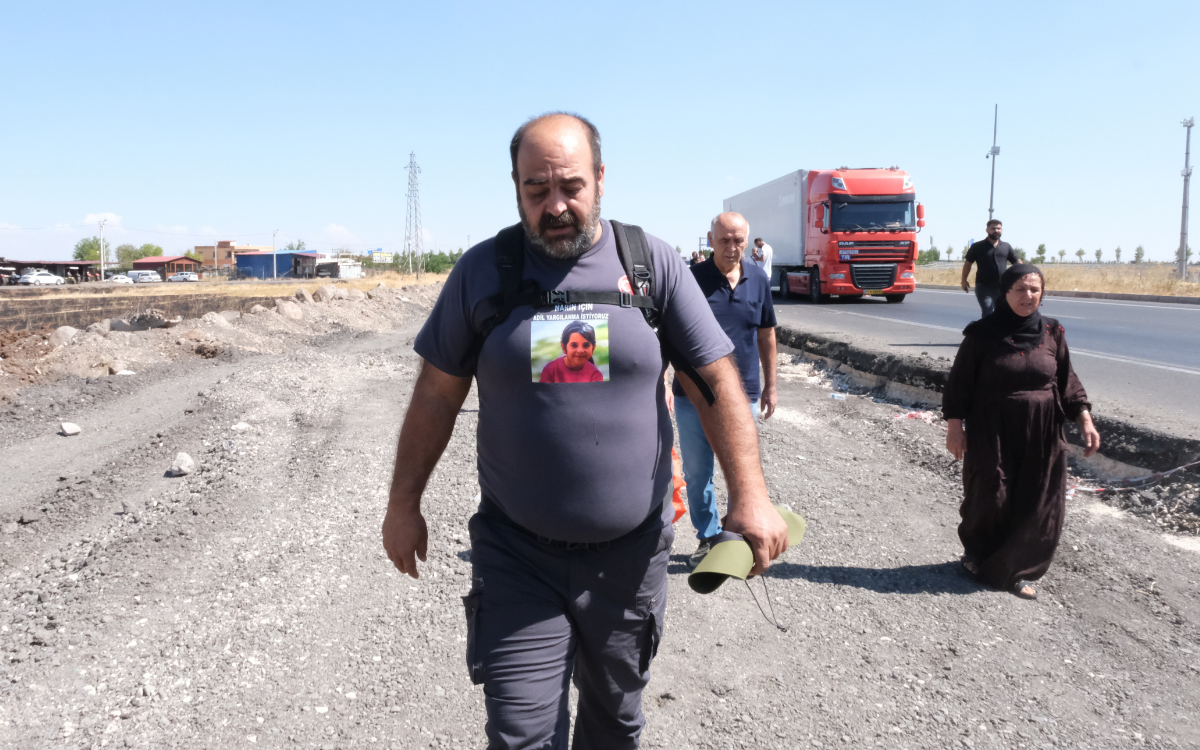
Father of Eight-Year-Old Narin Güran Begins 'Justice March' to Ankara, Demands Retrial and Truth
Arif Güran, whose daughter Narin was found dead in 2024 after a disappearance in Diyarbakır, has begun a march to Ankara calling for a full reinvestigation and a retrial. The family and their lawyer say authorities ignored or tampered with digital evidence and that existing court rulings failed to consider exculpatory technical data.
By Alexander Walter
937 views
The father of eight-year-old Narin Güran has set out on a long march to Ankara to demand that authorities reopen and fully investigate his daughter’s death and to press for a new trial. Arif Güran began the protest after making a statement in Tavşantepe neighbourhood of Bağlar district, where his daughter’s grave is located, and announced his intention to walk to the Presidential Complex in the capital if necessary.
According to reporting by the Mesopotamia Agency, the family’s lawyer, Onur Akdağ, told supporters at the departure point that the family has pursued a legal campaign for two years but has encountered what he described as serious shortcomings and irregularities in both the investigation and the prosecution. Akdağ said the family has lodged multiple objections during the investigation and trial phases, arguing that key technical data were either ignored or were the subject of tampering.
Akdağ alleged that at the start of the investigation camera footage from the nearby DARA-2 military base and audio recordings on the phone of suspect Salim Güran were deleted, and that police attempted to reset the phone of another suspect, Nevzat Bahtiyar, while it was in law enforcement custody. He also said that a WhatsApp report used in the prosecution was later shown to be forged and that a restricted base-station (cell-tower) report conflicted with audio, video and other digital evidence.
Challenging official forensic conclusions, Akdağ said the National Criminal Bureau’s assessment of video images was insufficient. He told the court the family had obtained images enhanced in the United States that, in his view, show Narin did not return home and indicate a person at the start of a track leading the child toward the direction of a barn where Bahtiyar lived. The family has submitted their own expert reports to the court asserting that other technical records — including a report related to voice recordings on Salim Güran’s phone — point to contradictions with the prosecution’s timeline and place Salim at home at the relevant time.
The family says these technical and digital discrepancies were not properly weighed by the courts and they have therefore requested a retrial. ‘‘The sole reason I have taken this path is for my daughter’s rights — for the truth,’’ Arif Güran said before beginning his march. He told reporters he planned to continue until he reached Ankara’s Presidential Complex to demand truth and justice for Narin, addressing President Recep Tayyip Erdoğan directly by name.
The case has seen multiple major legal steps. Narin disappeared on August 21, 2024, from the Tavşantepe neighbourhood in Diyarbakır’s Bağlar district. After a 19-day search, her body was discovered on September 8, 2024, in Eğertutmaz Stream inside a sack and covered with stones. Prosecutors charged Narin’s mother, Yüksel Güran, her elder brother, Enes Güran, her uncle Salim Güran, and neighbour Nevzat Bahtiyar. On December 28, 2024, the Diyarbakır 8th High Criminal Court convicted Yüksel, Enes and Salim Güran of intentional killing of a child with aggravated circumstances, sentencing each to aggravated life imprisonment, while Bahtiyar was sentenced to four years and six months for destroying, hiding or altering evidence.
The Court of Cassation’s 1st Criminal Chamber upheld the aggravated life sentences for Yüksel, Enes and Salim in December 2025 but overturned the ruling on Bahtiyar, ordering his case retried on the grounds his conduct should be assessed as assisting in the qualified intentional killing. On April 16, 2026, following the retrial, the Diyarbakır 8th High Criminal Court sentenced Bahtiyar to 17 years in prison for assisting in the qualified intentional killing of a child.
Despite these convictions, the family and their legal team maintain that the full picture has not been established and that critical technical evidence has either not been properly evaluated or was compromised. In July 2026 a civil society group, the Justice Platform for Narin and Her Family, publicly called for a comprehensive re-examination of the file.
After his statement in Tavşantepe, Arif Güran left the city limits and began his march toward Ankara. He said he would persist ‘‘for a month or two, whatever it takes’’ and reiterated his demand for a retrial. The march places renewed public focus on the case, on questions about the handling of digital evidence in criminal investigations in Turkey, and on the family’s long campaign for what they call truth and accountability.