The Community’s Long-Running Battle Against Environmental Contamination in Southern Italy
By Maryam Raz
1,125 views
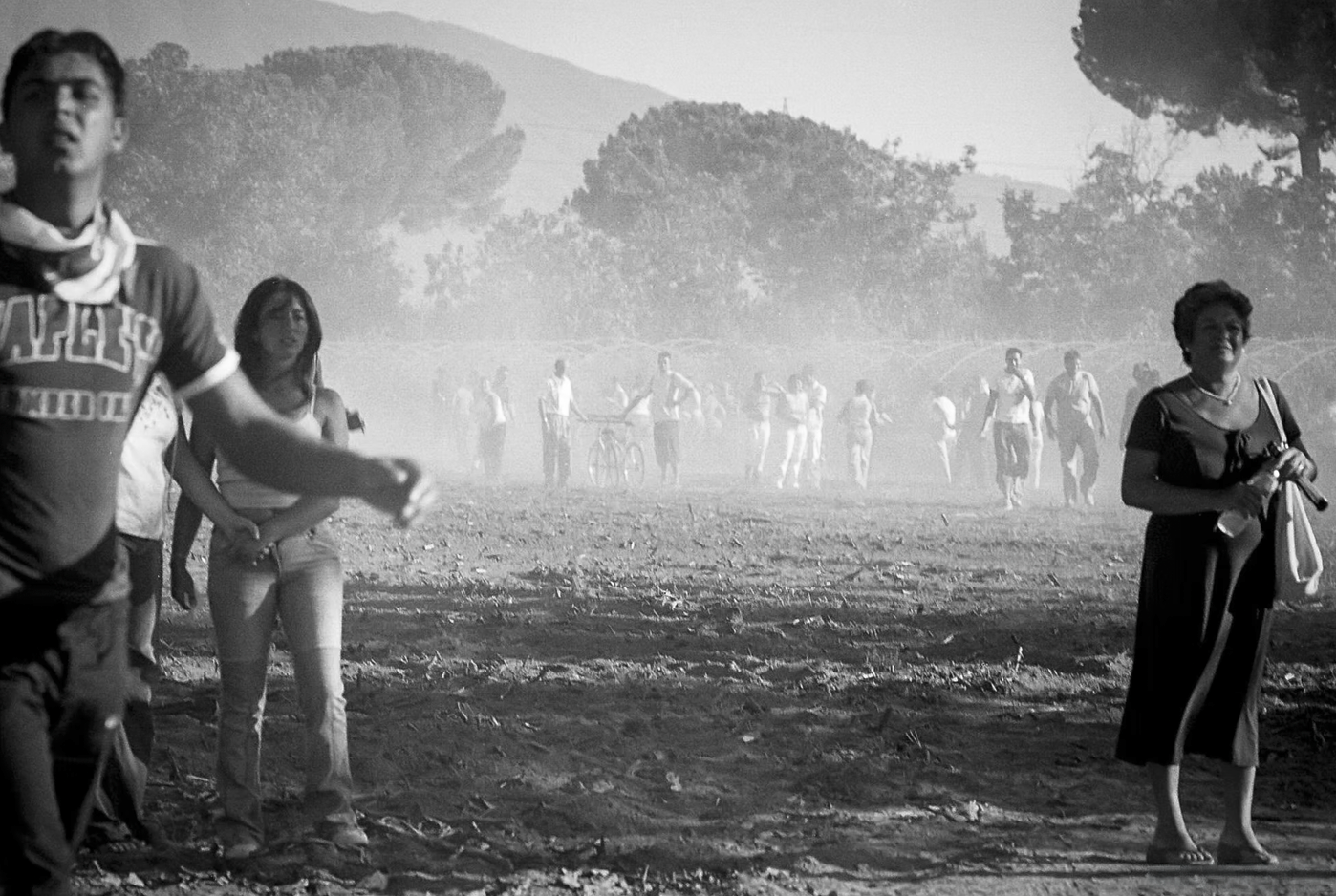
Photo: Salvatore Esposito - Manifestation of 29th August 2004
“Here, there was a variety of potatoes that was one of the best in Italy. San Marzano tomatoes, grown here, were among the finest in Campania. We are close to volcanoes, Vesuvius and the Phlegraean Fields that have made our territory extremely fertile,” Biagio says proudly over a video-call.
In the 1960s, Acerra, a city of mainly farmers, renowned for its agriculture and green lands was designated and transformed into an industrial zone under industrial development policies for southern Italy.
Acerra is located in Terra dei Fuochi (Land of Fires), a large area across the provinces of Naples and Caserta. The zone earned the title due to the constant, illegal burning of toxic waste. In southern Italy, organised criminal mobs, notably the Camorra, the infamous mafia of the Campania region took control of waste management for decades, secretly dumping and burying industrial waste into fertile fields and setting it on fire to hide the evidence. The contamination that directly threatened the food chain and living conditions, causing a health crisis that began long before authorities acknowledged the term “Terra dei Fuochi” around the early 2000s.
The industrial transformation brought highly polluting industries to the area. The first major chemical establishment in Acerra, or as the residents call it “eco-monster”, was the Montefibre chemical plant, owned by Montedison that marked the launch of heavy chemical industrialisation in the zone during the late 1970s.
“We remember it. I remember, from when I was a child, seeing deformities in the sheep grazing around. Almost all workers developed cancer or other chronic diseases,” Biagio recalls. His sudden raised tone of voice testifies how strongly he feels towards his long-suffering homeland.
There are three of them, sitting in the same room before the camera, Giovanni De Laurentis, Rosa Anatriello and Biagio Perreca, activists and intellectuals working and studying for decades in Acerra, all members of the Committee Against Incinerators Fourth Line. Biagio and Rosa are also members of the Archeoclub Acerra, an association that focuses mainly on archaeology and intangible heritage.
Towards the end of the 1990s, Acerra’s citizens were aware of plans to build Europe’s largest incinerator in their city. Biagio recalls the time when they set up a protest camp on the incinerator’s construction site, maintaining a 24/7 presence for about six months.
“There were always at least ten of us, taking turns, to maintain the protest camp. Eventually, on 17th August 2004, while many were away on holiday, the bulldozers arrived under police protection to launch the construction work.”
All three of them recall the events of the day in detail. They recall the morning when together with other activists, they managed to pass the closed accesses and enter the site to stop the construction. They mention twenty-one people were arrested that day, including themselves and even the mayor and deputy mayor of Acerra, though charges were later dropped because the construction was started without having all the proper permits.
After that, on 29th August 2004, a massive demonstration took place to stop the construction of the incinerator, but the protest was met with extreme violence and was suppressed by the police forces.
“The entire community, activists, farmers, some political groups, and even priests, everyone was on the street. It was sad because of how it ended up, but it revealed a beautiful sense of solidarity,” says Biagio still evidently angry and broken. “We were about 30,000 people. There were mothers with children. They threw tear gas on disarmed people from helicopters. I still can remember the faces of people covered in blood. The following day, there were abandoned pushchairs left in the fields.”
The demonstration of August 2004 became a milestone in southern Italy’s environmental movement but was not sufficient to stop the construction of the incinerator.
Acerra is infamously part of the Triangle of Death (a vast area between Acerra, Nola and Marigliano in the northeast of Naples) due to documented excesses in tumour rates and cancer mortality highlighted by epidemiological studies like the SENTIERI project (conducted by the Italian National Institute of Health).
While monitoring for PFAS (forever chemicals) seems to be mainly concentrated around industrial chemical hubs in northern Italy, public health and environmental testing in Campania prioritised tracking heavy metals, dioxins, and PCBs.
That being said, the landmark epidemiological studies (such as SENTIERI project) and regional environmental data from ARPA Campania demonstrate that these pollutants do not stay trapped in one place. Instead, toxic contaminants travel through multiple interconnected pathways, such as airborne, groundwater and soil dispersion.
“Following the campaign we carried out, the Ministry of the Environment established 27 required modifications that the facility had to undergo in order to be more compatible,” says Giovanni. “Even today we don't know where the ash and industrial sludge are disposed of. We don't really know how the systems work, not even in case of radioactive waste. There are a whole series of issues that remain unclear even today.”
The fight for environmental justice is ultimately an unequal battle of narratives between the voiceless population and the multinationals with financial resources and media access. While social media has taken away that exclusivity, it seems that the most effective act in claiming environmental equity is to have residents’ voices heard.
“I teach at a middle school. Recently, one of the teachers at a staff meeting, proposed to take the students on a tour to visit the incinerator. I could not believe my ears,” says Rosa.
“In 2004, this town suffered a wound that has still not healed. I am a non-violent person, and yet, I was running that year, with the police forces chasing after me in their vans. The State that was supposed to protect me and my land was chasing me. So, the incinerator is there; it exists, but it is an open wound. You cannot give this narrative to the pupils that the incinerator is something modern and clean because that simply is not true. It makes me furious that people can be so apathetic about what is happening in our area.”
In 2023 the authorities pushed to add a fourth line to the incinerator in Acerra, claiming it was needed for maintenance and extra capacity. This time, local citizens and movements successfully mobilised to suspend the expansion, arguing that the focus should be on introducing alternative waste-management systems rather than extending an ageing facility’s life span.
In January 2025, the European Court of Human Rights (ECHR) issued a landmark ruling against Italy, finding the state guilty of human rights violations for failing to handle the waste crisis, protect citizens and provide timely health information in Terra dei Fuochi. Giovanni, Biagio and Rosa together with activists and organisations from other municipalities, established an association to ensure the implementation of the ECHR ruling.
For years, residents pointed out high cancer rates in the zone. Giovanni mentions that recently, following the campaign against the fourth line, local citizens gained rare access to the cancer registry of the local health authority (ASL Napoli 2 Nord).
“This registry confirms our fears. During these years, we had seen friends, relatives, and neighbours constantly falling ill with cancer. We had the impression that there was an exponential increase in these cases, but we didn't have the data. Now we can see the numbers clearly in the cancer registry that shows the incidence of diseases in Acerra was higher than any other place across the entire ASL Napoli 2 Nord area.”
He mentions that according to this document, between 2010 and 2018, the incidence rate for tumoural disease in Acerra was more than 40 percent higher for men and more than 30 percent higher for women compared to the broader region.
“It is only Acerra that has this exceptional situation,” notes Giovanni, pointing out that the only difference between Acerra and other municipalities in the region is in fact the presence of the incinerator. To them this is shocking that these alarming figures were kept under lock and key instead of being addressed in the interests of citizens' health.
“I mean, we are perhaps oversimplifying things, but now we have a tool that the ASL has provided us with, and it needs to be read and interpreted by scientific committees. This cannot remain on the small scale of voluntary work. But unfortunately, the institutions in our area are rather deaf to these issues.”
Acerra is a city of rich history and fascinating traditions. It is one of the most ancient cities of the Campania region, sitting on a territory that encompasses the archaeological legacy of two ancient cities, dating back to the tenth century BC. Nonetheless, the city’s fame has been limited for years to the presence of the incinerator and environmental contamination.
Rosa, the “dreamer” of the group underlines that through the Archeoclub association, they try to look at the other side of the coin. “You cannot talk about an area only in negative terms. We do not want to remain a so-called sacrifice zone," notes Rosa.
“When you talk about archaeology, you cannot avoid talking about the territory. This is ironic. While the archaeologist digs up the treasures of the past, there are people burying toxic waste in the same land. Understanding the past and understanding the landscape could genuinely become a driving force for local development. You can love a territory by getting to know it, by walking through it, by watching the sunrise and sunset. Personally, I want to pass on this passion. You can't live somewhere without knowing it. That means, in a way, being a stranger in your own home.”