Europe’s young ask for a future as education funding falls short
Across Europe, young people are taking to the streets over underfunded education systems, teacher shortages, rising rents and shrinking career opportunities. From France and Italy to Greece and Albania, student protests are exposing growing inequalities and governments’ failure to invest in the next generation, raising broader questions about Europe’s economic future and political priorities.
By Klaudjo Jonuzaj
814 views
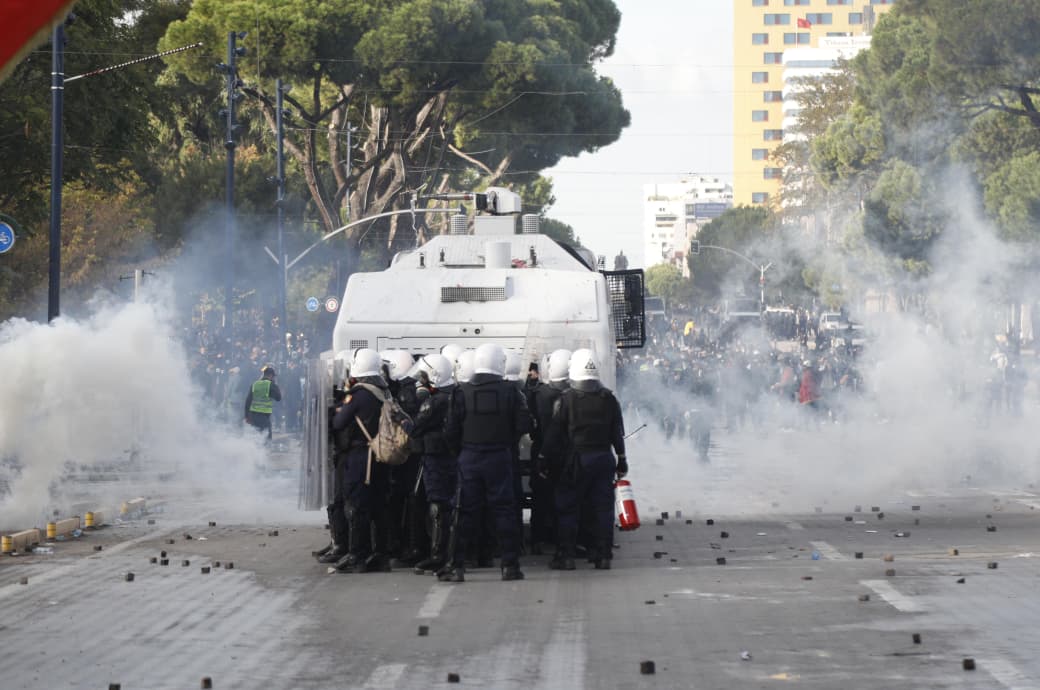
Photo: Protest in Tirana, Albania, October 24; Credit: LSA Photo
From the school gates of Paris to Syntagma Square in Athens and Tirana’s main boulevard, young Europeans are asking their governments the same question this autumn: are you investing in us? Their grievances differ by country, but the pattern holds. Classrooms are crowded, teachers are scarce, rents are rising, and the path from graduation to a decent job looks narrower than their parents’ did.
The numbers show why the question is being asked. Across the EU, countries spent €806 billion on education in 2023, which was 9.6% of public spending and 4.7% of GDP on average. Sweden (6.8%) and Finland (6.3%) spent the most as a share of GDP, while Romania (3.0%), Greece (3.3%) and Malta (3.4%) spent the least. Spending is recovering from the pandemic but remains below pre-crisis levels, and only 12 member states raised it in 2023, according to the Commission’s latest report, “Investing in education 2025”.
In that report, Commission Executive Vice-President Roxana Mînzatu argues that “Spending on education is an investment, not a cost.” Not every government acts accordingly. Italy spent 4.1% of GDP, and one reading of the report ranks it last in the EU for education’s share of public spending.
Headline figures, however, can mislead. In an interview with The Liberty Bulletin, Afrim Krasniqi of the Institute for Political Studies in Tirana said claims of a “record” budget in nominal terms “must be viewed in the context of inflation, rising costs, and the actual needs of the system.” Students, he argued, are “not just asking for more money; they are calling for a system that invests in knowledge, meritocracy, and their own professional prospects.”
In France, those demands are concrete. The protests began over teacher shortages and deteriorating school buildings and had reached 356 high schools by 30 September. A 17-year-old student from Aubervilliers told AFP: “The education authority is not investing enough in the suburbs.” A parent representative said classes in maths, humanities, English and sport had been cancelled for lack of teachers.
The pressure is also felt in higher education. Contacted by The Liberty Bulletin, French economist Thomas Piketty pointed to his recent column in Le Monde, which he authorised the outlet to use. In it, he puts a number on the strain: the budget per student has fallen by about 20% since 2017. The nominal higher education budget rose from €13.3 billion to €15.5 billion between 2017 and 2026, a 17% increase, he notes, but inflation over the period was 22% and student numbers grew from 2.6 million to more than 3 million. “Hundreds of thousands of young people work hard to earn their high school diplomas,” he writes, “but there is nothing planned to welcome them into higher education.”
This squeeze falls unevenly. The number of graduates from technical and vocational tracks has risen sharply, Piketty says, but places in short vocational programmes (IUTs and BTSs) have not kept pace. As a result, many students end up in “overcrowded and less expensive university programs that are often entirely ill-suited to their needs and aspirations.” Places are allocated through Parcoursup, the national admissions platform, which he calls opaque, with an “incomprehensible algorithm”, despite repeated calls for change from students, families, teachers and researchers.
The government’s response has so far been modest. Its draft 2027 budget raises education spending by 1.7% to €65.53 billion, which is below inflation, and French Education Minister Édouard Geffray attributes this to population decline. The protests have nonetheless won one concession: the ministry is contacting about 3,000 qualified reserve teachers for the neediest schools, Bdnews24 has reported.
In Italy, the main demand is housing. About 800,000 students living away from home are asking for €2 billion for public housing, rents, scholarships and textbooks. A Milan engineering student who started the tent protests found single rooms at €700 plus bills. The government points to more than €900 million of recovery funds for about 60,000 extra beds, but the student union UDU says only 3.8% of beds are public, according to an article published by Fortune.
Greece tells a similar story. About 10,000 people marched in Athens on 21 October, and teachers’ unions say the country is short of 15,000 secondary teachers. A 21-year-old student said her parents can barely cover rent and electricity, while a 20-year-old engineering student called the €120 monthly rent subsidy inadequate, Reuters reported. Youth and student protests have emerged in other EU countries as well, including Spain and Portugal.
For EU candidate countries such as Albania, the gap is larger still. The education budget in the small Balkan country was only 2.6% of GDP in 2024 and 2.4% of GDP in 2025. The 2026 budget raises it to 3.2% of GDP, and the ministry calls it the highest nominal budget in history, data from the finance ministry show. Krasniqi, however, notes the shortfall against Albania’s own ambitions: “For years, the government has promised to reach a funding level of 5% of GDP for education, yet this objective has not been met.” He adds that much university spending goes to administration and services without improving academic quality, while laboratories, libraries and research go underfunded.
What Albanian students are asking for also differs from the rest of Europe. “Protests in Albania bear little resemblance to those in France, Italy, or Greece,” Krasniqi says. They began in June over issues unrelated to education, and “education is not the sole focus; corruption and poor governance are the primary concerns.” Even so, basic student life is missing: former student housing has been repurposed, with “a notable absence of functional libraries, academic literature, communal spaces, and social support.” Many students work “one or two jobs – often informal, underpaid, and unrelated to their field of study”, and the need to survive pushes young people “to prioritise employment and income” over their education.
The government’s response has differed too. Where Paris and Rome offered measures, Krasniqi says Tirana “initially adopted a dismissive and contemptuous stance.” A package of interventions has now been promised, but he remains sceptical: “I see no clear strategy,” and “there are no real guarantees.” Promises on student housing are hard to believe, he adds, without addressing the influence of economic interests and clientelist ties in construction and real estate.
Nor is the pattern new. Of the 2018 Pact for the University, he says “many of the problems it aimed to resolve were already part of the higher education reform of 2014–2015 and remain present today.” He points to programmes with few students that persist to protect existing jobs, and to a system in which “the longest queue in Tirana is that of students waiting to obtain their Student Card” while no university municipality funds student life.
The consequences extend beyond the classroom. Across the EU, 11.0% of people aged 15–29 were neither working nor studying in 2025, against a 2030 target of 9%. Greece (13.6%) is among the worst performers, while Italy has cut its rate from 25.7% in 2015 to 13.3%, according to Eurostat data. In the Western Balkans, the cost is emigration: wiiw finds brain drain in Albania, Bosnia and Herzegovina and Kosovo, with many leaving soon after finishing tertiary education.
Krasniqi argues that the EU shares responsibility. Albanians are among Europe’s most pro-European peoples, he says, yet the EU “has failed to establish a comprehensive mechanism” for talented students to study on comparable terms. Many face high fees as non-EU citizens, pushing some to seek Greek or Bulgarian citizenship, and Erasmus students “often lose an academic year back home” when exams are not recognised. With families funding studies abroad from their savings, “it is understandable that graduates seek employment where salaries and professional opportunities are better.” Closing the EU accession chapter on science and education was “purely administrative and formal”, he argues, which is why protests erupted as it ended. Meanwhile, the EU has earmarked about €148 billion for education and skills in 2021–2027, the Commission report shows.
Governments are right that demographics are shifting. The Commission projects about 2.5 million fewer people aged three to 18 in the EU by 2030 than in 2022. Fewer pupils could mean more resources per child, but only if governments keep the money and use it to fix buildings, fill vacancies and make housing affordable. Piketty adds a warning about the decades ahead: spending on education is expected to rise faster than GDP, so budgets that merely track inflation will fall further behind.
Krasniqi’s diagnosis reaches beyond Albania. Education should be “a matter of state and national interest,” he says, yet “every government thinks only about its own term in office,” and education is discussed “only when crises arise.” Protesters are demanding what such short-termism withholds. Europe cannot ask young people to power its competitiveness while their schools lack teachers, their universities lack beds and their budgets lack ambition.