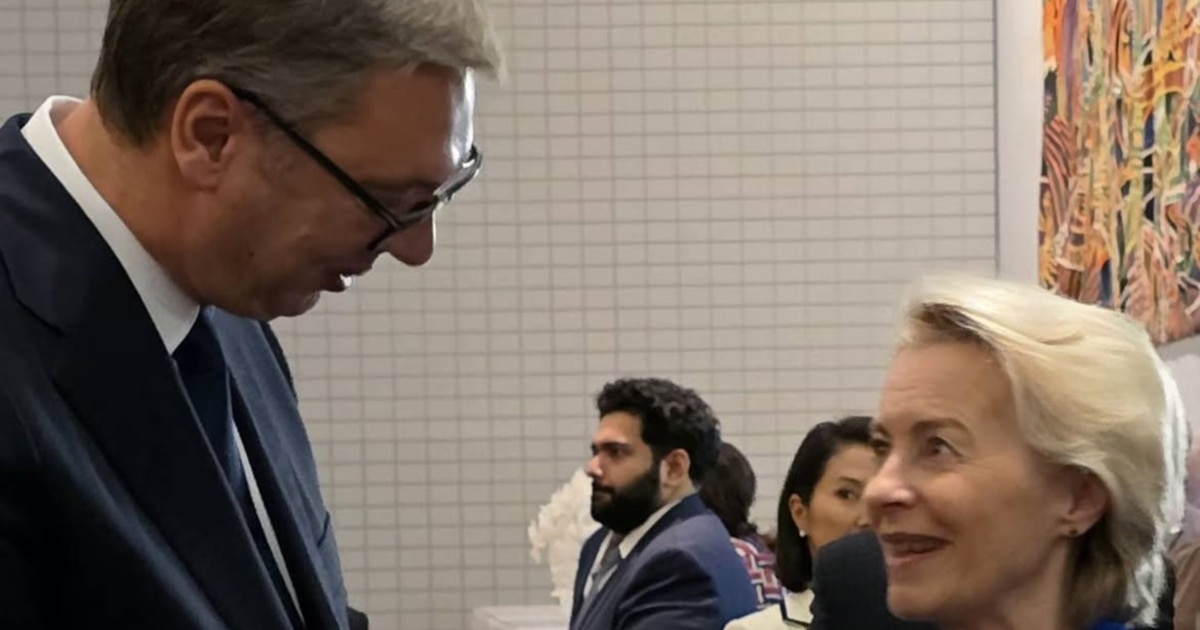
EU Says Von der Leyen’s Handshake with Serbia’s Vučić at UNGA Was Spontaneous as Commission Skips Serbia and Bosnia Visit
European Commission officials described a brief encounter between Serbian President Aleksandar Vučić and EU Commission President Ursula von der Leyen at the United Nations General Assembly as spontaneous and unplanned. Von der Leyen will make her annual Western Balkans tour next week but will not visit Serbia or Bosnia and Herzegovina; officials cite pre-election campaigns, while observers point to reactions to the funeral of convicted war criminal Ratko Mladić as a decisive factor.
By Christopher Manley
467 views
A short, unplanned meeting between Serbian President Aleksandar Vučić and European Commission President Ursula von der Leyen on the margins of the United Nations General Assembly in New York was spontaneous and very brief, European Commission officials said.
At a press briefing, European Commission spokesperson Ariana Podesta confirmed that the encounter took place by chance and that there was nothing more to add beyond that description. "They met by chance and briefly on the margins of the United Nations General Assembly. It was a spontaneous meeting, one of the very few such cases, so I think we have nothing to add beyond what I have already said. The meeting was very short, spontaneous and nothing more than that," Podesta said.
The Serbian president published a photograph of himself shaking hands with von der Leyen on his Instagram account, writing that during the brief conversation he expressed his "sincere gratitude for everything she has done for Serbia in recent years." Von der Leyen has been posting a series of meetings she held on the sidelines of the UN General Assembly but did not publish a post relating to a conversation with the Serbian president.
Von der Leyen is scheduled to travel to the Western Balkans next week as part of her customary annual tour of the region. This year, however, she will not visit Serbia or Bosnia and Herzegovina. The European Commission's official explanation attributes the omission to ongoing pre-election campaigns in both countries, which it says complicate the scheduling of such visits.
Unofficially, sources and commentators have pointed to another factor: the reaction of Serbian authorities and parts of the public to the death and state-honoured funeral of Ratko Mladić, a convicted war criminal. Reports suggest that those reactions played an important role in von der Leyen's decision to omit the two countries from her itinerary.
Von der Leyen herself, together with European Council President António Costa, said on September 8 that they were "shocked" by footage from Mladić’s funeral. In her State of the European Union address on September 16, von der Leyen said she was "appalled by the footage" from the event. The comments underscored deep concern in Brussels about public displays and official responses that appear to rehabilitate or glorify individuals convicted of grave human-rights violations.
The decision to bypass Serbia and Bosnia for the annual tour is a high-profile diplomatic signal, particularly given the European Union's long-standing engagement in rule-of-law issues, accountability for war crimes, and stabilisation in the Western Balkans. For Belgrade, the omission follows heightened scrutiny over how the state and political leaders respond to the legacy of the 1990s conflicts and the post-war process of reconciliation and justice.
The brief, chance encounter in New York — captured in a photograph shared by President Vučić — illustrates how informal diplomatic contacts can become politically significant when set against a backdrop of contested memory politics, regional tensions, and EU expectations on accountability. The European Commission has kept its public comments limited, emphasizing the accidental nature of the meeting, while von der Leyen’s deliberate choice to exclude Serbia and Bosnia from her upcoming regional visits keeps the focus on how wartime legacies and domestic political developments shape international engagement.
As the Western Balkans tour approaches, attention will likely remain on whether the EU will use other bilateral or multilateral avenues to press concerns over commemorations and official conduct related to convicted war criminals, and how Serbia and Bosnia and Herzegovina respond to continued international scrutiny amid pre-election campaigning.