EU’s Mînzatu warns against school budget cuts as basic skills decline
European governments are being urged not to cut education spending as pupil numbers decline, with EU Commissioner Roxana Mînzatu warning that sustained investment is essential to tackling falling academic performance and future skills shortages. The European Commission’s new education package proposes measures to improve basic skills, address teacher shortages and make education more accessible, but its success will depend largely on national governments.
By Klaudjo Jonuzaj
1,169 views
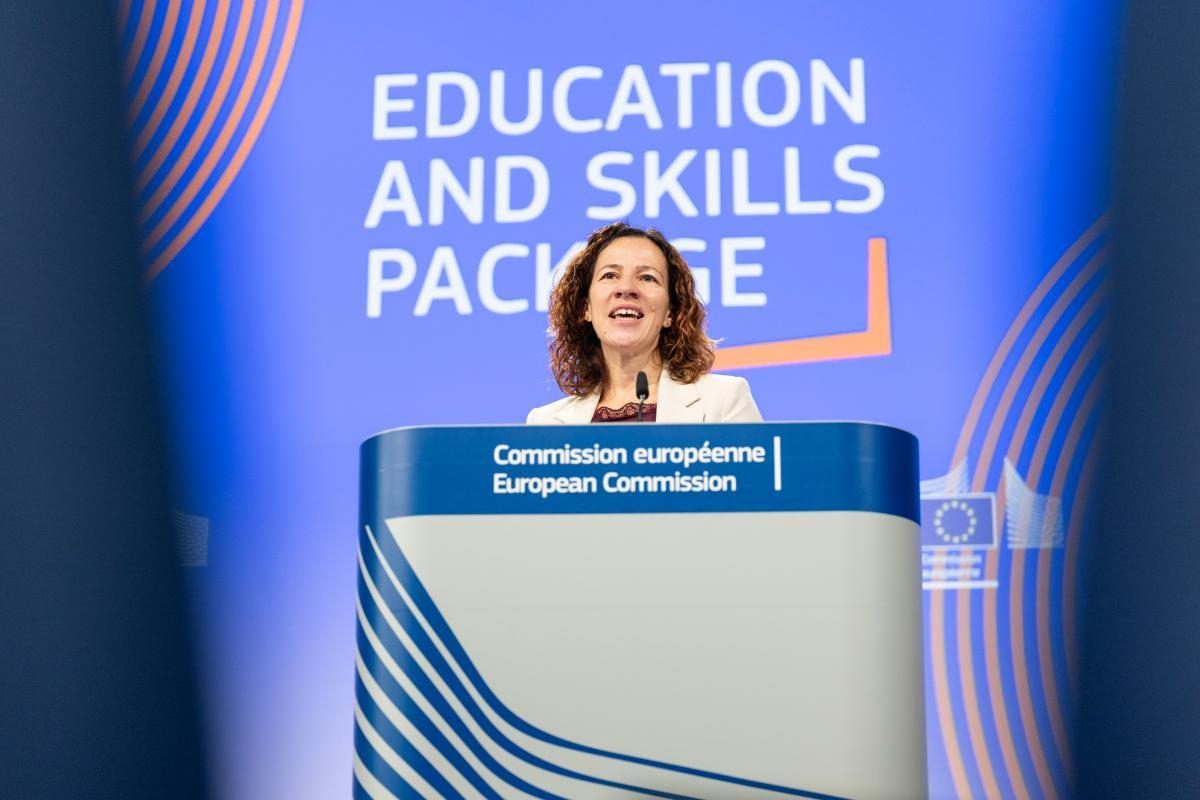
Photo: Roxana Mînzatu, European Commission Executive Vice-President for Social Rights and Skills, Quality Jobs and Preparedness. Source: EC - Audiovisual Service.
European governments should not treat falling pupil numbers as a chance to cut education budgets, EU Executive Vice-President Roxana Mînzatu said in an interview for The Liberty Bulletin, as the European Commission seeks to reverse a decline in basic skills with a package that leaves spending decisions to national capitals.
The Commission unveiled its Education and Skills Package on 5 November, citing PISA 2025 results showing that 33.9% of European 15-year-olds underachieve in mathematics, 31.3% in reading and 25.9% in science. The share of top performers has also fallen, to 4.8% in reading, 6.4% in science and 6.8% in mathematics. The Commission says persistent teacher shortages and online risks are adding to the pressure on schools.
Funding has been slow to recover. A Commission report put EU education spending at 4.7% of GDP in 2023, still below pre-pandemic levels. Mînzatu, who is responsible for social rights and skills, said the latest comparable figures for 2024 show ‘a modest recovery’, but that progress remains uneven. ‘We need comparable data for 2025 before we can judge whether that improvement is lasting,’ she said, adding that there was still too little evidence that countries investing less were consistently closing the gap. ‘For me, the political priority is to keep education high on governments’ agendas, even under budgetary pressure,’ she said, arguing that Europe’s competitiveness depends on sustained investment in its people.
That argument is being tested by national budget decisions. Some governments, including France, have justified below-inflation education budgets by pointing to shrinking cohorts, and the Commission itself projects millions fewer pupils by 2030. Reuters reported that France’s education minister, Edouard Geffray, attributed a below-inflation 1.7% rise in the 2027 education budget to population decline. Mînzatu rejected that logic. Fewer pupils means fewer future workers, she said, which strengthens the case for investing in each young person. She acknowledged that rising pension and healthcare costs put real pressure on governments, but warned that cutting school budgets in line with enrolment risks worsening future skills shortages. Smaller cohorts, she said, could free resources for small-group tutoring for struggling readers or let experienced teachers mentor new colleagues. ‘Before reducing a budget, I would ask what the same investment could achieve for the children who will be in those classrooms next September,’ she said.
The strain is already visible in the streets. Reuters reported on 4 October that protests over dilapidated schools, overcrowded classrooms and teacher shortages had spread across France, with police arresting more than 5,000 people in a week. In Greece, Reuters reported that thousands of students and teachers marched in Athens on 21 October demanding more public investment in education. The National News Desk reported that marchers also called for better school facilities and smaller classes, and that protests have also spread to Albania and Italy.
The EU’s room to act is nevertheless limited. Education is a national responsibility, and the package creates no binding obligations: the two proposed Council Recommendations, one on reversing the decline in basic skills and one on the attractiveness of the teaching profession, are not binding, and each member state will decide how to implement them.
Mînzatu said national and regional governments fund most education spending and decide on buildings and staffing, but EU money can be combined. A region could use the European Regional Development Fund to modernise a school and the European Social Fund Plus to train teachers to use it, she said. She noted that by 2025 the Recovery and Resilience Facility had supported almost 6.4 million places in new or modernised childcare and education facilities, and that Erasmus+ has provided €3.2 billion in school grants since 2021. The Commission says the EU is investing over €150 billion in education and skills in 2021–2027.
The package adds new tools. European School Alliances will link schools from different countries in long-term partnerships to improve results in at least one basic skill, such as reading or maths, and Mînzatu said each will receive €1 million in EU funding. An EU network of advisory and support services will help schools on leadership, well-being, and digital and AI readiness, while an EU Teachers Agenda urges governments to tackle shortages through better careers and working conditions. The Commission will also pilot an AI Literacy Certificate from the 2027/28 school year and propose a European Healthy Screens Pledge on online safety and screen time.
Looking further ahead, the Commission has proposed merging several funding streams in the 2028–2034 budget so that regions can plan investment in facilities and staff together. At least 14% of the proposed National and Regional Partnership Plans would go to social objectives, including education and skills, alongside a stronger Erasmus+. ‘Governments and regions will still need to show how their spending choices address the shortages schools face,’ Mînzatu said.
Living costs are another barrier. Responding to student protests over rents in Italy, Greece and elsewhere, Mînzatu said students can win a university place or an Erasmus+ grant and still turn it down because they cannot afford a room. Erasmus+ students with fewer opportunities can receive up to €250 a month on top of their grant, she noted, but a deposit can put a room out of reach. The Commission is exploring a guarantee with the European Investment Bank Group to reduce or remove upfront costs, and is considering an Erasmus+ pilot with cities. She added that InvestEU is already backing a €243 million student housing project at the University of Crete.
Member states agreed in June to cut the share of low-achieving 15-year-olds in reading, maths and science to below 15% by 2030, and to raise the share of top performers to at least 12%. The latest PISA figures show how far there is to go: 33.9% of pupils underachieve in maths and 31.3% in reading, and even in science, the strongest of the three, the figure is 25.9%. Top performers account for no more than 6.8% in any subject. The package now needs the backing of national governments. EU ministers are invited to adopt the two recommendations, and the Commission will host a summit in Brussels on 20 November to start putting the package into