EU Enlargement’s Western Balkans Test: Can Brussels Turn Promises Into Membership?
Montenegro and Albania may soon cross the finish line. For the rest of the region, and for the credibility of Brussels itself, the real test is only beginning.
By Klaudjo Jonuzaj
811 views
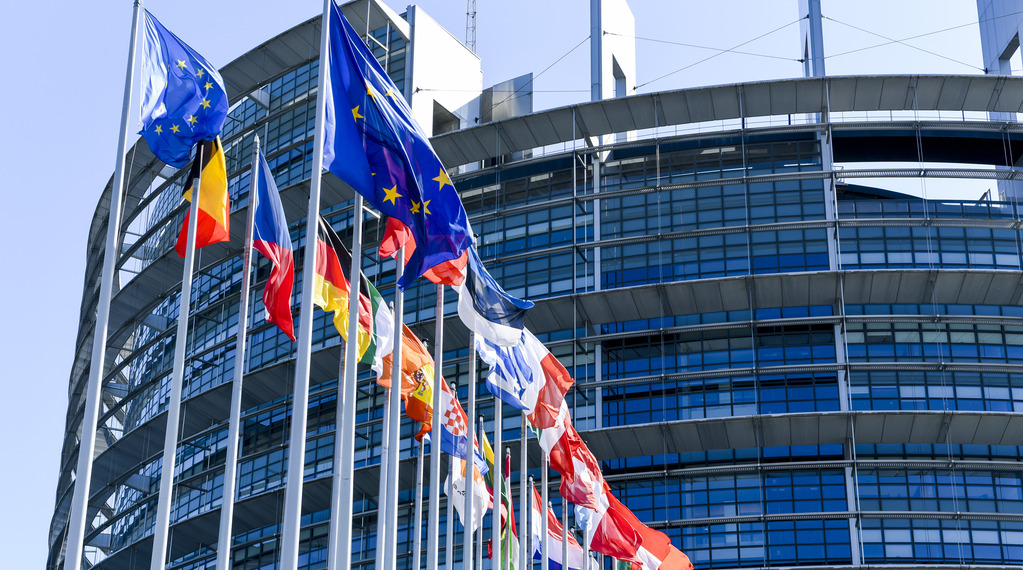
Photo: Flags waving in front of the European Parliament in Strasbourg
In 2003, EU leaders gathered in Thessaloniki and declared that the future of the Western Balkans lay within the Union. Since then, only Croatia has completed accession, as Monocle’s Guy De Launey noted in October 2025.
Today, the promise is being renewed with fresh energy. Montenegro’s accession treaty is already being drafted, and its government aims to join by 2028. Meanwhile, Enlargement Commissioner Marta Kos has said Albania could finish negotiations by the end of 2027.
For a region that has heard such promises before, the question is whether this momentum is credible for everyone or only for the two frontrunners. The honest answer begins with why the door reopened.
Milica Delević, an ECFR Council member and Secretary General of the EBRD, wrote in a September ECFR commentary that Russia’s full-scale invasion of Ukraine made enlargement a priority again. Candidate status for Ukraine and Moldova, she said, revived member states’ interest in the Western Balkans. At the EU-Western Balkans summit in Tivat in June, European Council President António Costa described the region as a strategic investment for the Union.
Yet the main driver, Delević argues, is no longer regional stability and reconciliation, as it was originally. The rule of law and democratic standards, she says, are too often sidelined by the broader geopolitical picture.
People in the region read the shift the same way. Few in the Western Balkans still believe the EU’s renewed interest is “driven purely by a sudden conviction that these societies have transformed,” Zvezdana Kovač of the Centre for Civic Education (CGO) in Podgorica said in an interview for The Liberty Bulletin. Instead, she says, it is understood as a response to the war in Ukraine, to Russian and Chinese influence, and to fear of a security vacuum on Europe’s doorstep.
The danger, in her view, is that a geopolitical motive leads the EU to lower the bar and admit countries faster without insisting that the substantive criteria are met. Vasil Vasilev, writing for The Western Balkans, makes a similar argument: injecting a geopolitical moment into enlargement strongly undermines the principle of merit. A promise built on circumstances lasts only as long as those circumstances do, and the problem arises when announcing dates becomes easier than explaining how to meet them.
A showcase, not yet a pattern
The progress at the front of the queue is real, but its causes matter.
Delević wrote that Montenegro and Albania have no major bilateral issues to resolve. Montenegro’s small size, she added, makes it ideal for presenting enlargement as an inexpensive and uncomplicated geopolitical win. Commission officials recently compared the annual cost of its entry per EU citizen to a cup of coffee.
That is a strong case for those two, but it does not answer what happens elsewhere.
Even Montenegro’s progress has limits, Kovač says. The country has advanced in the negotiations “with one leg.” Its public administration is overstretched by the pace and technical demands of the process, legislation is often adopted with little public debate, and members of parliament vote on texts they have not read in detail. The deeper reforms of the judiciary, the fight against corruption and the depoliticisation of institutions, she says, “consistently lag behind the formal, technical closing of chapters.”
Even technical completion, she adds, is not the finish line. Every chapter is only provisionally closed and can be reopened, while the final treaty must be ratified by all 27 member states.
The harder cases show these limits further. In a July analysis, Vasilev reported that eight member states had rejected the Commission’s proposal to open a new negotiating cluster with Serbia, calling it a partial defeat for the gradual integration policy. North Macedonia, for its part, changed its name in 2019 to settle a dispute with Greece, yet its progress has been blocked by a Bulgarian veto, De Launey wrote last October.
Albania’s own problems are also slowing it down. The Atlantic Council has pointed to recent scandals that could affect its accession timetable, and the Centre for Eastern Studies (OSW) reported that nine member states, citing concerns over judicial independence, blocked delivery of the interim benchmark report to Albania.
Taken together, the evidence suggests a process that works most smoothly where conditions are easiest. A showcase is valuable, but it is not yet a policy.
Gradual integration: ladder or waiting room?
The Commission’s answer for the rest of the region is gradual integration, which offers access to parts of the single market ahead of full membership, backed by a €6 billion Reform and Growth Facility.
In principle, this gives candidates visible benefits during a long process. Dimitar Bechev, a senior fellow at Carnegie Europe, argues that if membership is to remain a drawn-out prospect, prioritising market integration could boost growth on both sides and forge closer political and institutional ties.
The weakness, however, is definition. Before the Commission’s 6 October communication, Vasilev argued that it was unclear what gradual integration actually meant, because EU officials interpreted the term differently.
The communication, Preparing for a wider Union, goes some way towards answering that. It says participation should complement accession rather than replace it, be conditional on progress and be reversible where necessary. But it is not legally binding, and the Council and Parliament may take up as much or as little of it as they choose, The New Union Post reported. Until member states agree on what gradual integration means in practice, it risks remaining more concept than strategy.
For citizens, the difference between a ladder and a waiting room is simple: a ladder has a top.
Kovač sets out what would give it one. Pre-accession market access can be a useful tool, she says, but only if it is tied to a transparent, binding timeline and to measurable benchmarks toward full membership. Citizens need to see visible improvements, such as easier trade, new jobs and freedom to move for work and study, linked publicly to each phase of integration, so that the arrangement is not “an abstract promise with no clear deadline.”
There must also be an explicit assurance, ideally written into the arrangement, that phased access does not become a ceiling that lets the EU postpone full membership indefinitely while claiming credit for supporting the region. Kovač rejects any form of second-class membership, which she says would run against the principle of equality among members. A permanently “almost-in” status, she argues, would simply “institutionalise [the region’s problems] under a different name.”
The Union’s own readiness
Credibility depends as much on Brussels and the member-state capitals as on Tirana and Podgorica.
According to Politico, as reported by European Western Balkans, France, Germany and the Netherlands have expressed concern that new members could change governments and block EU policies, as happened with Hungary under former Prime Minister Viktor Orbán. In response, the Commission’s 6 October communication proposes new safeguards for future members, including one that could suspend a new member’s voting rights for serious breaches of EU values during its first 15 years, alongside wider use of qualified majority voting.
Vasilev goes further, asking whether the EU needs the Western Balkans, for what purpose, and whether it has the administrative capacity to absorb new members.
The Union has been here before, Kovač points out. Greece in 1981, Cyprus in 2004, and Bulgaria and Romania in 2007 were not fully ready when they joined, she says. Bulgaria and Romania still had unfinished business on judicial reform and the fight against corruption and organised crime, and the EU introduced an unprecedented post-accession monitoring mechanism for them. The EU’s reaction afterwards, in her words, was essentially “never again,” a lesson that hardened into a much stricter approach to the Western Balkans.
The money tells a similar story. On 10 October, the Irish Council Presidency proposed cutting the 2028-2034 budget heading covering enlargement and the eastern neighbourhood to €32.6 billion, from the €38.1 billion proposed by the Commission, a reduction of almost 14.4 per cent, The New Union Post reported. The proposal is a basis for negotiations and is not final. Still, it arrives as the EU asks candidates to deliver reforms while it has not yet settled how it will fund, or institutionally absorb, the countries it says it wants to admit.
That is the uncomfortable asymmetry: by asking others to be ready while remaining unsure of its own readiness, the EU risks weakening the authority of its conditionality.
What disillusion costs
The danger lies not only in delay but in disillusion.
De Launey argued that Brussels has been leading these countries on for decades, damaging the EU’s image and causing people in the Western Balkans to lose faith in the European project. Promises have been withdrawn before, he wrote: Serbia’s accession momentum never recovered after Jean-Claude Juncker, then European Commission president, said there would be no further enlargement.
Kovač dates the statement to 2014, when Juncker said there would be no further enlargement during his mandate. It “did real damage to public confidence in the region,” she says, by reinforcing the sense that membership could be postponed indefinitely. The EU launched the Berlin Process a year later to keep the region engaged, and in 2018 the Commission itself published a strategy titled “A credible enlargement perspective,” a reminder that credibility has long been promised before it has been delivered.
For citizens, credibility is measured less in communiqués than in dates that hold. Kovač says the EU must show predictability: clear, merit-based benchmarks that are “not casually moved once a country meets them,” and a political commitment that does not evaporate with the next change in Commission leadership.
That is why the 2028 target matters beyond Montenegro. Every missed deadline among the frontrunners will be read across the region as a verdict on its own prospects. Montenegro’s ambassador to the EU, Petar Marković, told The New Union Post in June that if the EU wants to show enlargement is credible, a country has to reach the finish line, and that Montenegro can be that country.
Here the geopolitical logic turns on itself. If enlargement is meant to anchor the region in the West, a process that stalls or dissolves into vague integration produces the opposite result.
The counter-argument from the region
Kovač, however, offers a counterweight. The EU’s motive, she argues, “matters less than the outcome,” because the Western Balkan countries have no better framework to democratise. Even a geopolitically driven process still obliges candidates to adopt EU law, reform their judiciaries and open their economies. She also believes it is better for at least one country to move forward than for everyone to stay frozen, and she does not think citizens in stalled countries would lose trust if a neighbour advanced. A success story, she says, would show that accession is achievable rather than a promise renewed without consequence.
She also puts the responsibility for the region’s drift firmly at home. “If a country wants to join a club, it has to play by that club’s rules,” she says, and countries cannot expect the EU to lower its standards to keep everyone moving in lockstep. The question to ask, in her view, is not what the EU must do for the region, but what the region is failing to do that is within its own power. Reforms, she adds, should be carried out for the region’s own sake, not for Brussels’.
The Western Balkans have heard the word “future” for more than twenty years. What they now need from Brussels is not another declaration, but a plan.