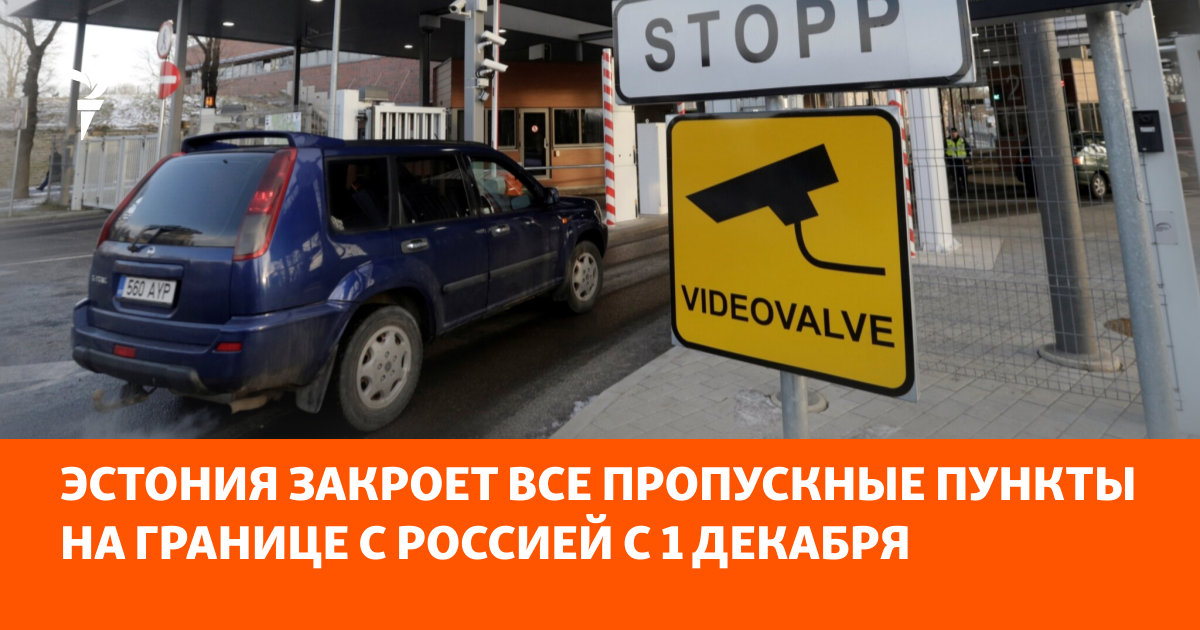
Estonia to close all border crossings with Russia from Dec. 1 after suspected GRU-linked sabotage attempt
Estonia will close all of its border crossing points with Russia beginning December 1, Foreign Minister Margus Tsahkna announced, calling the move a response to a sabotage attempt Tallinn says was directed by Russia’s GRU. The decision follows the November 15 arrest of eight Latvian nationals accused of attempting to set fire to a drone manufacturer and comes amid earlier attacks on defense firms this year.
By Christopher Manley
815 views
Estonia will close all border crossing points with Russia from December 1, the country’s foreign minister announced, describing the measure as a direct response to what Tallinn says was a Russian-directed attempt to sabotage an Estonian defense company. Margus Tsahkna said on social media that the closure is intended to reduce Moscow’s opportunities to conduct hostile activity on Estonian territory and to strengthen Estonia’s ability to prevent breaches of sanctions.
"Russia must understand that hostile actions against Estonia will not remain without consequences," Tsahkna wrote. He added that the Estonian government has already informed partners in Finland, Latvia and Lithuania of the decision. Tallinn framed the move as both a security measure and a tool to tighten enforcement of international sanctions.
The announcement follows the November 15 detention in Estonia of eight Latvian citizens on suspicion of attempting to set fire to Threod Systems, a company that manufactures unmanned aerial vehicles (drones). According to officials, the arson was prevented by the company’s security service. Estonia’s counterintelligence agency has said it confirmed Russian involvement in the operation and that it was coordinated by the Main Intelligence Directorate (GRU) of the Russian military.
Estonian security officials described the Threod incident as part of a pattern of hostile actions aimed at Estonian defense firms this year. In August, a fire occurred at Milrem Robotics, a Tallinn-based maker of unmanned ground vehicles that works closely with Ukraine. Two people were detained on suspicion of arson in that case, and Estonian authorities publicly accused Russia of involvement.
The full closure of border crossings with Russia represents an escalation in Tallinn’s response to what it characterizes as sustained, state-directed sabotage and covert action. Officials argue that limiting cross-border movement will reduce the risk of further incursions, make it harder for operatives or supplies to cross into Estonia, and improve the authorities’ capacity to detect and block activities intended to evade sanctions or support malign operations.
The measure will have immediate practical consequences for cross-border travel and trade. While Estonia has already tightened security and monitoring at its borders in recent months, closing all official crossing points is likely to disrupt commercial transit and personal travel between the two countries, and could complicate logistics for businesses that maintain links across the border. Tsahkna did not provide detailed operational guidance in his announcement on whether there will be exceptions for certain types of transit or humanitarian travel.
By notifying Finland, Latvia and Lithuania, Estonia has signaled its intent to coordinate regionally as the Baltic states and nearby Nordic countries confront what they describe as increased hybrid and covert threats from Russia. The decision is likely to be raised in forthcoming discussions among European partners and NATO, where concerns over Russian sabotage, espionage and pressure campaigns have featured prominently since Russia’s 2022 invasion of Ukraine.
Tallinn’s public attribution of both the November arson attempt and the earlier August incident to Russian intelligence services underscores an intensifying security standoff in the region. For Estonia, a NATO and EU member on Russia’s border, the steps aim to harden defenses against covert attacks on critical and defense-related infrastructure. For Russia, the actions risk further isolating cross-border connections with the Baltic state and prompt additional diplomatic fallout with Estonia and its allies.
Estonian authorities have not released full operational details about how the border closure will be implemented or how long it will remain in place. The announcement comes as the government pursues investigations into the suspected sabotage attempts and as regional partners assess the implications for border management, sanctions enforcement, and collective security planning.