Deeper Social Crises Emerge Behind Recycling Scheme Tensions in Budapest
Hungary's bottle-deposit scheme has nearly hit EU recycling targets, but in Budapest it has surfaced a deeper crisis of poverty, exploitation and addiction — turning a waste-management success into a lens onto social problems that long predated it.
By Kristóf Ábel Tarnay
1,015 views
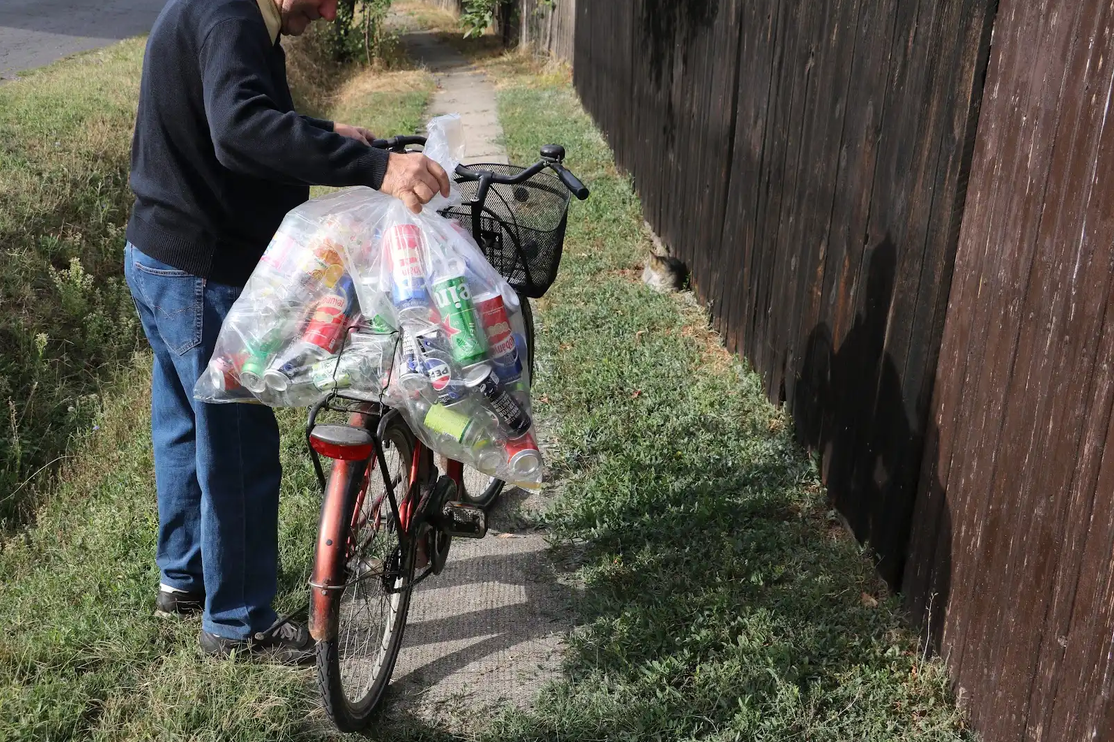
Photo: A person carries collected containers in Gyomaendrőd. (Photograph: János Ungvölgyi)
While the DRS helps boost the recycling rate of bottles, cans and glass beverage containers in Hungary, it also intensifies tensions around existing social problems, including poverty and addiction. Mayors of several Budapest districts are seeking solutions to mitigate antisocial behaviour linked to people making money by collecting these containers. Meanwhile, a part of those vulnerable people are exploited and can keep only a part of the deposit.
In 2024, following 13 other EU member states, Hungary introduced a deposit return system for plastic bottles, aluminium cans and glass bottles, with some exemptions, to meet the bloc’s collection rate targets. The system appears to be working: according to MOHU, the return rate for those containers reached 88.8% in 2025, close to the EU’s 90% target for 2027. However, the scheme also intensified some social tensions.
Consumers pay a 50 HUF (0.14 EUR) deposit fee – a similar amount to those used in Romania, Slovakia and Portugal – which is paid back after returning the containers to a reverse vending machine, mostly placed in or near grocery stores. The machine prints a voucher that can be used in the same store chain or can be cashed. Other options include transferring the money to a bank account via a smartphone app, or donating it to charity. The scheme is operated by MOHU, a subsidiary of the oil company MOL, as a part of a broader waste-management concession.
Similar to other countries with a DRS, a parallel phenomenon quickly emerged: people who make money by collecting others’ beverage packaging in large quantities. In Hungarian, they are called “flakonozók” derived from a word for plastic bottle – which is a term very similar to “canners”. One of those people told RTL that he earns 20,000 HUF (55 EUR) a day. Another said to the channel that she once collected 70,000 HUF (192 EUR) in one night.
In late 2024, Budapest mayor Gergely Karácsony already raised the issue in a TV interview on M1 that, after years of decline, the number of homeless people had started to increase, and that he believed the change was linked to the social phenomenon that had emerged around the DRS. He said the system had prompted people in difficult circumstances from outside Budapest to come to the capital and try to make a living by collecting the containers.
Since then, frequently mentioned effects have included cleannesses and safety problems. “Our apartment building is quite secure, but today I also encountered someone slipping in to collect bottles. Somehow, we should find a way to keep the bins behind bars or behind a locked door, so that they can only be opened with a key,” one user posted in a local Facebook group in the 6th district. Another person shared photos of strewn litter in front of their bins, ironically writing: “it’s great to live here.” Several district mayors have called for government action while also dealing with the consequences themselves, such as by cleaning public spaces.
Exploited canners
While the approximately 1500 homeless people who live on Budapest’s streets were rummaging through bins way before the DRS was introduced, they are now a minority among canners, according to Péter Győri, a sociologist and chair of the board of trustees at Menhely Foundation, which provides assistance to people living in homelessness and extreme poverty in the capital. People began coming to the capital especially for this activity, while low-income locals, including pensioners, also took part, he says, effectively pushing homeless people out of this source of income.
Győri adds that people who come from rural areas are frequently not collecting the money for themselves, but hand most of it to people who exploit them. He estimates that of the approximately 3,000 regular canners in the capital, more than 1,000 people are affected. The sociologist explains that their “bosses”, often men with a strong physique, usually chase away other canners from busy locations, keeping competitors away from the areas where their team operates.
According to the tabloid Blikk, some people have the deposits transferred to a bank account and get half of the money back in cash. “They are in an extremely vulnerable situation,” Győri emphasises, adding that while this situation at least allows them to earn some money, if they tried to collect cans and bottles independently, they would have also been sent away from busier areas. According to Győri, this behaviour also exists outside the capital, but not on the same scale, and not necessarily in the same hierarchical form. He adds that the exploited people and their “bosses” are sometimes relatives.
He mentions that it is very difficult to expose these exploitative relationships. “I don’t know anyone who rummages through bins for fun,” he emphasises, explaining that people do it because of extremely difficult life circumstances, including existential hardship, mental health problems and dependency-related issues, such as untreated drug and alcohol addiction. He notes that not all canners contribute to the public-order problems.
Győri says that there are several hundred Hungarian settlements with no jobs, shops or public transport. “These are isolated and neglected settlements, with drug use and crime, where you can’t make a decent living. And then this 50 HUF deposit was introduced, and people came here to collect [the containers]. It is a source of income because there are no other opportunities there. These are very serious problems, and they are the results of what has happened over the past decades.”
The National Police Headquarters (ORFK) did not provide a substantive response to my questions about the potential criminal-law implications. MOHU replied that my request had been forwarded to its communications department but did not provide answers to my questions by the time of this article’s submission. According to a TV report by RTL in August, MOHU told the channel that it was important to them to pay attention to the social impacts of the deposit return system and continuously evaluate these experiences. “We are open to cooperating with the municipalities in order to make the system work in the long term,” the company stated.
Drug money?
Among the district mayors demanding government action, András Rózsa of the 14th district claimed on his Facebook page that “in many cases, this money goes straight to drug dealers, leaving people struggling with addiction completely vulnerable and contributing to a deterioration in public safety.” In a Facebook post, Tamás Soproni of the 6th district linked canning to the spread of drug use in public spaces in Budapest.
András Pikó, the mayor of the 8th district, posted on his Facebook page that “an aggressive group of drug users has emerged due to canning, fundamentally undermining the sense of safety among residents of Józsefváros. Our patience has run out: the drug-dealing network must be dismantled first, after which a restored sense of security can provide the basis for addressing the deeper social problems.”
According to Ferenc Dávid, Head of the Innovation Working Group at the Kék Pont Foundation, an addiction treatment and outpatient care provider, there are no exact data on the number of drug users involved in canning. He adds that his hypothesis is that addicts may take canners’ money. “So an amount of money arrived at a field that was already affected by drugs, including designer drugs,” he explains.
He also stresses that when we are talking about the cheap drugs consumed by deprived people for pain relief, like synthetic cannabinoids and cethinones, there are no traditional dealers, as people know it regarding drugs often used by middle-class people for recreation, such as marijuana or cocaine. In this other illicit drug market, even the distributors are in destitution, he explains.
He adds that Budapest’s new psychoactive substance problems are only a fraction of what is present in rural areas. “This problem is surrounded by a social catastrophe, existing in segregated communities, from where people come [to Budapest], driven by a lack of drugs, seeking a better livelihood and drawn by the prospects of bottle collecting,” Dávid explains, adding that this interpretation of his is still just a hypothesis.
There are many uncertainties surrounding these patterns. Several phenomena appear to overlap to some extent: canning, other forms of making a living among people in poverty, including illegal activities, as well as drug use, addiction and homelessness. According to Telex, there is currently no study examining the socioeconomic composition of the social group making a living by collecting bottles.
Is cash the problem?
In a Facebook post, district mayor Rózsa called for cash payments to be abolished, although this proposal was controversial. Ambrus Kiss, Director General at the Municipality of Budapest, argued in a statement to Telex that banning cash payments would only create a secondary market for the vouchers.
Several district mayors and MOHU, the waste company, supported the proposal. However, the decision is not up to them, as it would require an amendment to national legislation. In an email response, the Ministry of the Living Environment told me it didn’t support the proposal. It argued that everyone must have the opportunity to receive the deposit they paid back in cash, even if they do not make a purchase at the same time or do not have a bank account.
Instead, the ministry argued that the appropriate solution lies in residents’ approach: if people return their containers to the designated return points, some of the problems could be reduced. It also noted that “a significant proportion of these problems exist independently of the deposit-return system and were already present before it was introduced.” The ministry added that other solutions, such as bottle holders placed next to bins and specially designed bins that make rummaging through waste more difficult, can also help reduce these burdens. (Bottle holders are already used in Budapest and other cities.)
Scheme under review
Some district mayors have even suggested suspending the whole scheme, as László Kiss of the 3rd district wrote on Facebook, until “figuring out a normal system”. Tamás Soproni of the 6th district highlighted in a Facebook post that “currently, national crises are playing out on the streets of Budapest: impoverishment, exploitative workers’ hostels, the housing crisis, low incomes, a fragmented psychiatric care system, a weak addiction treatment system, cutbacks to child protection services, and the side effects of the poorly designed PET bottle deposit scheme.” Among other measures, Soproni also calls for the DRS scheme to be suspended, as he told RTL, until 1 January, to figure out a system without the currently experienced externalities.
Meanwhile, the new government, which took office in May, announced a review of the 35-year waste-management concession awarded under Viktor Orbán’s previous administration. “Given the flood of complaints regarding waste management and the fact that MOHU is failing to meet its contractual obligations and targets, the government has decided to conduct a comprehensive review of the entire waste management system,” Prime Minister Péter Magyar wrote on his Facebook page in early September.
“MOHU agrees with the government that the waste management system needs to be reviewed. We also believe that the complex concession system needs to be reconsidered to ensure that the agreed objectives can be achieved,” the company responded. According to Telex, MOL had lost around 200 billion HUF (around 548 million EUR) on the waste-management system as of June 2026.