Cultural Treasures Are Being Destroyed in Odesa: 5 Are Gone – 14 Live in Danger
Nearly two years ago, more than a hundred well-known cultural figures from around the world signed an appeal begging the authorities in Odesa, Ukraine, not to touch 19 named cultural monuments. Today, five of these have been destroyed or removed, and the remaining ones are living in great danger.
By Jesper Enerstvedt
1,017 views
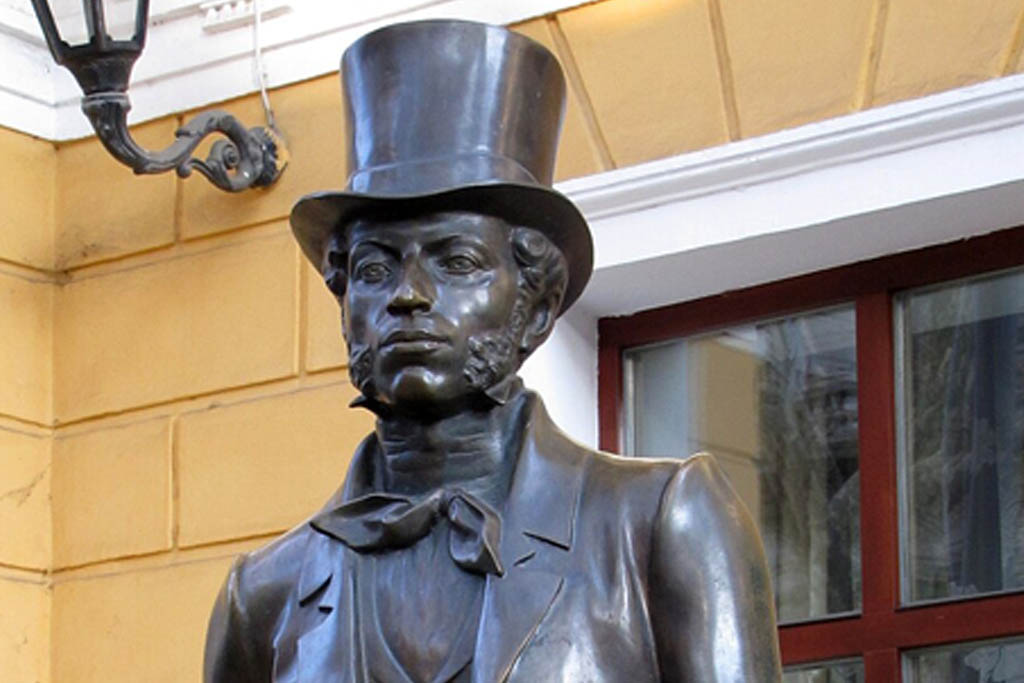
Photo: Radek Linner CC BY-SA 4.0 Pushkin Statue on Pushkinskaya Street outside the Odessa Pushkin Museum, Odessa, Ukraine
The bust of the famous poet Pushkin now stands locked inside a wooden crate. This is because regional governor Oleh Kiper signed an order in 2024 to remove 19 statues and monuments connected to Russia. The list included, among others, the poet Alexander Pushkin, the writer Isaac Babel, the singer Vladimir Vysotsky and Tsar Alexander II.
The letter with more than a hundred signatures was delivered to UNESCO Director-General Audrey Azoulay on 21 October 2024. The initiator was the anthropologist Anastasia Piliavsky, who was born in Odesa and teaches at King’s College London. Among the most prominent names are the American poet Ilya Kaminsky, who was born in Odesa and is a professor at Princeton and the author of Dancing in Odessa. From Britain come the historian Sir Christopher Clark of Cambridge, the writer Neal Ascherson, and the artist and writer Edmund de Waal. Also on the list are Labour peer Maurice Glasman and the Italian historian Carlo Ginzburg. The same goes for Stanford professor Steven Zipperstein, who has written about the Jews of Odesa.
Among the musicians on the list are names such as the conductor Oksana Lyniv, the first woman to open the Bayreuth Festival. Conductor Hobart Earle and opera singer Oleksandr Tsymbalyuk have also signed. From the world of sport we find chess grandmasters Vladimir Tukmakov and Mikhail Golubev. Isaac Babel’s daughter Lidia and grandson Andrei Malaev-Babel are on the list, as are several people serving in the Ukrainian armed forces, among them the historian Oleksandr Babych and the sculptor Klim Stepanov. Despite the cultural weight behind the letter, it has still not been possible to protect these objects of high historical value.
The signatories argued that a Pushkin monument which the city itself erected through a public collection in 1889 was not a Russian gift, but something owned by the people of Odesa. They also recalled that Pushkin himself had been exiled for criticising the Tsarist regime. Despite all good intentions, many Ukrainians disliked the letter. Odesa’s director of culture, Ivan Liptuga, called it a “stab in the back of a country that is already bleeding.” As of October 2026 one might call it a kind of draw between those who signed the appeal and those who want to destroy everything.
The Gorky bust was dismantled in September 2024. Activists have destroyed the “Krylia Pobedy” monument with the Victory Wings bearing the Order of Lenin. On the night of 31 December 2024, Vysotsky was taken down and driven to a warehouse. In May 2026 the partisan Zoya Kosmodemyanskaya disappeared. The last one to go was a bust of the biologist Michurin. People only discovered this as late as 27 August this year. On the same day the activists stated that Pushkin, Babel and Vorontsov are now next in line.
The best-known bust is without doubt the Pushkin monument. It stands in the middle of the city, in front of the city hall, but no one can see it any longer. The 1889 bust was packed into a wooden crate on 30 October 2025. It is still standing there. To protect it from vandalism, a UNESCO status notice has been stuck on the crate. City councillor Petro Obukhov has somewhat sarcastically remarked that the only thing the removal of Mayor Trukhanov achieved was the crate. Former mayor from 2014 to 2025, Trukhanov, believed the monument should remain. Trukhanov, who opposed the demolition, lost his citizenship in October 2025 after the SBU claimed he held a Russian passport, something he himself disputes. Odesa is now governed by a military administration.
The Alexander II column from 1891 was removed from the state register of protected monuments in February. A month later, someone came at night and smashed off the coat of arms and the commemorative plaque. No one has been arrested or detained for the vandalism. The most important objects have so far not been destroyed. These are the Pushkin bust from 1889 and the Tsar’s column from 1891. The Pushkin monument by the museum was erected in 1999, the Babel monument in 2011 and the Vysotsky monument in 2012.
Those who signed the appeal believe that the fate of the art should be postponed until the war is over and people have calmed down. There is nevertheless no doubt that they consider any destruction a threat to the city’s world heritage status. Opponents maintain that both Pushkin and the others are markers of Russian imperial power. It has gone so far that even the otherwise neutral Institute of History concluded that honouring Babel amounts to imperial propaganda, because Babel fought in the Red Army.
Those who signed the appeal fear that the old Pushkin monument will suffer the same fate as other Pushkin monuments in Ukraine. The first known incident related to the poet Pushkin was the dismantling of a statue in Mukachevo on 7 April 2022. Two days later the same thing happened again in Uzhhorod and Ternopil. That was the starting signal for a cultural cleansing in Ukraine. In Odesa this is not so easy to carry out because most of the people who live there speak Russian.
UNESCO has not condemned the removal of Pushkin statues in general, but the organisation has engaged itself in protecting the protected area in Odesa. The monument lies inside this area in Odesa’s historic centre. Because it is located in the buffer zone, changes must be approved by the World Heritage Committee, but similar cases show that it is difficult to enforce such rules in wartime.