Criminal investigation opened after violent brawl erupts in Armenian parliament
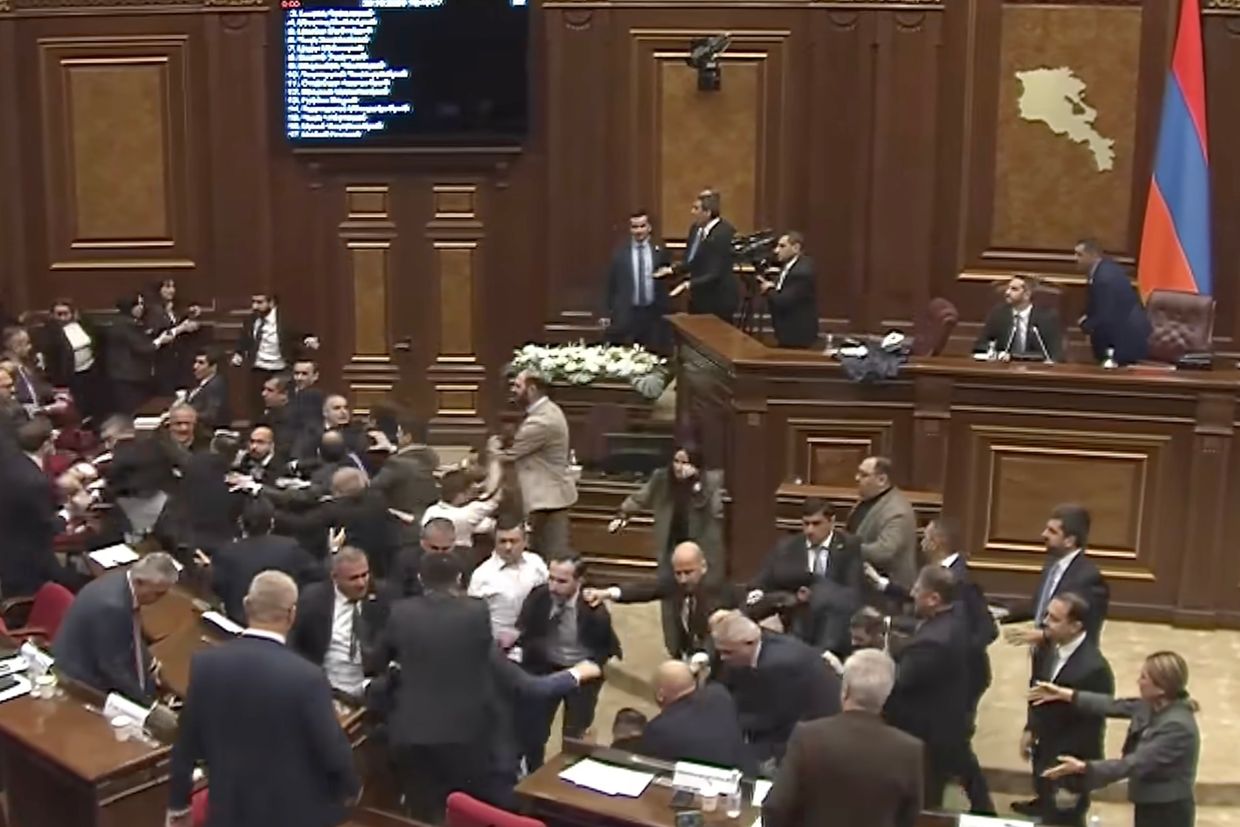
Armenian authorities have launched a criminal probe into a chaotic and unusually violent brawl that erupted in the national parliament on 29 October, involving MPs from the ruling Civil Contract party and the opposition Strong Armenia faction. The case, opened about two weeks after the clash, is being investigated on charges of group hooliganism and violence against an official, but any prosecution will require parliament to lift the immunity of the MPs involved.
By Clémence Desjardins
1,072 views
Armenian law enforcement has opened a criminal case following a particularly violent brawl in the National Assembly on 29 October that involved members of the ruling Civil Contract party and the opposition Strong Armenia faction. Authorities said the investigation, which was launched around two weeks after the incident, will look into allegations of group hooliganism and violence committed against an official with the aim of interfering with their lawful official or political activities. Under the charges, those found guilty could face up to five years in prison.
Scuffles and heated exchanges are not uncommon in Armenia’s parliament, but the 29 October confrontation stood out for its intensity and the scale of the physical violence. Video from the chamber showed MPs throwing bottles, nearly overturning tables and chairs, and engaging in hand-to-hand confrontations. Several parliamentarians left the chamber with visible injuries and torn clothing. Observers described the episode as the most violent since the newly constituted parliament convened after the June elections.
The immediate flashpoint came during a speech by ruling party MP Taron Chakhoyan, who accused opposition factions, including Strong Armenia, of being "steeped in corruption." As the dispute escalated, Deputy Speaker Vahagn Aleksanyan, a member of Civil Contract, was captured on footage launching a chair in the direction of opposition MPs. Chakhoyan was also seen pouring a glass of water on an opposition MP. Strong Armenia MP Narek Karapetyan later described the episode as "a normal Armenian-style man-to-man fight," while Parliamentary Speaker Ruben Rubinyan accused Karapetyan of initiating the melee.
Prime Minister Nikol Pashinyan defended members of his party after the clash, saying that the act of throwing a chair was "proportionate and right," remarks that drew criticism from civil society groups. Around a dozen rights organisations issued a joint statement expressing "deep concern" and condemning the acts of "physical violence and hooliganism" inside the legislative chamber. The groups said such behaviour is "unacceptable and contrary to the principles of parliamentary democracy," adding that citizens did not give MPs a mandate to resolve political disagreements through physical force or to enjoy impunity for such conduct.
The rights organisations called on the parliament’s Ad Hoc Committee on Matters Related to Parliamentary Ethics to examine the conduct of the MPs involved and urged law enforcement authorities to carry out a full and proper criminal investigation into possible offences committed during the incident. They also criticised political leaders’ responses to the brawl, saying that statements which treat the violence as normal or justified, or that appear to condone it, further erode public trust in democratic institutions.
A key legal and practical barrier to prosecuting any MP for actions taken in the chamber is parliamentary immunity. Under Armenian law, MPs enjoy protections that prevent immediate arrest or prosecution; law enforcement agencies must obtain parliamentary consent to lift immunity before charges can be brought. As of the announcement of the investigation, no charges had been filed and no parliamentary votes to remove immunity had been reported.
The criminal case represents a test of Armenia’s mechanisms for holding elected officials accountable for violent or unlawful conduct and raises broader questions about political culture and the rule of law. If parliament does not act to lift immunity or if the inquiry stalls, critics warn the episode could reinforce perceptions of impunity for politicians and weaken confidence in democratic norms. Authorities have not provided a timeline for the investigation or said whether any MPs will be requested to have their immunity lifted to permit prosecutions.