“Criminal imitation”: Why Russia stages Duma elections in occupied Crimea and how they endanger residents
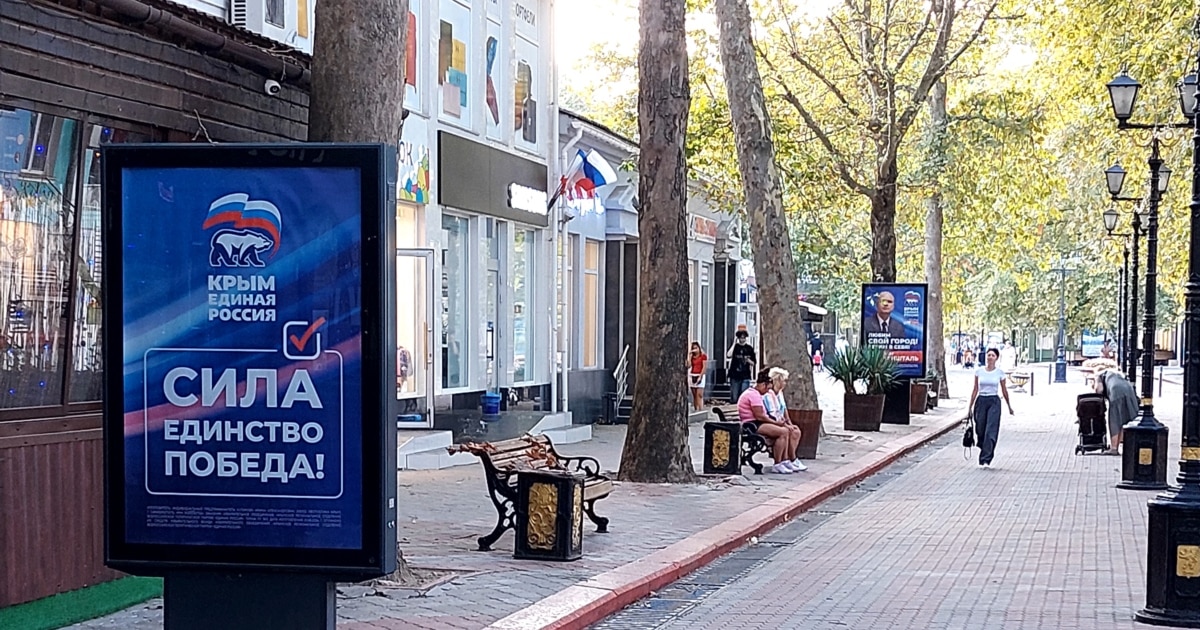
Russia has scheduled State Duma voting for 18–20 September on its own territory and on Ukrainian lands it occupies, including Crimea. Human rights defenders and Ukrainian officials say the ballots are illegal under international law and serve as instruments of control — creating a façade of normal political life while enabling administrative pressure, data gathering and potential mobilization of local residents.
By Alexander Walter
966 views
From 18 to 20 September, Russia is organising voting for deputies of the State Duma not only on sovereign Russian territory but also across regions of Ukraine under Russian control — among them the occupied and annexed Crimean peninsula. The Central Election Commission of the Russian Federation has listed these occupied territories as places where elections for the ninth convocation of the Duma will be held. Journalists at QIRIM.Media and human-rights advocates in Ukraine warn that these procedures are neither lawful nor benign for the people who live under occupation.
Russian authorities have conducted such exercises in Crimea repeatedly since the peninsula’s 2014 occupation, progressively transplanting Russian administrative, legal and political mechanisms. That process has included issuing Russian passports, introducing Russian laws and reshaping education and media systems. According to Tamila Tasheva, a Crimean-born member of Ukraine’s parliament, ballots and polling stations are the next step: visible trappings that are meant to demonstrate an ordinary political life where, in reality, the fundamental conditions for free elections do not exist.
"Polling stations, ballots, candidates and results are intended to show that the occupied territory is allegedly already part of the Russian political system," Tasheva said. She stressed that the Kremlin is not trying to learn the views of local residents so much as to normalise control and integrate occupied territories into Russian legal and administrative structures. International bodies and Kyiv reject that normalization: Ukraine’s Foreign Ministry says the voting violates its sovereignty and international law, the European Union has refused to recognise previous occupied-territory polls, and the United Nations has similarly questioned their legality.
Leaders of the Crimean Tatar community and human-rights activists call the three-day voting format and other campaigning practices instruments of coercion. Refat Chubarov, head of the Medjlis of the Crimean Tatar People, described the vote as "not an election in a legal, political or moral sense," calling it a "criminal imitation" carried out in violation of international law and Ukrainian legislation. He warned that multi-day voting windows are likely designed to maximise turnout figures by whatever means necessary, including pressure on vulnerable groups.
Local residents interviewed anonymously by QIRIM.Media say they are largely indifferent to the electoral campaign’s substance — candidates and party platforms — but deeply concerned about the prospect of renewed mobilisation to the Russian military. Recent months have seen persistent rumours in Russia about possible fresh waves of conscription after the parliamentary vote. Moscow has officially denied preparations for new mobilisation, yet similar denials preceded the partial mobilisation announced in September 2022. For Crimeans, the practical stakes are high: people mobilised from occupied territories not only supplement Russian forces but, once enlisted, enter Russian military and social systems, which can be deployed politically to consolidate control.
Advocates also document coercive tactics used during past occupied-territory votes. Alena Luneva, advocacy director at the Ukrainian human-rights group ZMINA, noted that local commissions sometimes perform door-to-door visits and bring ballots to people’s homes — a practice officially rationalised by security or access concerns. These visits have in several instances involved armed individuals accompanying election workers. Such encounters, Luneva said, cannot be considered free expression of political will given the potential for intimidation, threats of job loss for public-sector employees, and other pressures.
The organisation of these electoral procedures has legal implications beyond questions of legitimacy. Under Ukrainian law, participation in organising so-called elections on temporarily occupied territory can constitute a criminal offence. This may affect members of precinct and territorial election commissions, observers and other people recruited to administer the vote: Kyiv has already opened cases in some instances, and those involved may face investigation or be placed on wanted lists.
Observers underscore that the purposes of conducting these votes extend well past recording ballots. Elections can provide occupation authorities with updated household-level information, confirm channels for administrative outreach and be used to demonstrate to residents that they are integrated into a new state system. That administrative reach can intersect with efforts to mobilise people for military service, to absorb families into Russian compensation or social-welfare systems, and to further erode ties to Ukraine. In short, what may look like a routine political exercise is, according to Ukrainian officials and rights groups, a tool of occupation with tangible and potentially coercive consequences for local populations.
International bodies have repeatedly refused to recognise elections carried out by occupying powers on seized territory, and Kyiv maintains that such votes create no legal change in the status of those lands. Nonetheless, for residents of Crimea and other occupied regions, the immediate risks are practical and personal: pressure at work, home visits by officials and armed men with ballot boxes, possible targeting for collaboration charges by Ukrainian authorities, and the looming threat that Moscow’s demand for military service could extend to them. Those realities make the September voting not merely a matter of diplomatic dispute, but a human-rights and rule-of-law issue with direct consequences for ordinary people living under occupation.