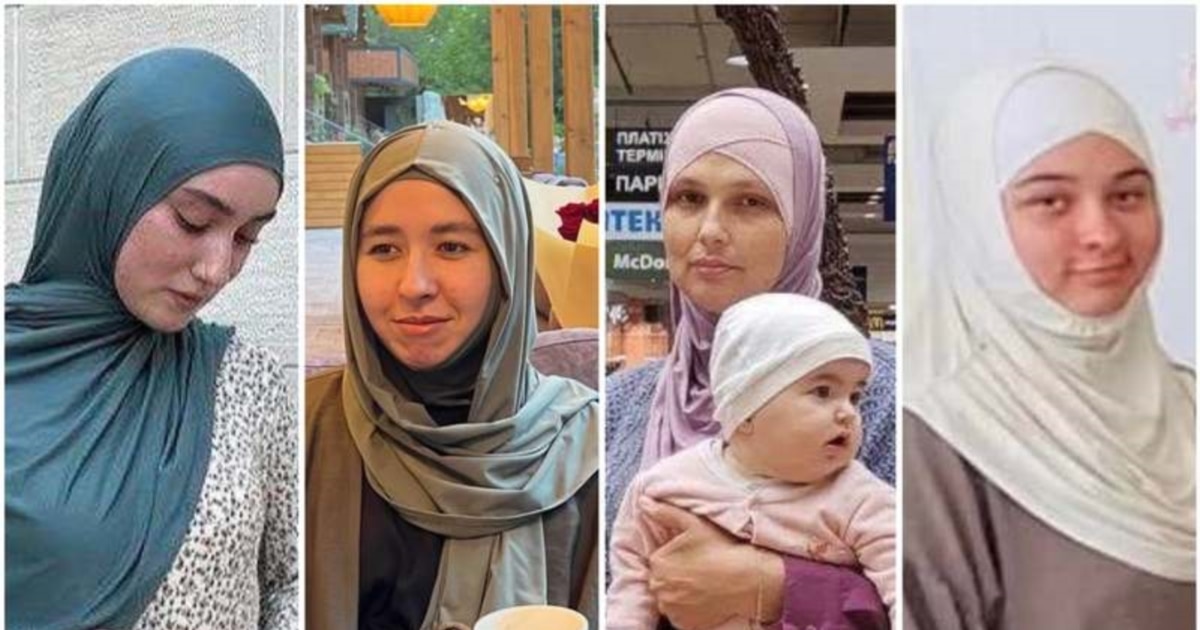
Court in Russian-controlled Crimea extends detention of four Muslim women in Hizb ut-Tahrir case until Sept. 14
A Kiev District court in Russian-controlled Akhmetchet (Simferopol) has extended the pretrial detention of four Muslim women charged in a case linked to Hizb ut-Tahrir until September 14. Their lawyer told the court the federal law relied on does not list the group under the 2007 designation framework; prosecutors argued house arrest would risk flight or witness intimidation. The hearing was held behind closed doors and family access was severely limited.
By Christopher Manley
1,015 views
A court in Russian-controlled Akhmetchet (Simferopol) has extended the pretrial detention of four Muslim women accused in a case tied to the Islamist group Hizb ut-Tahrir, an RFE/RL (Azatlyk) report said. The Kiev District Court ruled on an extension that will keep Esma Nimetullaeva, Nasiba Saidova, Elvisa Alieva and Favziya Osmanova in custody until September 14.
The four women have been held since October 15 of last year, when they were detained in Crimea following investigations linked to alleged ties to Hizb ut-Tahrir. They are currently held in Investigative Isolation Center No. 1 in Akhmetchet, according to the report. The judge conducted the latest hearing behind closed doors, and family members were not permitted to communicate with the women during proceedings.
Their lawyer, Emil Kurbedinov, told the court that the legal basis used to treat the group as a terrorist organization does not apply under the federal law passed in 2007. Kurbedinov told Azatlyk that he drew the court’s attention to this point during the hearing: "Мин мәхкәмә игътибарын шуңа юнәлттем: террорчы оешмаларны тану тәртибен билгеләүче һәм 2007 елда кабул ителгән федерал канун нигезендә 'Хизб ут Тәхрир' оешмасы террорчы дип танылмаган", дип сөйләгән Курбединов.
Prosecutors opposed changes to the women’s detention conditions, arguing that placing them under house arrest could allow them to flee or to pressure witnesses. Those objections formed the basis for the court’s decision to prolong pretrial custody, the report said. The closed nature of the hearing, combined with the restriction on family contact, has raised concerns among relatives and rights defenders about transparency and access to due process.
Relatives were allowed extremely limited contact. Elianora Osmanova, the mother of Favziya Osmanova, said she was permitted to see her daughter for only a second at the hearing. Such restricted access and the continued use of pretrial detention have been highlighted by advocates as problematic in politically sensitive cases, particularly in Crimea where courts operate under Russian authority following Moscow’s 2014 annexation.
Hizb ut-Tahrir is an international Islamist political organization that advocates the establishment of an Islamic caliphate by political means. While it says it rejects violence, many states treat it as a security threat. The group is banned in a large number of countries, the report noted, and it is explicitly prohibited in Russia and Germany. The article also states that the organization is banned in most Muslim-majority states, with some exceptions cited.
In Russia, the Supreme Court designated Hizb ut-Tahrir as a terrorist organization in 2003, and the country’s criminal code provides for severe penalties, including life imprisonment, for organizing or participating in a terrorist organization. Since Russia’s annexation of Crimea in 2014, prosecutions linked to Hizb ut-Tahrir have been reported in the peninsula, drawing criticism from human rights groups who argue that such cases often lack transparency and adequate legal safeguards.
The extension of detention for Nimetullaeva, Saidova, Alieva and Osmanova adds to a string of high-profile detentions tied to alleged extremist activity in Crimea. Human rights observers and family members continue to press for greater access to detained individuals and for public court hearings to ensure that legal standards are respected in politically charged prosecutions. Azatlyk reported the details of the hearing and the lawyer’s statements.