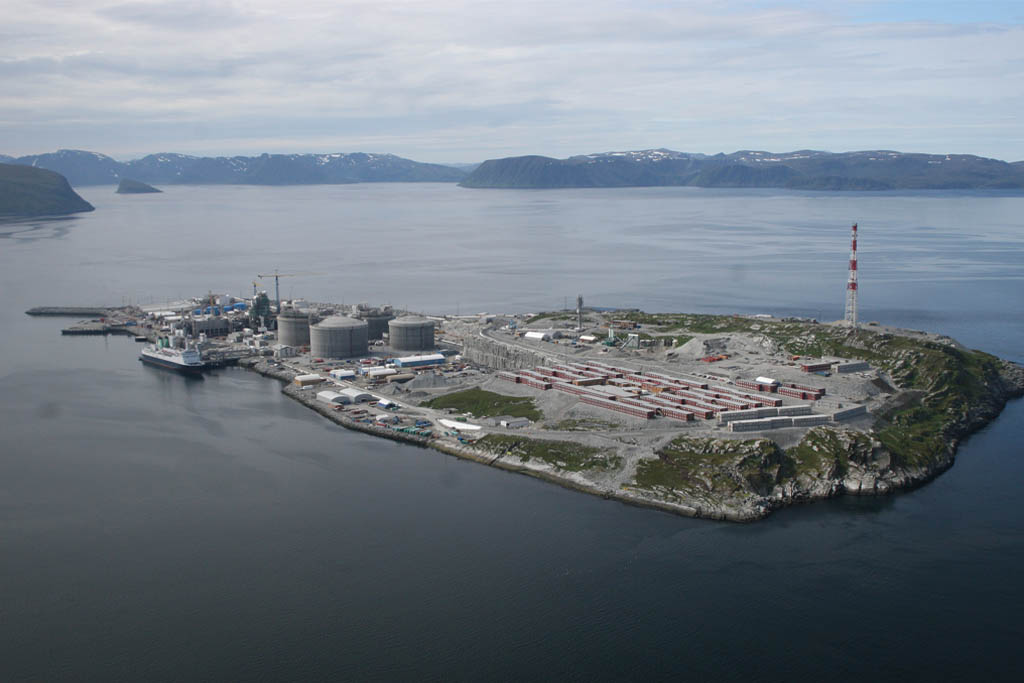
Cost Overruns in the Billions: EQUINOR'S "SNØHVIT FUTURE"
Norway is spending more than 1.8 billion euros to bring electricity to an island that already
has almost free power. The purpose is to stop CO2 emissions from the LNG plant. Now the
case is drawing international attention.
On a small island far out in the open sea off Northern Norway, one of the world's most sought-after products is made — LNG gas. The processing plant cools the gas down to –163°C. This turns the gas liquid and reduces its volume by a factor of 620. That makes shipping possible. Until now, the plant has used its own gas to do this job. That's about to end. Norwegian authorities have decided to electrify the island with power from the mainland.
LNG production is energy-intensive. The gas turbines on the island use roughly 330–340 million Sm³ of gas per year. The plant has five gas turbines that deliver about 200 MW of electrical output and 140 MW of heat to the facility. Now the Norwegian government wants to end gas use at the gas-fired power plant. They want to bring power from the mainland out to the island. Whatever the cost. That's why they're building a tunnel. It's so expensive that it makes everyone wonder whether Norwegians are quite right in the head.
Freezing down the LNG gas requires enormous amounts of energy. The LNG plant solved this problem by using its own gas via turbines. That keeps costs to a minimum, but it results in CO₂ emissions from the plant. That was something Norway could not accept. After careful consideration, the Norwegian government therefore arrived at something so controversial that it is drawing attention far beyond the country's borders. They electrified a plant that already had almost free electricity. According to Equinor, electrification is expected to cut emissions by 850,000 tonnes of CO2 a year.
In 2025, excavation began at an impressive pace. Hypermodern drilling and digging machines are still working around the clock. Everyone working down in the new tunnel knows what the final goal is: to deliver expensive mainland electricity to an island that already has unlimited, almost-free power. The price tag on Norway's Snøhvit Future project has drawn sharp criticism at home. The then research director for climate and energy at the Fridtjof Nansen Institute, Lars H. Gulbrandsen, wrote in an op-ed published in the newspaper Aftenposten shortly after the government's decision that "Electrification of Melkøya entails high costs related to society's expansion of the grid and power supply, negative impacts on reindeer herding and nature costs. It may also lead to higher electricity prices and an increasing power deficit in the north."
Equinor's development plan from December 2022 put the cost of the tunnel at 1.2 billion euros. The government approved electrification on August 8, 2023. Two and a half years later, in March 2026, the cost of the tunnel had exploded to 1.8 billion euros. According to a statement from Equinor in March 2026, the goal is to switch to electricity from the mainland by 2030.
It's not just the power connection from the mainland that costs billions. Once the plant is finally finished, it will have to pay its electricity bill just like any other business. A cautious estimate shows that the electricity bill after electrification will rise to over 180 million euros annually. This is based on an electricity price of a reasonable 5–6 eurocents/kWh.
Most LNG plants around the world still use gas turbines because gas is cheap. Even so, the trend is moving toward electric operation where it's practical and politically desirable — just as at Melkøya. For example, Woodfibre LNG in British Columbia, Canada, uses renewable hydropower from BC Hydro. It's one of the cleanest LNG plants in the world — if you set aside the product itself. The gas from Canada emits just as much CO2 as before, once it's finally burned by end users.
Norway is one of the world's largest gas distributors, but doesn't want to emit the CO2 itself. That's left to end users in Europe to do. This has drawn criticism from international observers, too. The U.S. based NGO Oil Change International, in a briefing on the Melkøya project, argued that the electrification does not eliminate emissions but merely shifts them elsewhere, since the gas no longer burned on the island will simply be exported and burned abroad. The British outlet The Ecologist reported that environmental critics have called the project a case of greenwashing, describing it as less a matter of genuine decarbonization than of "creative accounting." Equinor was contacted for this article but declined to comment on the criticism. Norway knows the gas will be burned somewhere, but Norway does not want to be the one doing it, at any cost.
Equinor is Norway's largest energy company and was formerly called Statoil. It was established by the Norwegian state in 1972 to develop Norway's oil and gas industry. The Norwegian state owns 67 percent of Equinor, while the rest is publicly traded shares owned by, among others, Norwegian and foreign investors. The old oil and gas giant Equinor has now become a major player in wind power and other renewable energy. The company is investing heavily in low-carbon solutions, including CO₂ transport and storage.
Despite the fact that the country's wealth is built on oil and gas extraction, Norway has made a name for itself as a country that invests enormously in environmental measures. Norway has often been described as a "showcase" for Tesla and electric cars. Norway was the first country outside North America to receive the Model S, and Tesla built its first Supercharger network outside North America here.