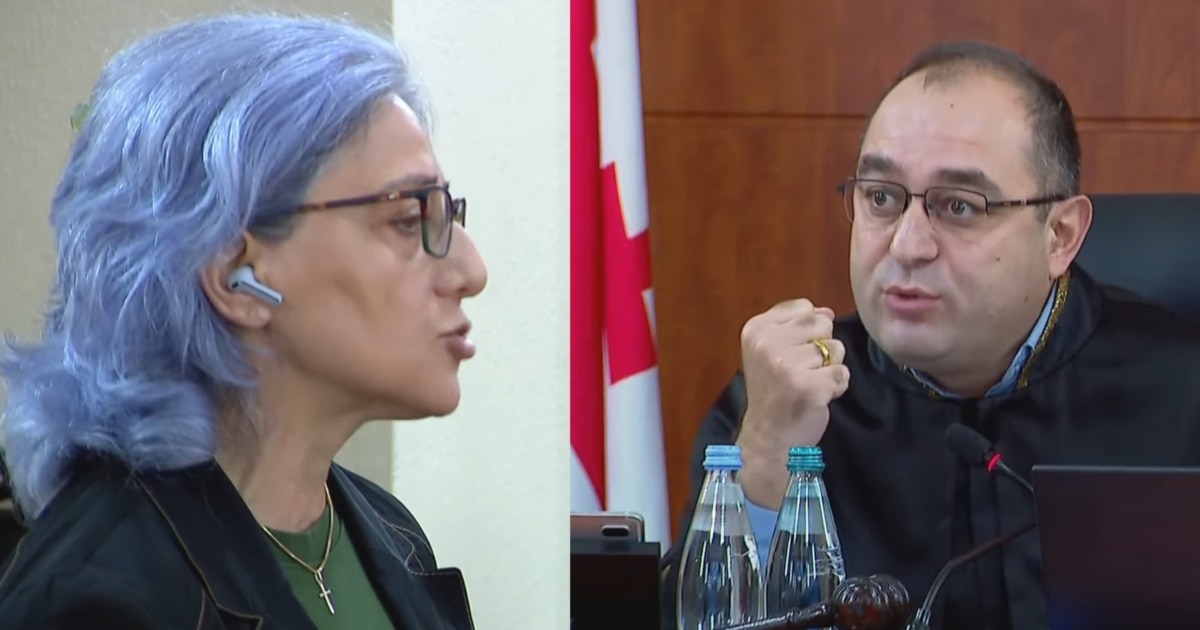
Constitutional Court Chair Rebukes Former Judge After She Suggests Court Is Being Restricted During Hearing on Banning Five Opposition Parties
Tensions flared at a Constitutional Court session considering a lawsuit by the ruling Georgian Dream party to ban five opposition parties, when court chair Revaz Nadaraya chastised former judge Maia Kopaleishvili for implying the court was being constrained and appearing to take the complainant's side. The exchange followed statements by Coalition for Change leader Nika Gvaramia and a rebuke from Georgian Dream MP Archil Gorduladze, highlighting deep divisions over the case and questions about the court's neutrality.
By Christopher Manley
1,163 views
A tense exchange unfolded at a session of Georgia’s Constitutional Court convened to consider a landmark application by the ruling Georgian Dream party seeking the ban of five opposition political parties. The dispute escalated when court chair Revaz Nadaraya reprimanded former judge Maia Kopaleishvili after she criticised the court’s impartiality and suggested it was being portrayed as constrained by the parties before it.
The confrontation followed testimony by Coalition for Change leader Nika Gvaramia, who spoke about aspects of his record in previous government roles, including actions during the 2008 Russia-Georgia war. Gvaramia’s comments prompted a sharp reaction from Georgian Dream MP Archil Gorduladze, who addressed the court and said: “How long must we listen to what Nika Gvaramia is proud of?” He warned that the courtroom should not become a forum for personal views and emotions.
Maia Kopaleishvili, representing the Coalition for Change, responded to Gorduladze by accusing him of attempting to define or limit the court’s activities. She said that Gorduladze seemed to be setting boundaries on how the court should operate and suggested that subsequent remarks from the court mirrored exactly what he had demanded. Kopaleishvili also said she believed Gorduladze hoped to see him become a future judge of the Constitutional Court.
Chair Revaz Nadaraya forcefully rejected Kopaleishvili’s characterisation and described her remarks as an insult to the judiciary. Nadaraya said telling the court that it was being restricted was an “unimaginable” criticism coming from a former judge who served for a decade. He stressed that while parties to the case have a right to register protest, it is the court’s duty to maintain order in the hearings and to remain neutral.
Nadaraya further accused Kopaleishvili of attempting to present the court as if it were limiting the parties and of reacting in a way that aligned with the position of the applicant. His comments underscored the high sensitivity within the courtroom over accusations of bias or partiality as the judges weigh the politically charged application.
Georgian Dream’s lawsuit seeks the ban of five opposition formations: the United National Movement, the Coalition for Change, Strong Georgia – Lelo, the Federalists, and For Georgia (the party led by former prime minister Giorgi Gakharia). In its application, the ruling party contends that the activities of these political forces contravene the constitutional order and pose a threat to Georgia’s independence and territorial integrity.
The complaint also references events surrounding the 2008 conflict with Russia, alleging that policies pursued by Georgia’s authorities at that time contributed to escalation and the occupation of territory. Georgian Dream argues that more recent actions by the targeted opposition parties, including stances it characterises as seeking warmer ties with Russia, amount to a national security risk.
Opposition parties have rejected the accusations, framing the litigation as a political attempt to silence and eliminate competition. They argue that the ruling party’s move aims to erode pluralism and remove political rivals rather than to address genuine legal breaches. The case has therefore become a focal point for broader concerns about the independence of democratic institutions and the future of political competition in Georgia.
The hearing at the Constitutional Court is being watched closely by domestic and international observers who see the outcome as consequential for the country’s democratic trajectory. The sharp exchange between the bench and a former judge during the session has added to scrutiny over the conduct of the proceedings, the court’s ability to preserve impartiality, and the balance between order in court and the parties’ rights to present grievances.