Columnist Warns Decline in Religious Literacy Undermines Society’s Grasp on Truth
Writing ahead of the Jewish holiday of Shavuot, columnist Josh Hammer argues that the revelation at Mount Sinai established an objective moral order that became foundational to Western civilization. He contends that falling religious literacy and the rise of conspiratorial thinking among Americans illustrate a broader erosion of shared access to truth that threatens democratic life.
By Josh Hammer
1,013 views
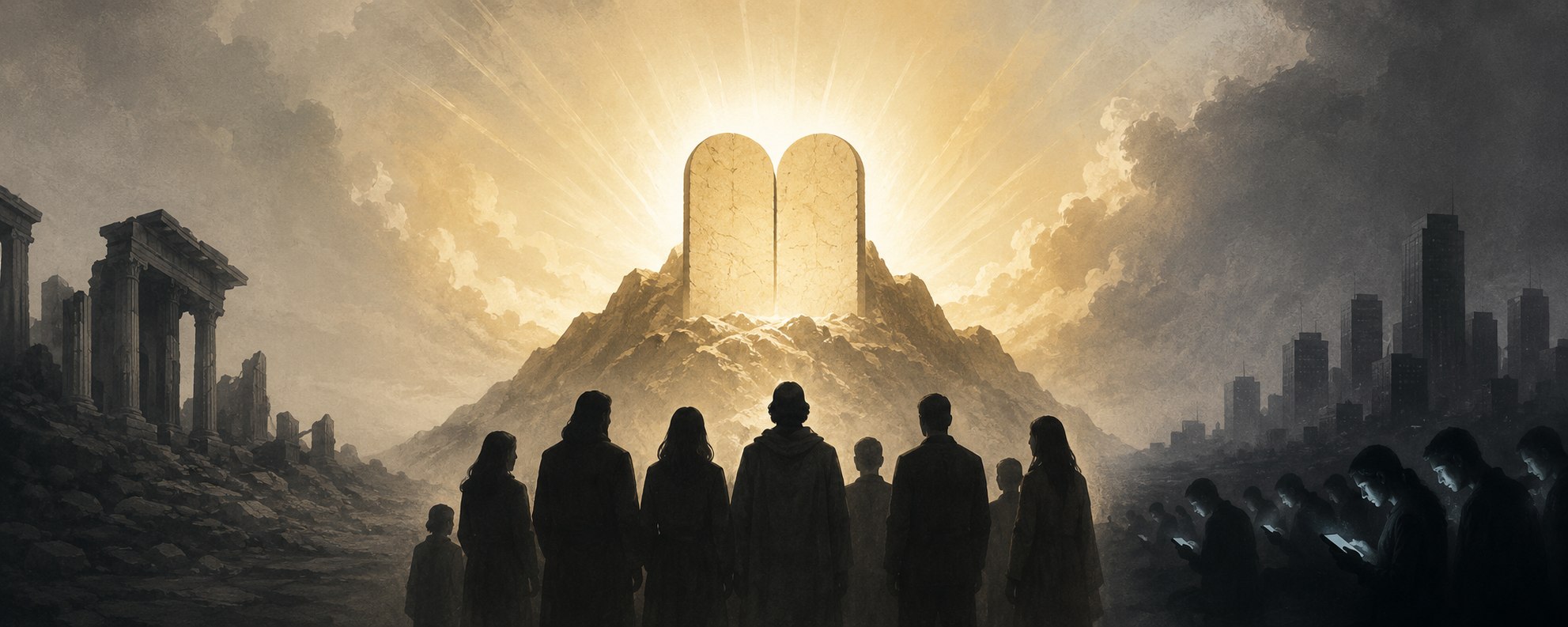
In a column published as Jewish communities prepare to observe Shavuot, columnist Josh Hammer contends that the revelation at Mount Sinai fundamentally reoriented humanity's relationship to truth. Shavuot, which falls seven weeks and a day after Passover and whose name means "weeks," commemorates what Hammer calls the most transformative event in human history: God's revelation of His word to the ancient Israelites at the base of Mount Sinai, where they pledged fidelity to the covenant before even receiving the Ten Commandments. Before Sinai, Hammer argues, truth was treated as subjective and contingent on the shifting moods of capricious gods; afterward, the existence of one Creator who had disclosed His will replaced moral relativism and idolatry with moral objectivity and monotheism, furnishing for the first time a fixed standard against which human conduct, laws, and institutions could be measured. Because of the depth of that influence, he treats Sinai as the logical starting point of Western civilization, linking it to Alexander Hamilton's invocation in Federalist No. 31 of the "primary truths" or "first principles" on which all subsequent reasoning depends — principles that, in Hammer's reading, were long understood in America and the West to rest ultimately on the word of God, and that make possible the very claim that any truths are "self-evident."
The column expands the critique beyond one political persuasion, asserting that susceptibility to delusional conspiracies and misleading information affects a wider swath of the population, including those who might align with conservative commentators. To illustrate the decline in religious literacy, Hammer points to a recent Washington Post op-ed by Princeton politics professor Gregory Conti, who recounted a campus lecture on religion and free speech that failed to connect with students because several of them did not know what the Ten Commandments were — and who observed that even bright, driven undergraduates often cannot distinguish the Old Testament from the New. Hammer reads this as evidence that many of the country's future leaders no longer recognize the foundational truths on which the civilization rests. He then argues that the resulting loss of a grip on reality cuts across the political spectrum. On the left, he cites polling indicating that large shares of Democrats — roughly 42 percent — believe the July 2024 attempt on Donald Trump's life in Butler, Pennsylvania, was staged, with a comparable share saying the same about a later alleged attempt, claims for which he says there is no evidence. He insists the phenomenon is not confined to the left, naming the audiences of right-leaning media personalities such as Candace Owens and Tucker Carlson as similarly prone, in his view, to conspiratorial thinking and what he describes as AI-driven online "slop."
Hammer's central claim is normative: he asserts that only a society rooted in an orientation toward the eternal and transcendental can consistently cultivate citizens who seek truth and distinguish right from wrong. Absent that orientation, he warns, democratic societies will face increasing "misery, despair, and destruction." He links this diagnosis to a civic appeal, saying the approaching semiquincentennial of American independence — the 250th anniversary of the nation's founding — is an opportune moment to reaffirm the self-described "self-evident truths" that birthed the country. The framing deliberately fuses the religious and the civic: just as Shavuot marks the moment a people accepted a revealed moral order, Hammer suggests the 250th anniversary offers Americans a comparable occasion to recommit to the founding's first principles, and he goes so far as to tie the nation's survival for another two and a half centuries to whether it recovers them.
The column closes with a prescriptive note rather than specific policy recommendations: a call, in effect, for Americans to recover a transcendent moral framework in public life. The piece, syndicated through Creators Syndicate, interprets religious observance, historical memory and civic education as mutually reinforcing elements of a healthy polity and frames the restoration of religiously informed truth as essential to the nation's longevity. Hammer, a Newsweek senior editor-at-large, host of "The Josh Hammer Show," and author of a recent book on the Jewish nation and the destiny of the West, writes from an avowedly conservative vantage, and the argument reflects a broader strand of thought that locates the source of Western political order in the Hebrew Bible and the Judeo-Christian tradition.
Critics of this perspective might argue that pluralism, secular governance and other sources of moral consensus also sustain democratic societies, or that declines in formal religious knowledge need not translate directly into moral or civic failure. They might add that the Enlightenment and classical antiquity contributed at least as much as Sinai to the West's "first principles," that conspiracy belief tracks more closely with partisanship, social media, and institutional distrust than with religiosity, and that highly secular democracies elsewhere remain stable and rights-respecting. Hammer's column, however, insists that the loss of a shared, God-centered foundation for truth is a primary cause of contemporary epistemic instability and political fragmentation, and he urges a cultural reorientation ahead of a major national milestone.