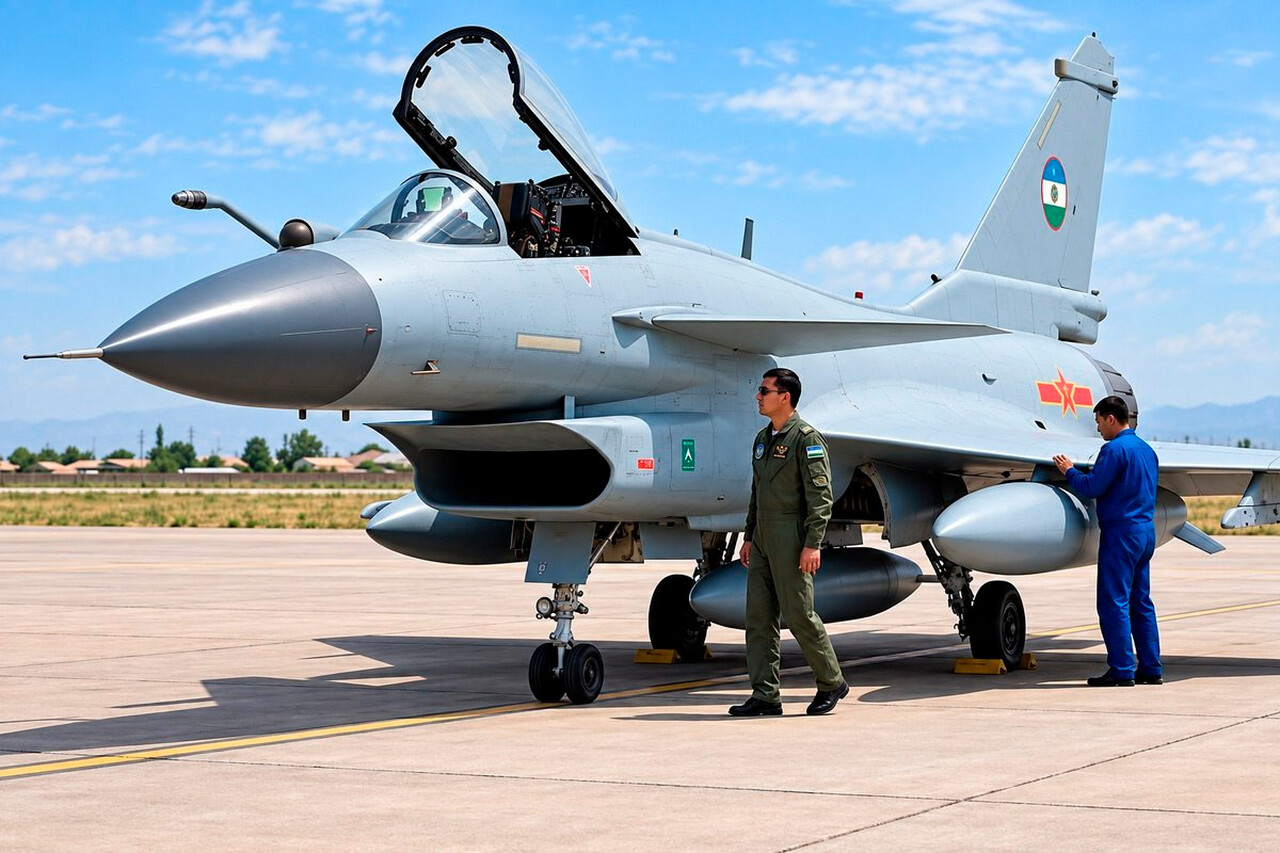
China Confirms Delivery of J-10CE Fighters to Uzbekistan, Making Tashkent Second Confirmed Export Customer
China’s Defence Ministry has for the first time confirmed it has transferred J-10CE multirole combat aircraft to Uzbekistan, a move that signals deepening military-technical ties between Beijing and Tashkent. The delivery, disclosed by a ministry spokesman on September 24, comes as Uzbekistan seeks to modernize its Soviet-era air force and follows public sightings of the jets earlier this year.
By Christopher Manley
886 views
China’s Ministry of National Defense has publicly confirmed the delivery of J-10CE multirole fighter jets to Uzbekistan, marking the first official acknowledgment by Beijing that it has transferred the aircraft to a Central Asian partner. At a press conference on September 24, Defence Ministry spokesman Jiang Bin responded to a journalist’s question by saying that the transfer had been completed and framed the cooperation as part of friendly bilateral relations conducted in accordance with international law and common practice.
The confirmation makes Uzbekistan the second foreign operator of the J-10CE to be officially acknowledged by China, following Pakistan. Chinese state and regional outlets reported earlier public evidence of the deployment: late in August 2026 Uzbek state television broadcast footage showing at least six fighters bearing Uzbek Air Force markings at the Karshi-Khanabad air base ahead of the country’s 35th independence anniversary.
The J-10CE is the export variant of China’s J-10 series, produced by the Chengdu Aircraft Corporation. It is described by manufacturers and observers as a fourth-generation-plus multirole fighter equipped with an active electronically scanned array (AESA) radar and an advanced electronic warfare suite. The jet is intended for both air-to-air engagements and precision strikes against ground targets. Estimates place the base unit cost of the aircraft at roughly $40–50 million, though that figure excludes weapons packages, training for pilots and technical staff, and infrastructure or support costs.
Neither Chinese nor Uzbek authorities have disclosed the exact number of aircraft ordered or delivered. Unconfirmed reports circulating in the region have suggested that the contract could include as many as two dozen J-10CEs with a package value approaching $1 billion, but those figures remain unverified. The Ministry of National Defense spokesman reiterated in his remarks that the cooperation was not directed against any third party.
For Tashkent, the acquisition forms part of a broader effort to modernize an air force that still relies heavily on aging Soviet-era platforms. Uzbekistan retired its Su-27 fighters around 2020, citing airframe fatigue and difficulties in obtaining spare parts. Remaining MiG-29 and Su-25 fleets are also older designs, prompting Tashkent to seek newer, more readily supported aircraft. Uzbekistan had long been reported to be in talks over Russian Su-30SM fighters — negotiations that reportedly started around 2017 — but ultimately chose to purchase Chinese-made jets.
Interest in the J-10CE outside China increased after reports of combat use by Pakistan’s Air Force during a May 2025 aerial confrontation with India. Chinese state media subsequently credited the aircraft with successful participation in air-to-air engagements, a claim that contributed to regional attention on the platform’s operational record. China has already supplied other military systems to Uzbekistan in recent years; Chinese FD-2000 surface-to-air missile systems were first publicly shown during Uzbekistan’s air defense exercises in 2018.
The transfer deepens military-technical ties between Beijing and Tashkent at a time when Central Asia’s strategic landscape is evolving. Observers note that the introduction of modern Chinese fighters into Uzbekistan’s inventory could influence regional air power calculations and defence procurement patterns among neighboring states. The lack of publicly available contract details and the Chinese statement emphasizing routine compliance with international law may draw scrutiny from analysts concerned with arms transfers, transparency, and the potential consequences for stability in a region with complex security dynamics.
Officials in Uzbekistan and China have not provided additional public details about training, sustainment arrangements, the number of aircraft delivered, or the timing of deployment beyond the visual evidence shown on state television and the defence ministry’s confirmation. As the two governments move forward with this relationship, international observers and regional neighbours will likely monitor how the new platform is integrated into Uzbekistan’s air force and whether further Chinese military-technical cooperation follows.