Canada as an EU ‘associate member’: Renew Europe’s ambitions face a legal test
Following Ursula von der Leyen’s announcement, Irish MEP Cynthia Ní Mhurchú makes the case for closer EU-Canada ties in an exclusive interview with The Liberty Bulletin. Renew Europe backs the proposal, but the rights Canada would gain, the obligations it would assume and the legal framework for such an agreement have yet to be defined.
By Martin Bertrand
1,136 views
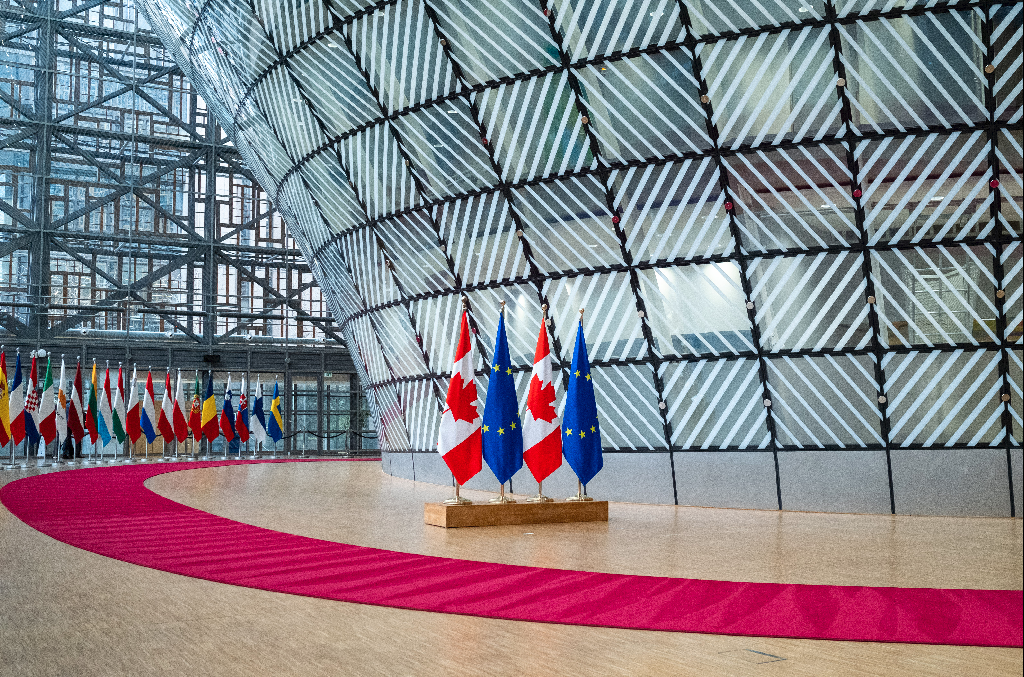
Photo: Flag during the meeting between Prime Minister of Canada Justin Trudeau and President of the European Council Antonio Luis Santos da Costa and President of the European Commission URSULA VON DER LEYEN in the European Council an institution of the European Union in Brussels in Belgium on 12th February 2025
Inside the European Parliament’s navy-blue chamber in Strasbourg, MEPs from the EU’s 27 member states listen as Ursula von der Leyen delivers her State of the Union address on 16 September 2026. Among the guests is Canadian Prime Minister Mark Carney. The European Commission president raises the prospect of a historic shift: bringing another country into the European family. Not quite as a full member, however. And the country in question is Canada. Von der Leyen proposes paving the way for the EU’s first-ever “associate member”.
“I believe that an associate membership agreement between Canada and the EU is a very realistic prospect,” Cynthia Ní Mhurchú tells The Liberty Bulletin in a written interview. The Irish MEP belongs to the Renew Europe political group and sits on the European Parliament’s delegation for relations with Canada. She supports deeper integration, provided that any additional benefits granted to Ottawa come with clear commitments.
Access to the single market: the main challenge
Renew Europe had already taken a position before von der Leyen’s speech. In a statement published on 14 September, the group led by Valérie Hayer called on the Commission to explore a strategic association under Article 217 of the Treaty on the Functioning of the European Union. Its proposals include completing the ratification of CETA, investing in strategic industries, strengthening cooperation against economic coercion and extending Erasmus+ opportunities to Canada.
Ní Mhurchú, meanwhile, focuses on the conditions under which Canada could gain greater access to the EU single market. “Access cannot simply be about enjoying the benefits; it must also involve respecting the rules, standards and obligations that underpin the market,” she explains. She points to Norway, which enjoys extensive access to the single market without being an EU member, while complying with common rules on competition, product standards and data protection.
For Canada, the MEP advocates a sector-by-sector approach, with enforceable commitments and oversight mechanisms proportionate to the level of market access granted.
She also highlights a revealing Canadian request. According to Ní Mhurchú, during a meeting of the parliamentary delegation, Mr Wilkinson, then Canada’s ambassadordesignate to the EU, expressed Ottawa’s ambition to receive treatment comparable to that of EU member states under the Industrial Accelerator Act. The proposed EU legislation, aimed at strengthening European industry, illustrates what is at stake: Canada wants greater access to the Union’s economic and industrial initiatives.
An agreement that is far from settled
The first obstacle is legal. “Associate membership” is not a status currently recognised under the EU treaties. An association agreement under Article 217 is possible, but its conclusion would require unanimous approval from member states in the Council, as well as the consent of the European Parliament, under Article 218. Von der Leyen’s announcement in Strasbourg therefore does not amount to automatic access to the single market, let alone a deal that has already been agreed.
CETA itself illustrates how difficult it can be to finalise commitments between the two partners. Provisionally applied since 2017, the trade agreement has yet to be ratified by every EU member state. Ní Mhurchú specifically points to Ireland, urging her own country to move forward with ratification.
On the Canadian side, Mark Carney welcomed the prospect of a closer alliance in his address to the European Parliament on 17 September. His speech focused primarily on the areas where Ottawa wants to strengthen cooperation, including defence, energy, critical minerals and technology. The precise terms of any future association, particularly which EU rules Canada would be prepared to adopt, remain unresolved.
A partnership extending beyond trade
Ní Mhurchú believes closer ties with Canada could also help Europe reduce its strategic dependencies and encourage Canadian investment in Ireland, particularly in pharmaceuticals, medical technology and renewable energy. She also supports broader mutual recognition of professional qualifications and greater opportunities for university exchanges.
“This is not about turning away from the United States or abandoning the transatlantic relationship,” she stresses. The MEP also believes a future agreement with Canada could provide a model for partnerships with Japan, South Korea or Australia, although each arrangement would need to reflect the specific commitments and circumstances of the country concerned.
The EU-Canada summit, scheduled for 29 and 30 October in Montreal, will provide the next opportunity to advance discussions. For Ní Mhurchú, the substance of the agreement matters more than its name. “We need to focus on what we can achieve together, rather than simply what we call the agreement.”
The central question remains unanswered: how much access is the EU prepared to offer Canada, and what obligations would Ottawa have to accept in return?