Blast in Pakistan Kills Seven as Regional Tensions, Drone Claims and Press Exile Spotlight Humanitarian and Security Risks
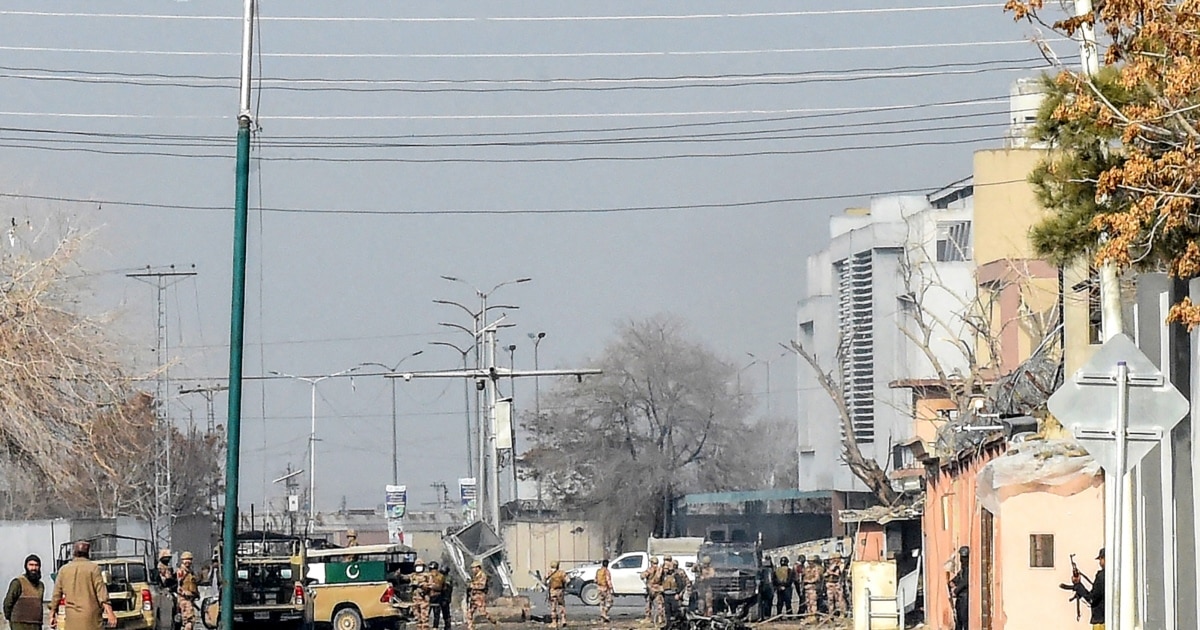
A powerful explosion in Bannu district of Khyber Pakhtunkhwa killed at least seven people after a bomb struck a private vehicle early on Saturday. The incident comes amid competing claims over drone strikes, Iran’s confirmation of naval mines in the Strait of Hormuz, stalled US–Iran technical talks in Switzerland and a continuing wave of Afghan journalists fleeing threats and persecution.
By Clémence Desjardins
926 views
A powerful explosion in the Bannu district of Pakistan’s Khyber Pakhtunkhwa province killed at least seven people early on Saturday after a bomb detonated against a private car, authorities said. The German news agency cited local officials reporting that the device was attached to the vehicle and exploded in the early hours of the morning. A local police official was quoted as saying: «لږ تر لږه اووه کسان وژل شوي او درې نور سخت ټپیان دي.» Security forces sealed off the area and launched an investigation. No group has claimed responsibility for the attack.
Pakistan’s Prime Minister Shehbaz Sharif condemned the bombing and reiterated his government’s commitment to fighting terrorism. The strike adds to ongoing instability along and across Pakistan’s western frontier, where competing claims of cross-border operations have heightened tensions between Islamabad and neighboring actors.
In separate developments, Taliban-linked sources and Pakistani officials offered conflicting accounts of recent drone activity. Sources close to the Taliban claimed that Taliban unmanned aircraft struck a major Islamic State Khorasan (ISIS-K) hideout in Khyber’s Bary area of Qambar Khail, saying the facility was precisely targeted and destroyed. Pakistan’s information ministry, however, denied that the Taliban carried out cross-border strikes and said it had shot down a Taliban drone over the Pakistani village of Shinko as it entered Pakistani airspace. The competing narratives underscore growing concerns about cross-border violence and the potential for diplomatic friction between Afghanistan’s de facto authorities and Islamabad.
Former U.S. special envoy Zalmay Khalilzad called for the reactivation of diplomatic ties between Afghanistan and Pakistan after reports of Taliban drone strikes inside Pakistani territory. His appeal reflects worries among diplomats and regional observers that without clearer channels of communication, such incidents could escalate and further endanger civilians.
The violence in the region coincides with broader maritime and diplomatic strains involving Iran. The Guardian, citing an Intertanko official, reported that the central lane of the Strait of Hormuz remains largely blocked by roughly 80 naval mines, forcing commercial vessels to use alternative northern and southern channels. Iran’s Revolutionary Guard Corps had closed parts of the strait earlier, and while the United States said it had lifted an effective maritime blockade after a temporary understanding was reached, Tehran’s Supreme National Security Council confirmed on Thursday the presence of naval mines in the waters of the Strait of Hormuz.
Iran’s statement said that, for reasons tied to “special circumstances and certain security risks,” vessels should traverse specified routes and timings determined by Iran while authorities gradually expand navigation options. The statement also said that issues such as “ماینونو پاکول” (mine clearance) would be addressed under the fifth clause of a U.S.–Iran understanding. Intertanko’s head, Phil Blecher, told the Guardian that even if a ceasefire held, returning the strait to pre-conflict normalcy will likely take significant time because of mines and other obstacles.
Diplomatic activity linked to the Iran crisis has been turbulent. The U.S. envoy Steve Witkoff and Iran’s deputy foreign minister Abbas Iraqchi were reported to be en route to Switzerland for technical talks, a move that followed a temporary ceasefire between Israel and Lebanon’s Hezbollah that raised hopes of broader regional de-escalation. Reuters and Axios reported that interruptions to high-level travel — including a cancelled trip by U.S. Senator J D Vance — had created uncertainty about the negotiations’ timing. Axios said Witkoff planned to meet Jared Kushner in Switzerland, and Iran’s Abbas Iraqchi was also expected to travel. However, Swiss authorities later said talks scheduled for the day were canceled, and Tehran’s state-adjacent Tasnim news agency had reported that Iranian negotiators wanted evidence of U.S. implementation before proceeding with new rounds of discussions.
Amid the conflict and diplomatic maneuvering, human rights groups say civilians, and particularly media workers, continue to suffer. Reporters Without Borders (RSF) said in a new report timed to International Migrants Day that no country has seen as many journalists forced into exile as Afghanistan. Between 2021 and 2025, RSF said at least 677 Afghan journalists fled their country because of threats, arrests or risk of death — nearly half of the 1,468 journalists the organization assisted over the same period. The report said these journalists are now living in 28 countries, a figure that makes Afghanistan “the world capital of journalists’ exile.” RSF also noted that 160 Russian and 101 Myanmar journalists received support during the same timeframe.
Other migration and protection concerns surfaced in Europe. Afghan interpreters who worked with Dutch forces and government missions have urged the Netherlands to exempt them from parts of the European Union’s new asylum rules, after receiving notice they would no longer be offered the long-term protection they had expected. Dutch media reported that the interpreters were told they would receive three-year residence permits instead of permanent status. The interpreters argue that because they lost security, livelihoods and futures in Afghanistan through their cooperation with Dutch missions, the Netherlands has a moral obligation to provide a stable, durable form of protection.
Meanwhile, a senior Kazakh delegation led by the country’s deputy prime minister and minister of national economy arrived in Kabul to open an Afghan–Kazakh trade and economic forum and inaugurate an exhibition of Kazakh products. The Taliban’s ministry of industry and commerce said the visit aims to expand bilateral economic links, facilitate private sector trade, and market Kazakh goods in Afghanistan. Kazakhstan has not recognized the Taliban government formally but has increased economic and trade engagement with Afghanistan over the past two years.
Taken together, the developments reported from Pakistan, Afghanistan, Iran and international capitals illustrate an overlapping set of security, diplomatic and humanitarian challenges. A deadly car-bombing in Bannu highlights continuing threats to civilians inside Pakistan; divergent accounts of drone strikes and cross-border operations increase the risk of escalation; Iran’s declared minefields in the Strait of Hormuz complicate global shipping and raise the specter of prolonged maritime disruption; and the forced exile of hundreds of Afghan journalists underscores the ongoing human rights consequences of regional instability.