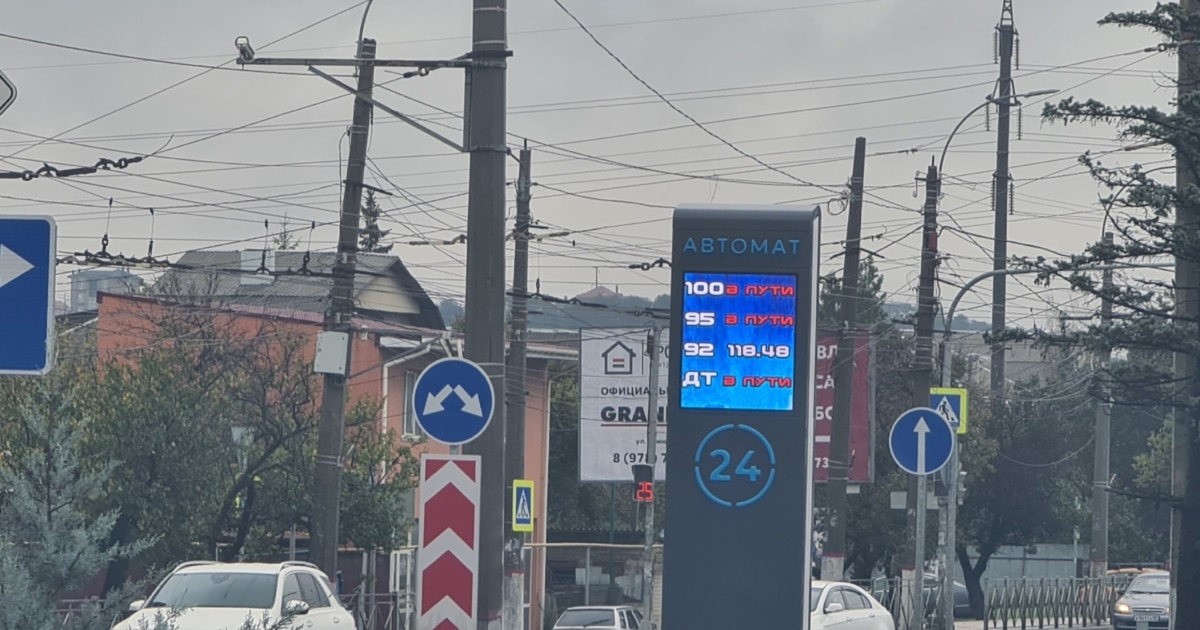
Blackouts in Russian-occupied Crimea Spur Acute Petrol Shortages as Residents Rely on Generators
A widespread power outage across Russian-occupied Crimea on November 3 has driven a surge in demand for petrol for household and building generators, deepening fuel shortages at many filling stations. Regional head Sergey Aksyonov said the restrictions on electricity supply followed a nighttime strike on energy infrastructure beyond the peninsula, but residents and users on social media sharply criticized the authorities’ planning and communications.
By Clémence Desjardins
1,159 views
A fresh wave of power outages across Russian-occupied Crimea on November 3 has created a rapid and severe increase in local demand for petrol, as households and buildings turn to generators to maintain electricity. Reporters from Krym.Realii said that by midday many petrol stations across the peninsula had run out of fuel, and even outlets belonging to ATAN, the largest fuel company operating in Crimea, were reported to have no petrol available.
Residents and local activists described the situation as alarming, particularly with winter approaching. An anonymous Crimean public figure told Krym.Realii that generators were running across the peninsula, even in central Simferopol where power had previously been relatively stable. ‘‘On this background petrol is vanishing rapidly: many people are stocking up and buying fuel for generators,’’ the activist said, adding that energy supplies in Crimea remain unstable and that occupants of multi-storey, gasless buildings were particularly worried about how they will cope.
Russian-installed head of Crimea Sergey Aksyonov announced that restrictions on electricity supply had been introduced. He framed the measures as a response to ‘‘a nighttime attack by the enemy on energy infrastructure outside the peninsula,’’ and said repair work was underway. ‘‘Energy workers are doing everything they can to quickly eliminate the consequences of the attack and restore power supply,’’ Aksyonov wrote in a social media post.
Aksyonov’s post prompted vocal criticism from his followers and local residents, who accused regional authorities of failing to provide adequate planning, transparent schedules or civil protection measures. One commenter, identified as Darina Shlomina, wrote that people had shown patience but lacked understanding of the situation. She asked why an emergency operations headquarters had not been convened and why clear, fair schedules for electricity and water supply had not been published, arguing that better information would increase public tolerance. She also praised field technicians for their work but said ‘‘there are many questions for your clerks’’ whose negligence, she suggested, was making the crisis worse.
Another resident, Anastasia Obrucheva, warned that the outages have dragged on since summer and called the current season ‘‘deep autumn,’’ stressing that children are at home without heating and reliable communications. ‘‘Why were contingency plans not developed, why is there no additional power source?’’ she asked in comments responding to Aksyonov’s announcement.
Krym.Realii also reported that overnight on November 3 explosions were heard in several districts of the peninsula and an air-raid alert was declared; Russian air defenses were activated. Following those events, much of the Crimean peninsula experienced a loss of power.
The unfolding situation has intersected with broader concerns about press freedom and access to information. Roskomnadzor, Russia’s federal communications regulator, has been attempting to block access to the Krym.Realii website inside Russia, and readers were directed to a mirror site and advised to follow the outlet on Telegram, Instagram and Viber or to use a VPN to access coverage. Radio Svoboda and Krym.Realii have previously been branded ‘‘undesirable’’ organizations in Russia.
The combination of recurring blackouts, an acute shortage of petrol for generators and constrained access to independent reporting has heightened unease among residents of the occupied peninsula. The immediate humanitarian concerns include heating, water and communications for apartment buildings that lack gas heating, and the prospect of a difficult winter if energy supply and contingency measures are not substantially improved.