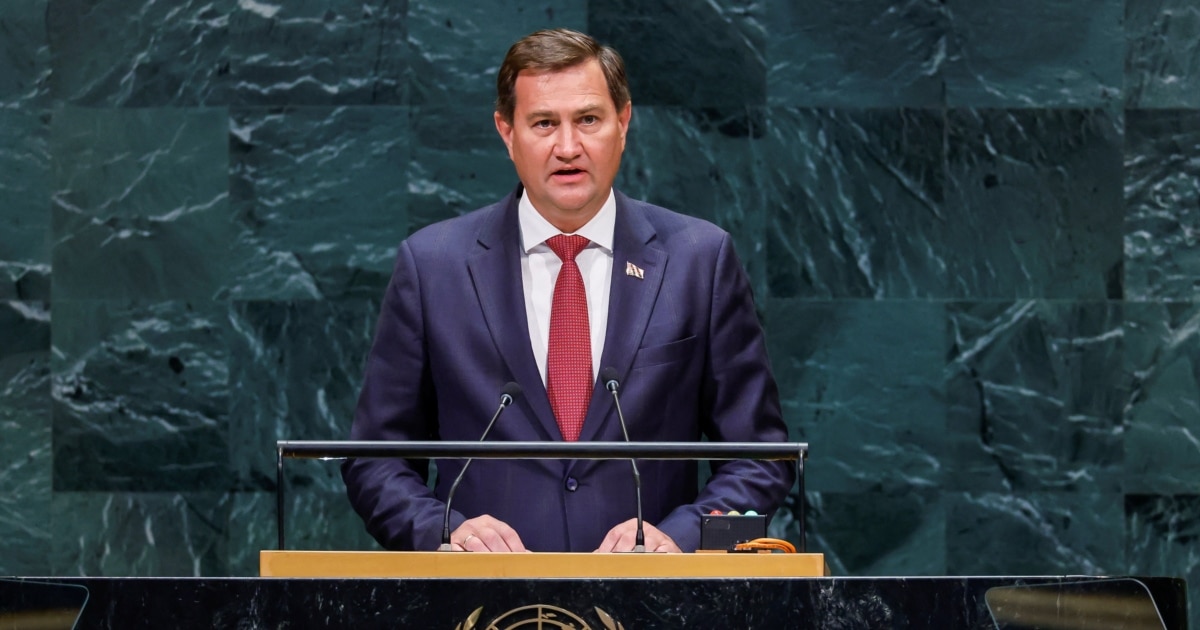
Belarus foreign minister tells UN that Europeans could become 'cannon fodder', advances pro‑Russia, anti‑West line
Speaking to the United Nations on September 26, Belarusian Foreign Minister Maksim Ryzhankov delivered a speech strongly siding with Russia and sharply critical of Western policies. He warned Europeans they could be turned into "cannon fodder," urged against arming Ukraine, accused Western elites of clinging to unipolar dominance, and denounced international bodies for allegedly fomenting unrest.
By Alexander Walter
1,157 views
On September 26, Belarusian Foreign Minister Maksim Ryzhankov addressed the United Nations with a speech that combined pro‑Russian messaging and strident criticism of the West. In remarks that echoed Kremlin narratives about NATO expansion, Minsk accords and Western ‘‘elite’’ behavior, Ryzhankov warned Europeans that the pursuit of what he called a revenge against Russia could turn them into "cannon fodder." The speech included appeals to halt arms supplies to Ukraine and denunciations of international institutions that, he said, meddle in sovereign affairs.
Ryzhankov directly accused European Union leadership of pursuing policies that jeopardize global stability and the welfare of their own citizens. ‘‘The politics of the EU leadership is particularly worrying: through an unrestrained desire to preserve a sinking dominance, it is trying to obstruct global stability and the maintenance of peace. And to achieve this goal it is ready to sacrifice even the well‑being of its own citizens,’’ he told the UN assembly. He posed rhetorical questions about whether the peoples of Europe seek revenge against Russia or wish to become ‘‘cannon fodder’’ in conflicts allegedly prepared by European politicians.
The minister continued by arguing that Western elites resist a multipolar world because their influence would no longer be decisive, and that instead of adapting to change they deliberately use instability as a tool. He specifically cited Ukraine as an example of this approach, contending that the EU’s stated objective there is to inflict a ‘‘civilizational defeat’’ on Russia—‘‘to weaken, humiliate, break and continue to live off Russian resources,’’ he asserted.
Ryzhankov also criticized the International Labour Organization, accusing it of trying to turn trade unions into revolutionary forces in the tradition of the Communist International. ‘‘Today the International Labour Organization, in the best traditions of the Communist International, is trying to foster revolutionary forces out of trade unions, not in some countries to protect the rights of workers, but to, at the behest of certain countries, rock the situation in states conducting an independent policy,’’ he said.
On the conflict in Ukraine, Ryzhankov reiterated points central to Belarusian and Russian diplomatic lines: that a sustainable peace is impossible without addressing the root causes he identified, including NATO’s plans to include Ukraine despite security realities and the alleged failure to implement the Minsk agreements, which he described as the only legitimate path to peace. He warned that continuing to arm Ukraine ‘‘to the point’’ will destroy Ukraine and its people, and called for immediate meaningful negotiations that would lead to a stable peace.
The speech comes amid ongoing international scrutiny of Belarus’s role in Russia’s full‑scale invasion of Ukraine. Belarusian leader Alexander Lukashenko and Belarus’s military leadership supported Russia’s military action on February 24, 2022, and Belarus allowed Russian forces to use its territory, military facilities and airspace in the invasion and in strikes on Ukrainian cities. Those actions prompted international sanctions against Belarus for facilitating Russia’s aggression.
Ryzhankov’s remarks are likely to amplify concerns among Western governments and human rights advocates about Minsk’s alignment with Moscow and its rhetoric toward Europe. By framing the West as intent on revenge and depicting international organizations as instruments of destabilization, the speech reinforces a narrative used to justify restrictive measures and to delegitimize independent civil society and labour groups in Belarus and other countries.
Observers note the diplomatic implications of such statements at the UN, where member states expect high‑level representatives to adhere to norms of international discourse. The speech may harden positions in multilateral fora, complicate efforts to reach international consensus on sanctions or accountability measures, and make it more difficult to secure cooperative steps toward conflict resolution. Ryzhankov’s call for negotiations echoes the stated desire for talks, but his framing places responsibility for the conflict on Western policies, underscoring the deep divisions that continue to define diplomatic debates over Ukraine and regional security.