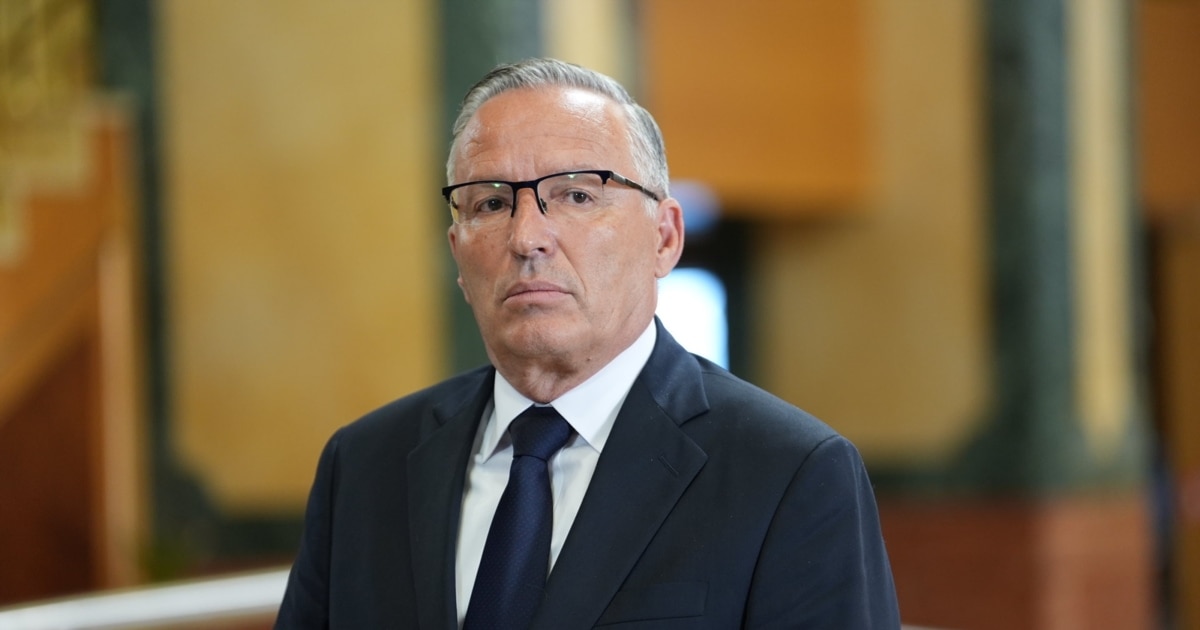
Bedri Hamza resigns as chairman of Kosovo's Democratic Party (PDK) less than a year after taking charge
Bedri Hamza announced his irrevocable resignation as chairman of the Democratic Party of Kosovo (PDK) at a press conference, saying he will remain a loyal party member and voter. He criticized the September 16 convictions by the Kosovo Specialist Chambers as a grave injustice, called for internal party elections to open space for younger members, and did not specify a timetable for the leadership contest.
By Christopher Manley
935 views
Bedri Hamza announced on [date of conference] that he has tendered his irrevocable resignation as chairman of the Democratic Party of Kosovo (PDK), stepping down less than a year after assuming the party's top post. Speaking at a press conference, Hamza said the decision was carefully considered and framed it as a move intended to allow internal party elections to create space for younger members to contribute to the PDK, Kosovo’s second-largest political force.
Hamza was emphatic that his resignation applies only to the position of party chairman, not to his commitment to the party’s values. “I am not leaving the PDK. I am leaving only the position of chairman, but not my belief in our political values,” he said. He added that as long as he lives he will remain a loyal PDK voter and member of the party, and that he stands ready to contribute to it in the future.
The outgoing chairman did not provide specifics on when the internal election process to choose his successor would take place. He expressed confidence that a properly run internal contest would result in a stronger, more consolidated party, and insisted that the process should open opportunities for younger politicians within PDK to take on leadership roles.
Hamza’s resignation comes amid a turbulent period for the party following the Sept. 16 convictions by the Kosovo Specialist Chambers in The Hague. At the press conference Hamza said he had expected that, after Sept. 16, the party’s leadership mantle would fall back to former PDK and Kosovo Liberation Army (UÇK) leaders who were subsequently convicted in the first-instance verdicts by the specialized tribunal. He described the guilty verdicts against former president Hashim Thaçi, former parliamentary leader Kadri Veseli, former parliament speaker Jakup Krasniqi and former MP Rexhep Selimi as “a great injustice against the people of Kosovo.”
Hamza characterized Sept. 16 as “one of the darkest days of my life, one of the darkest days for Kosovo,” while also saying that efforts to seek justice will continue. His remarks underscore the deep political and emotional repercussions that the Specialist Chambers’ decisions have had within Kosovo’s political parties and among segments of the electorate.
Hamza took over the leadership of the PDK on Nov. 17, 2025, shortly after Memli Krasniqi resigned as party leader. He had been elected at a party convention without an opposing candidate; Enver Hoxhaj had earlier signaled interest in running but ultimately did not take part, citing what he described as “unequal conditions” and having requested the convention be postponed by a week.
During his tenure, Hamza led the PDK through a sequence of three national ballots earlier this year and in 2025. He was the party’s candidate for prime minister in the February and December 2025 elections and in the June 2026 vote. In all three contests, the PDK finished as the second-largest party behind the ruling Vetëvendosje movement led by Prime Minister Albin Kurti. Under Hamza’s leadership, PDK’s vote share stood at 20.95 percent in February 2025, 20.19 percent in December 2025, and 19.44 percent in June 2026.
Reflecting on those repeated electoral cycles, Hamza said his mandate was not a typical one: the frequency of elections, he argued, did not leave sufficient time for internal consolidation and for implementing longer-term plans to renew and strengthen the party.
Prior to becoming PDK chairman, Hamza served in senior government and municipal roles, including as Kosovo’s finance minister and as mayor of South Mitrovica. His resignation sets the stage for an internal leadership contest within PDK at a sensitive moment for the party and for Kosovo politics more broadly, as the aftermath of the Specialist Chambers’ verdicts continues to reverberate through public institutions and political life.
Radio Evropa e Lirë contributed reporting to this article.