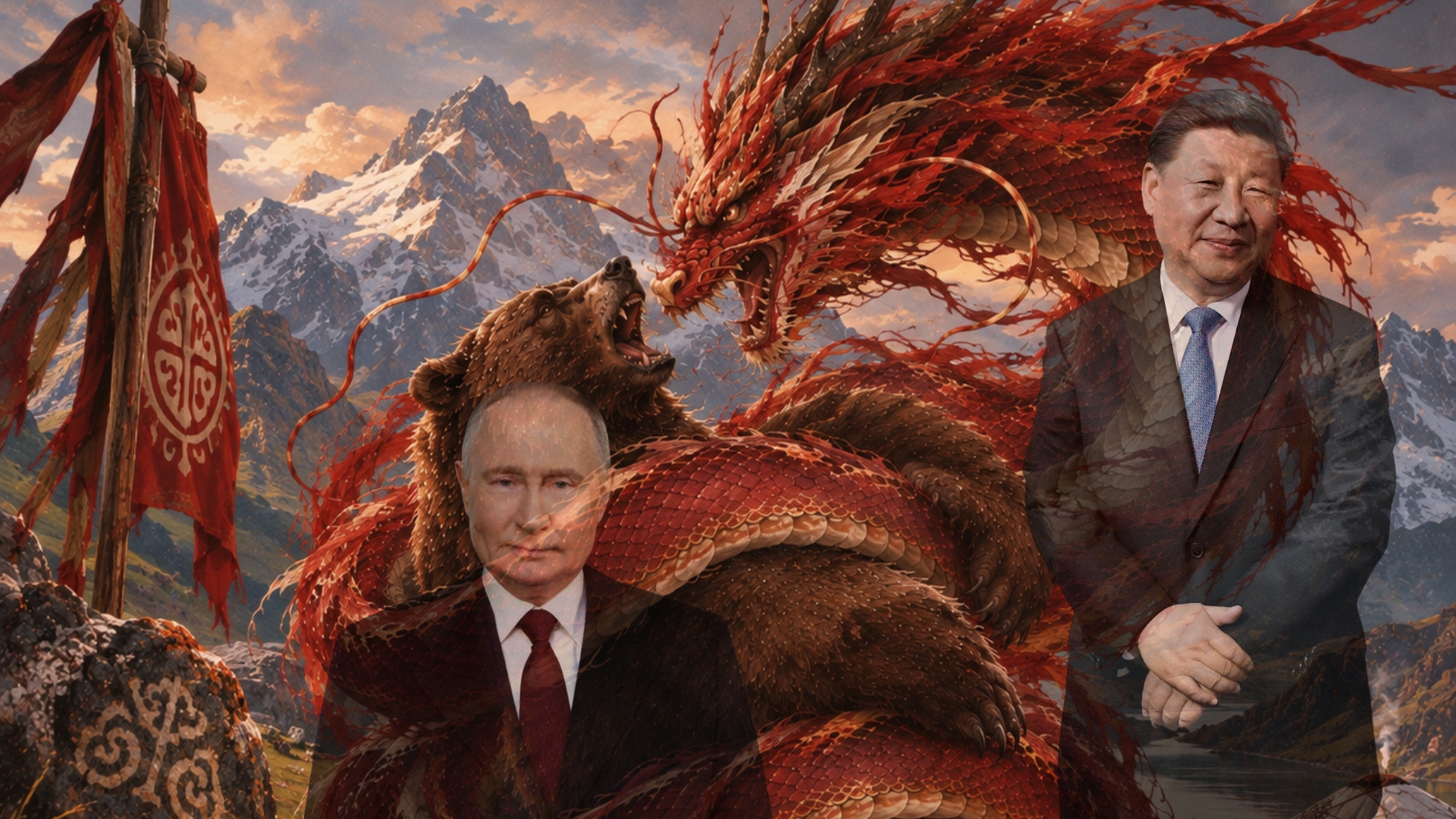
Bear in the Dragon’s Embrace: How China Is Encroaching on Russia’s Position in Central Asia
The Shanghai Cooperation Organisation summit in Bishkek, coinciding with Chinese President Xi Jinping’s state visit, highlighted Beijing’s expanding economic and political clout across Central Asia and signaled a relative diminishment of Russian regional authority. In Kyrgyzstan in particular, Beijing’s rising influence is translating into closer cooperation on media and ethnic-policy matters even as authorities arrest and threaten critics of Chinese investment and migration ahead of presidential elections.
By Alexander Walter
858 views
The Shanghai Cooperation Organisation (SCO) summit in Bishkek this year — held concurrently with Chinese President Xi Jinping’s state visit to Kyrgyzstan — became a visible marker of China’s expanding influence in Central Asia and of a relative decline in Russia’s once-dominant role. While the summit produced no dramatic breakthroughs, it underscored Beijing’s growing international weight: SCO+ participation reached a record level, and leaders approved a regional ports and logistics development plan for 2026–2030 that binds the interests of China, Central Asian states, the EU, the United States, Azerbaijan and Turkey.
Analysts say that China is broadening its footprint beyond transport corridors to digital infrastructure and security-related cooperation. Kazakh political scientist Dosym Satpaev described the trend as a patient, non-confrontational expansion: “Like a boa constrictor, China is gradually swallowing the economic space of the EAEU and the military-political field of the CSTO,” he said, pointing to recent increases in SCO membership — including Belarus — and the organization’s expanding role at the expense of Russian-led blocs.
The change in relative influence was evident in the summit’s diplomatic dynamic. Before 2022, Russian President Vladimir Putin chaired SCO summits and was a founding, system-shaping leader. Since Russia’s full-scale invasion of Ukraine, Putin has appeared to lose some of that authority: other leaders have met him with less deference, and several pressed him directly on his war in Ukraine. Indian Prime Minister Narendra Modi again urged Putin to end the “endless war,” Kazakhstan’s Kassym-Jomart Tokayev said he did not understand the reasons for it, and Armenia’s Prime Minister Nikol Pashinyan declined to endorse a referendum proposal on choosing between the EU and the EAEU.
At the same time, Beijing’s economic penetration has deepened. In 2025 China became the top trading partner for all five Central Asian republics, with bilateral trade reaching a record $106.3 billion. The region is also buying increasing amounts of Chinese military hardware. Those economic ties are converting into political leverage, most visibly in Kyrgyzstan, where bilateral documents signed by Xi and President Sadyr Japarov mention a “Memorandum on interaction in the field of ethnic issues,” a “Program for cooperation in human resources development,” and an “Agreement on cooperation in television, broadcasting, media content and online audiovisual media.” The texts have not been published, but officials and experts say they signal Beijing’s desire to shape Kyrgyz public discourse and blunt criticism.
Kyrgyz public opinion is already sensitive to Chinese influence. The government’s external debt to China remains substantial: the Finance Ministry estimates Beijing’s share of Kyrgyz external debt at 27%, while the Chinese ambassador places it at 36%. Although the debt has declined by about $300 million since 2021, anxieties persist that Chinese investors could take control of assets built on credit. Social tensions are fueled by the growing number of Chinese workers: between January and June 2026 Kyrgyz authorities issued roughly 61,000 work visas, about 60% of which went to Chinese citizens. Critics also point to disputes over land and property purchases and reports of Chinese companies importing labor rather than hiring locals.
Those tensions have intersected with a pattern of state pressure on critics. In June, activist and politician Mavlan Askarbekov was arrested under Article 330 of the Kyrgyz Criminal Code — “incitement of enmity” — after criticizing the influx of Chinese workers. Later arrests included activist Azamat Bayamanov, detained on charges of organizing mass unrest for criticizing 49-year land leases to foreign investors. The presidential press secretary, Dairbek Orunbekov, publicly posted personal data of citizens he accused of spreading false information about Chinese activity and threatened legal action against several groups. President Japarov has accused “external and internal forces” of stoking anti-Chinese sentiment and ordered security services to punish “enemies of the people,” rhetoric critics say risks criminalizing legitimate protest and dissent.
Experts see Beijing as accommodating — even encouraging — a more authoritarian approach in exchange for guarantees that Chinese assets and projects will be protected. Timur Umarov of the Carnegie Berlin Center argues that China values stable partners in Kyrgyzstan who will ensure protection of Chinese investments and endorse Beijing’s regional ambitions. Agreements on media cooperation, Umarov notes, appear designed to improve China’s reputation in Kyrgyzstan and limit negative coverage — a development with clear implications for freedom of expression.
Despite the momentum of Chinese influence, Russia remains a major security actor across Central Asia, and many analysts caution against overstating Beijing’s readiness to replace Moscow as guarantor of regional regimes. China lacks the deep informal networks and shared language with local elites that have long underpinned Russia’s role. Nevertheless, the convergence of economic penetration, media cooperation pacts and a pattern of arrests and threats against critics in Kyrgyzstan points to an evolving balance: Beijing is converting economic ties into political leverage, and authorities in Bishkek are tightening the space for dissent at a moment when regional alignments are shifting and Kyrgyzstan prepares for presidential elections on 24 January 2027.
For observers of human rights and press freedom, the developments in Bishkek offer a cautionary example of how external economic influence and domestic political consolidation can combine to erode civic freedoms. The suite of signed agreements, the rhetorical support offered by Xi for a “strong state,” and the criminal prosecutions of activists and journalists signal growing constraints on independent voices in a country with a long history of public protest and plural politics.