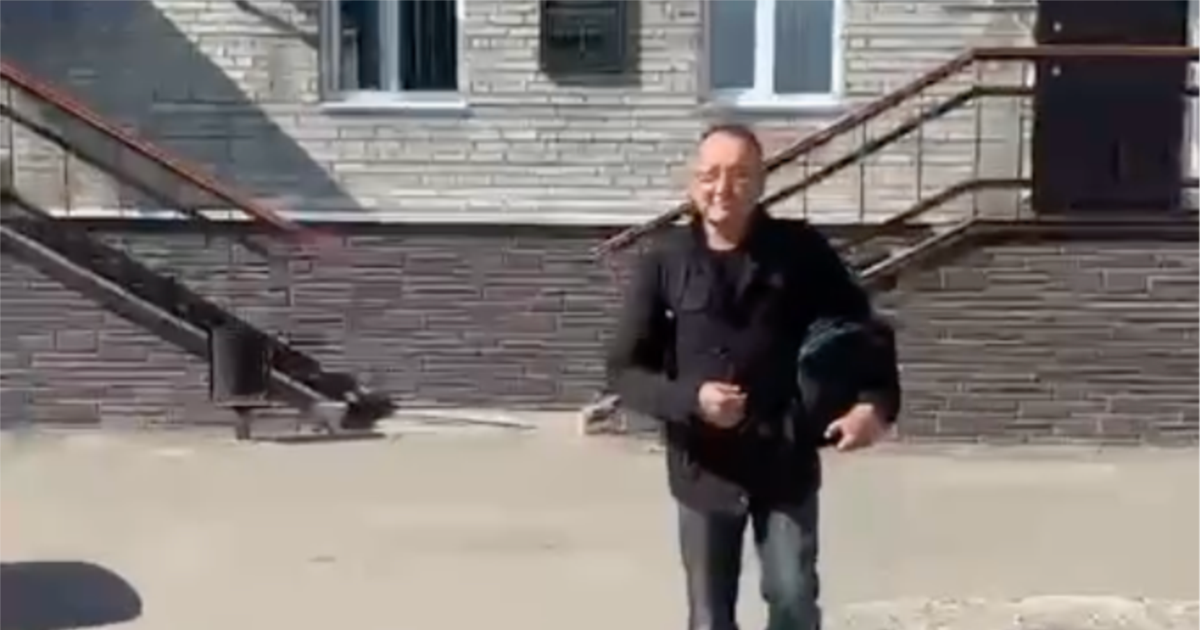
Bashkort Opposition Journalist Ayrat Dilmukhametov Released After More Than Seven Years Behind Bars
Ayrat Dilmukhametov, a 60-year-old Bashkort publicist and political activist, was released from a strict-regime penal colony and has returned to Ufa after more than seven years in detention. Convicted in 2020 on a range of charges from calls for extremist actions to alleged advocacy of terrorism, his case was denounced by rights groups and found to involve rights violations by the European Court of Human Rights.
By Clémence Desjardins
1,151 views
Ayrat Dilmukhametov, a veteran Bashkort publicist and opposition activist, returned to his native Ufa on September 11 after being released from a strict-regime penal colony where he had been held for more than seven years. Dilmukhametov, who turned 60 in June, had been serving a nine-year, six-month sentence imposed by a military court in 2020.
Security services detained Dilmukhametov in March 2019, and the Kirov district court in Ufa placed him in custody. Investigators brought charges under provisions of the Russian Criminal Code related to calls for actions aimed at violating Russia’s territorial integrity (Article 280.1) and later under articles alleging extremist activity and offences linked to terrorism. Authorities point to a video message he sent to an opposition “Free Russia Forum,” comments he made on the Ufa radio station Echo of Moscow in May 2018, and public remarks about trials of alleged members of the banned organization Hizb ut-Tahrir in Ufa in November 2018.
Prosecutors additionally accused Dilmukhametov of using the internet to openly justify or promote terrorism; that charge was later edited in the case file from "open justification" to a formulation of "propaganda of terrorism." In January 2020, authorities opened a separate probe alleging he financed extremist activity. In August 2020 a Samara military court found him guilty and sentenced him to nine years and six months in a strict-regime penal colony. The sentence also included a three-year prohibition on operating internet pages.
Dilmukhametov has long maintained that his prosecution was politically motivated and that he was targeted for criticizing the federal government and what he called exploitative practices toward Russia’s regions. He told the court and supporters that he had been imprisoned previously on political grounds, saying he had become "a political prisoner three times" and expressing pride in resisting what he described as unchecked state power.
Rights groups condemned the conviction. The Russian rights organization Memorial designated Dilmukhametov a political prisoner in 2019. Human Rights Watch publicly criticized the case, with Rachel Denber, deputy director for Europe and Central Asia at the organization, saying in a statement that peaceful and lawful expression should not be criminalized under terrorism or anti-extremism laws. Denber warned that poorly drafted laws on terrorism and extremism have been used to prosecute people who did not call for or engage in violent acts.
Dilmukhametov’s legal appeals failed. His lawyers appealed the sentence and in June 2021 the criminal cases panel of Russia’s Supreme Court upheld the conviction. During his detention he served time in a colony in Chita (colony No. 5 in the Trans-Baikal region) before being moved to a strict-regime penal colony in Minusinsk, Krasnoyarsk Krai, where he had been held since 2023. Reports from his relatives indicate that prison authorities repeatedly disciplined him for allegedly violating internal rules.
His family and supporters described the hardship of the campaign to visit him in remote colonies. His 84-year-old mother, Agilash Dilmukhametova, who worked as a doctor in Ufa for most of her life, was unable to travel to see her son in the distant facilities and said she had not seen him since his 2019 court hearings. She publicly spoke about the years of worry, expressing a simple wish to see her son alive and to embrace him when he returned.
European human rights bodies have found shortcomings in the Russian authorities’ handling of Dilmukhametov’s case. In June 2022 the European Court of Human Rights (ECHR) concluded that Russian authorities had violated his rights and awarded him 3,100 euros in compensation. In a subsequent ruling at the start of 2025 the ECHR again found violations of his freedom of expression and ordered Russia to pay 7,500 euros. Those decisions add international scrutiny to a prosecution that domestic critics have decried as part of a broader pattern of repressing dissent.
Journalists and activists in exile, including journalist Ruslan Valiev, hailed Dilmukhametov’s release as the freeing of one of Russia’s foremost political prisoners. Supporters said his experience and knowledge of both regional and federal issues make him an important voice for public debate. Dilmukhametov’s release will likely be followed closely by rights monitors and opposition circles who consider his case emblematic of the use of counter-extremism and terrorism laws against peaceful critics.
For now, the returning activist faces the practical challenges of rebuilding life after long imprisonment. His family and allies have expressed relief at his return to Ufa and the hope that he can recover from years in harsh penitentiary conditions. The international rulings in his favor mean that, in addition to the personal ramifications of his release, the case will remain a point of contention in discussions about freedom of expression and the application of anti-extremism and counterterrorism laws in Russia.