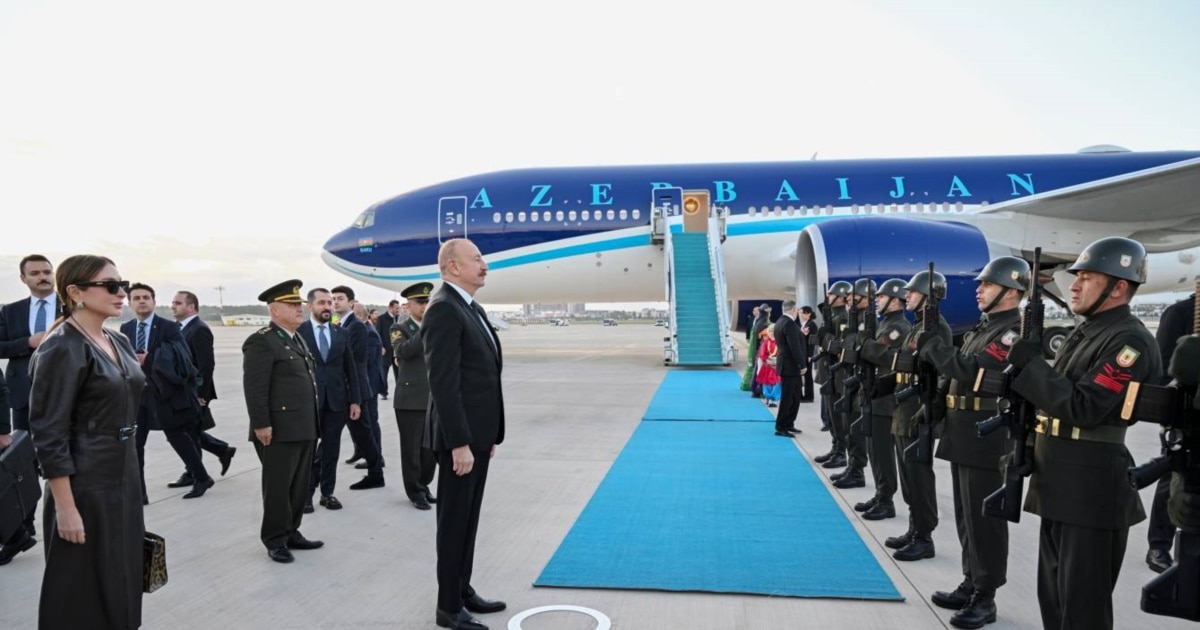
Azerbaijan’s President Travels to Turkey for COP31 Summit amid Recent Bilateral Tensions
President Ilham Aliyev arrived in Turkey on November 10 to participate in the COP31 Leaders Summit in Ankara at the invitation of President Recep Tayyip Erdoğan. The trip follows months of intermittent strain between Baku and Ankara, sparked by diplomatic disagreements over responses to an Israeli leader’s UN appearance and changes to school uniform rules that affected the wearing of the headscarf.
By Christopher Manley
1,033 views
Azerbaijan’s President Ilham Aliyev travelled to Turkey on November 10 to take part in the Leaders Summit of the United Nations Framework Convention on Climate Change (COP31), which Turkey is hosting. State news agency AZERTAC reported that Aliyev accepted an invitation from Turkish President Recep Tayyip Erdoğan to attend the summit, with the leaders’ segment scheduled to take place on November 11 and 12.
The visit comes against the backdrop of an intermittent cooling of relations between the two close allies. Aliyev did not attend the Turkic Council (TDT) 13th Summit in Ankara on October 29–30, a notable absence that many political analysts linked to mounting disagreements between Baku and Ankara in recent months. Observers said that tensions surfaced at both official and unofficial levels, producing public criticisms and reciprocal accusations.
Two episodes in particular drew attention and contributed to the strain. At the United Nations General Assembly session in September, when Israel’s prime minister addressed the assembly, many delegations left the hall in protest but Azerbaijani representatives remained. That decision provoked objections in some Turkish circles. Separately, a change in Azerbaijan’s school uniform policy that affected the wearing of the headscarf became a flashpoint. Critics in Turkey accused Azerbaijan of cooperating with Israel and of taking steps that would prevent students from wearing the hijab to school, thereby raising concerns about religious freedom and the rights of Muslim girls.
The exchanges included public commentary from Turkish presidential adviser Oktay Saral, who wrote on the social platform X that "the right to education should not be sacrificed to ideological interference." The ruling New Azerbaijan Party responded sharply, arguing that "the use of sensitive issues such as the headscarf as a tool for political manipulation and division serves neither the unity of the Turkish people nor the solidarity of the Muslim world." Saral later resigned, and Ankara issued more conciliatory signals toward Baku. In the aftermath, Azerbaijan was represented at the Turkic Council summit by its foreign minister rather than by President Aliyev.
Despite those frictions, relations took a more positive turn in early November. Turkish President Erdoğan attended Azerbaijan’s Victory Day commemorations on November 8, marking the end of the 44-day 2020 Nagorno-Karabakh war, and both leaders issued affirming statements. Aliyev said, "we will not allow anyone to come between us or to cast a shadow over our unity, brotherhood and solidarity for personal interests," while Erdoğan said that relations between Turkey and Azerbaijan "have stood the test of time." Those gestures appeared to open a path toward resumed engagement and may have set the stage for Aliyev’s participation in the climate summit.
Aliyev’s attendance at COP31 is significant for several reasons. The summit is a major international forum and provides a platform for leaders to engage bilaterally on the sidelines. For Baku and Ankara, the meeting offers an opportunity to reassert cooperation on regional and global issues, to manage recent disagreements, and to clarify positions on sensitive domestic policies that have stirred cross-border public debate—particularly over religious dress and educational policy. It also underscores how domestic policy changes can spill over into diplomatic relations and public discourse between allied states.
Observers will be watching for any statements or joint actions by the two presidents during the COP31 Leaders Summit that could indicate whether the recent conciliatory gestures mark a lasting rapprochement or a temporary easing of tensions. For now, state reporting frames Aliyev’s trip as a continuation of high-level engagement with Turkey and with international climate diplomacy, while the underlying disputes that surfaced earlier this year remain part of the bilateral context to be addressed.