Attendees and Republicans Criticize Security Lapses After Attempted Assassination at White House Correspondents’ Dinner
An attempted assassination at the 2026 White House Correspondents’ Dinner prompted sharp criticism from Republican attendees who say hotel lobby screening and ID checks were insufficient, as authorities identify the suspect and describe writings that indicate a politically motivated attack.
By Drew Hernandez
821 views
Republicans and several attendees at the 2026 White House Correspondents’ Dinner are sharply criticizing what they describe as dangerously lax security after an attempted assassination at the Washington Hilton forced President Donald Trump, the first lady, and senior officials to be rushed from the ballroom. Shots were fired near a security checkpoint outside the main event space, prompting immediate concern and debate over access controls at the high-profile gathering.
Authorities have identified the suspect as 31-year-old Cole Tomas Allen of Torrance, California. Investigators say Allen charged a Secret Service screening area outside the main ballroom armed with a shotgun, a handgun, and multiple knives. During the incident, a Secret Service agent was shot in the chest; the agent survived, officials said, because the ballistic vest he was wearing stopped the round. The suspect was tackled after the shooting and taken into custody.
Law enforcement officials have described writings attributed to Allen — including a manifesto and social media posts — that criticized Trump administration policies, contained anti-Trump and anti-Christian rhetoric, and referred to himself as the “Friendly Federal Assassin.” Those materials, investigators say, indicated an intent to target Trump officials, likely including the president, and authorities are treating the case as a politically motivated assassination attempt.
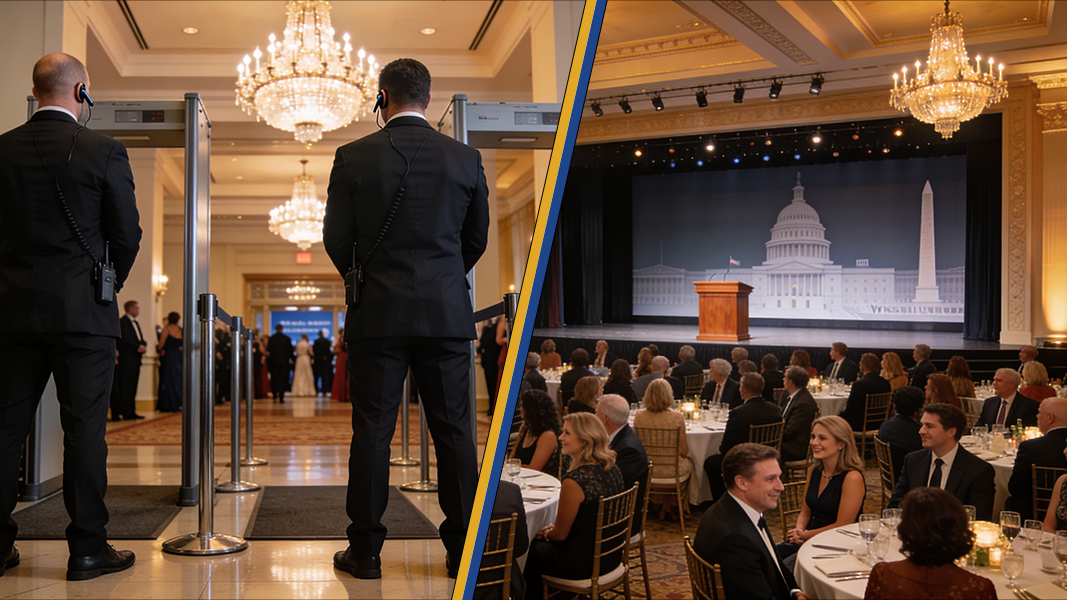
Even before shots were fired, several attendees reported alarm at what they characterized as minimal ID checks and security screening in the hotel lobby. According to multiple accounts, guests could enter the Washington Hilton and move toward pre-event areas without bag checks or metal detectors until just before they reached the secured ballroom. That perceived gap in security has become a focal point of Republican complaints in the aftermath of the attack.
Conservative commentator Kari Lake, who attended the event, wrote on X that she “can’t believe how lax the security was at the White House correspondents dinner tonight,” saying that when she arrived, “nobody asked to visibly INSPECT my ticket nor asked for my photo identification.” Lake reiterated in interviews that the setup felt shockingly exposed given the presence of the president, vice president, and Cabinet members.
Fox News correspondent Bill Melugin described a similarly cursory screening, saying he flashed his ticket and was “waved through in one second” without having his name checked against a list, shown ID, patted down, or sent through a metal detector. Melugin warned that if someone had hidden an explosive in a shoe or jacket, they might have reached packed pre-party ballrooms with no additional screening. Other Republican allies pointed to reports that there were “no checkpoints to get into the hotel” and “no real buffer” between public hotel spaces and VIP areas, arguing that a gunman was effectively able to roam near a room containing the president and much of the presidential line of succession before confronting the Secret Service barrier.
Rep. Anna Paulina Luna posted on X that security at the event was noticeably relaxed and that multiple attendees had reported inadequate protection; her post has since been deleted. Her comments reflect a broader Republican narrative blaming insufficient physical screening and hotel access controls for creating the circumstances that allowed the suspect to approach a Secret Service checkpoint with multiple weapons.
The attempted attack and the subsequent critiques raise immediate questions about protocols for securing venues that host top government officials. Authorities have said they are treating the incident as a politically motivated assassination attempt based on writings attributed to the suspect; beyond that, officials have not publicly detailed whether a formal review of Secret Service procedures or the Washington Hilton’s security practices will be launched. Republican calls for accountability and for an examination of how the suspect gained access to areas near high-level officials are likely to intensify as more information becomes available.
For now, the incident has underscored the vulnerabilities critics say can exist when public hotel spaces are used for events attended by the president and other senior officials. It has also highlighted the potentially life-saving role of ballistic protection for agents on duty, given that the shot to the chest did not prove fatal. Authorities continue to investigate the suspect’s writings and social media activity to establish motive, and further details are expected as the investigation proceeds.
The attempted assassination and ensuing debate over security procedures are likely to have political and operational consequences. Republican officials and media figures have already voiced strong criticism, and the incident will almost certainly prompt renewed scrutiny of how security perimeters are established and enforced at public venues hosting national leaders. At the same time, the immediate focus remains on the investigation into Cole Tomas Allen’s actions and the writings attributed to him, and on confirming whether any additional measures or policy changes will be implemented in response to the breach.