At Tudor Creek, restoring mangroves means more than planting trees
Community-led mangrove restoration in Kenya’s Tudor Creek is helping revive degraded coastal ecosystems while supporting local livelihoods and protecting shorelines. But as climate change and urban development increase pressure on these forests, long-term funding, effective monitoring and community involvement remain essential to ensuring restoration efforts survive.
By Martin Bertrand
1,160 views
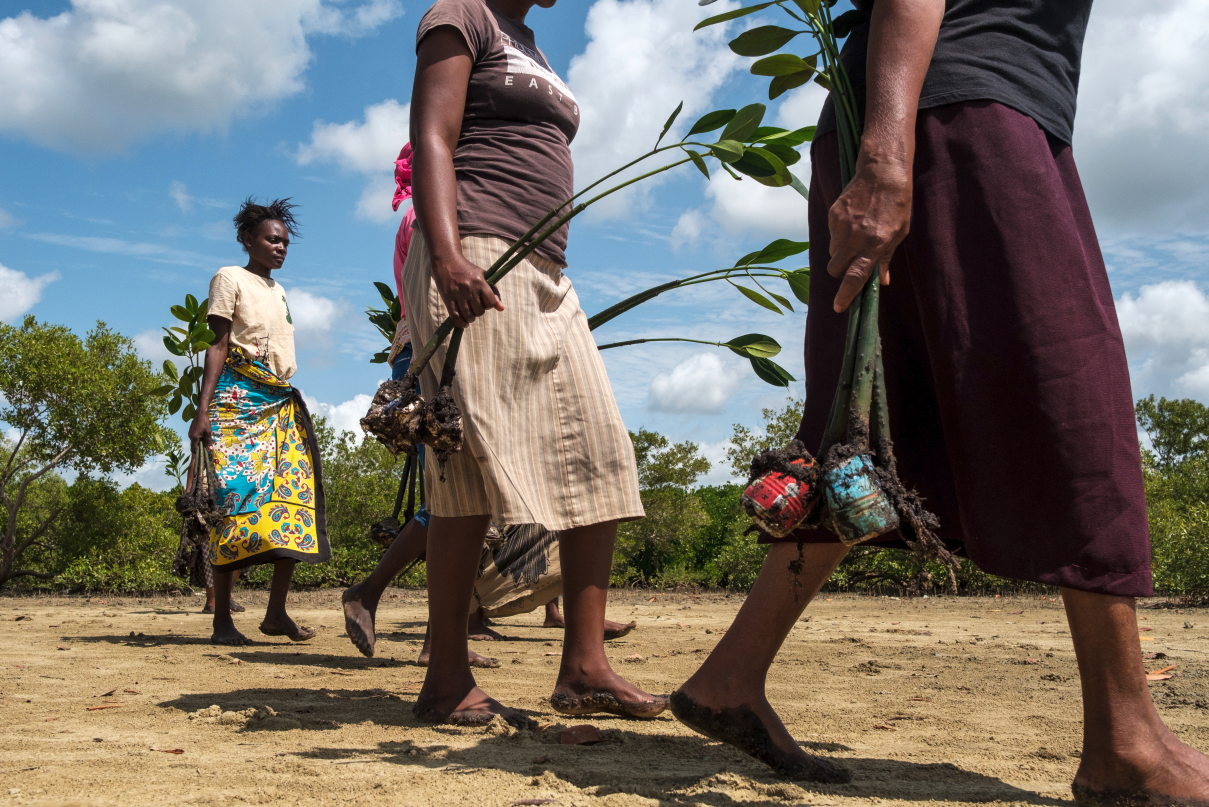
Photo: Low-angle photograph of women crossing an open tidal flat while carrying mangrove saplings with roots still wrapped in soil, in Tudor Creek, Mombasa, Kenya, on June 8, 2026. Transporting seedlings across the shore is a stage in replanting areas of degraded coastal vegetation
Barefoot in the thick mud of Tudor Creek, near Mombasa, a group of women prepares to plant mangrove seedlings. There are smiles and laughter as the participants collect the young plants and move towards the water. At a signal, a countdown begins: “One, two, three!” Everyone plants at once. Using their feet, they dig small holes in the mud, insert the seedlings and press the sediment back around them. With every few steps, dozens of tiny crabs scatter across the creek bed.
Most participants come from the Junda neighbourhood. For these women, planting mangroves has also become a chance to meet, work together and develop a closer relationship with their environment. During two visits to Tudor Creek, the contrast with the surrounding city is striking. From a boat, fish and birds can be seen among the mangroves, while fishermen work along the creek. This expanse of water and vegetation survives within Mombasa's urban landscape.
Mbaarak Abdalla, founder and programme director of Brain Youth Group, has been working to restore this ecosystem for more than a decade. Established in 2011, the community organisation involves local residents, particularly women and young people, in restoring degraded mangrove forests. “When we first started working in Tudor Creek, many areas were severely degraded,” Abdalla tells us. Large sections had been cleared, natural regeneration was limited and the shoreline was increasingly exposed. Wood harvesting, urban expansion, coastal development and pollution were the main causes. Climate change is now adding further pressure.
The scale of the problem extends across Kenya. According to the Kenya Forest Service's 2025 restoration guidelines, the country has approximately 61,271 hectares of mangroves spread along its 600 kilometre coastline. About 40% are considered degraded. Mombasa County accounts for 3,771 hectares, nearly half of which are degraded, with Tudor and Makupa creeks identified among the most affected areas.
Yet these forests perform several essential functions. Their dense root systems trap sediment, stabilise shorelines and reduce the force of waves and tidal currents. They provide breeding and nursery habitats for fish and crustaceans, while storing substantial quantities of carbon in their vegetation and waterlogged soils. For Abdalla, these benefits also explain why community involvement matters. “One of the most important changes, however, is not only what we see in the forest but also the change in people's relationship with it,” he explains. Around Tudor Creek, residents have become increasingly involved in protecting the areas they help restore.
But planting is only the beginning. Brain Youth Group reports approximately 90 to 92% seedling survival during the early establishment period in monitored restoration sites. Abdalla emphasises that this is not a five or ten year survival rate. Some planting attempts have been less successful because of unsuitable tidal conditions, excessive sedimentation, disrupted drainage or poorly chosen species. “Restoration success is determined by ecology, not by the number of seedlings planted,” he says. The organisation now places greater emphasis on studying soil conditions, salinity and water circulation before planting. Sometimes, restoring tidal flows or protecting naturally regenerating trees achieves better results than planting thousands of seedlings.
Back in the creek, the importance of these conditions is visible in the landscape itself. Water circulates between muddy banks and mangrove roots, providing habitats for countless organisms. Abdalla has observed sediment accumulating around regenerating roots and previously degraded sections becoming more stable. These observations reflect the established protective role of mangroves, although the precise reduction in coastal erosion at Tudor Creek has yet to be quantified through long-term measurements. The biodiversity benefits are equally important. Mangrove roots shelter juvenile fish, crabs and molluscs, while their branches provide habitats for birds. Abdalla reports increasing biological activity in restored areas, with more organisms returning as vegetation develops. For fishing communities, healthier nursery habitats support the marine resources on which their livelihoods depend.
This local work has gained wider significance since the Our Ocean Conference, held in Mombasa from 16 to 18 June 2026. Kenya announced 42 commitments worth approximately $1 billion, including measures to strengthen marine conservation and climate financing. During the conference, the country also launched a national plan dedicated to protecting and restoring blue-carbon ecosystems, including mangroves and seagrasses.
Mangroves are particularly valuable carbon sinks because much of their carbon remains stored underground in sediments. Carbon-credit schemes could therefore help finance restoration over longer periods. But Abdalla insists that communities must benefit directly from such projects. “The carbon should be an additional source of value for a healthy ecosystem, not the reason communities lose control of that ecosystem.”
Financing remains a challenge for Brain Youth Group, which depends largely on international grants, philanthropic contributions and partnerships. The organisation is exploring other income sources, including beekeeping and potentially carbon finance. The difficulty is securing resources to protect and monitor restored forests long after the initial planting campaigns have ended. “A three year project can start restoration, but ecosystems and communities need support and protection for much longer,” Abdalla explains. At Tudor Creek, the women can plant hundreds of young trees together in the mud. Keeping them alive will require a commitment that lasts well beyond that morning's activity.