As Albania closes another EU chapter, student protests turn violent in Tirana
As Albania advances toward EU membership, escalating student protests in Tirana over education conditions and government accountability have raised concerns about police conduct, press freedom, and the country’s democratic standards.
By Klaudjo Jonuzaj
1,144 views
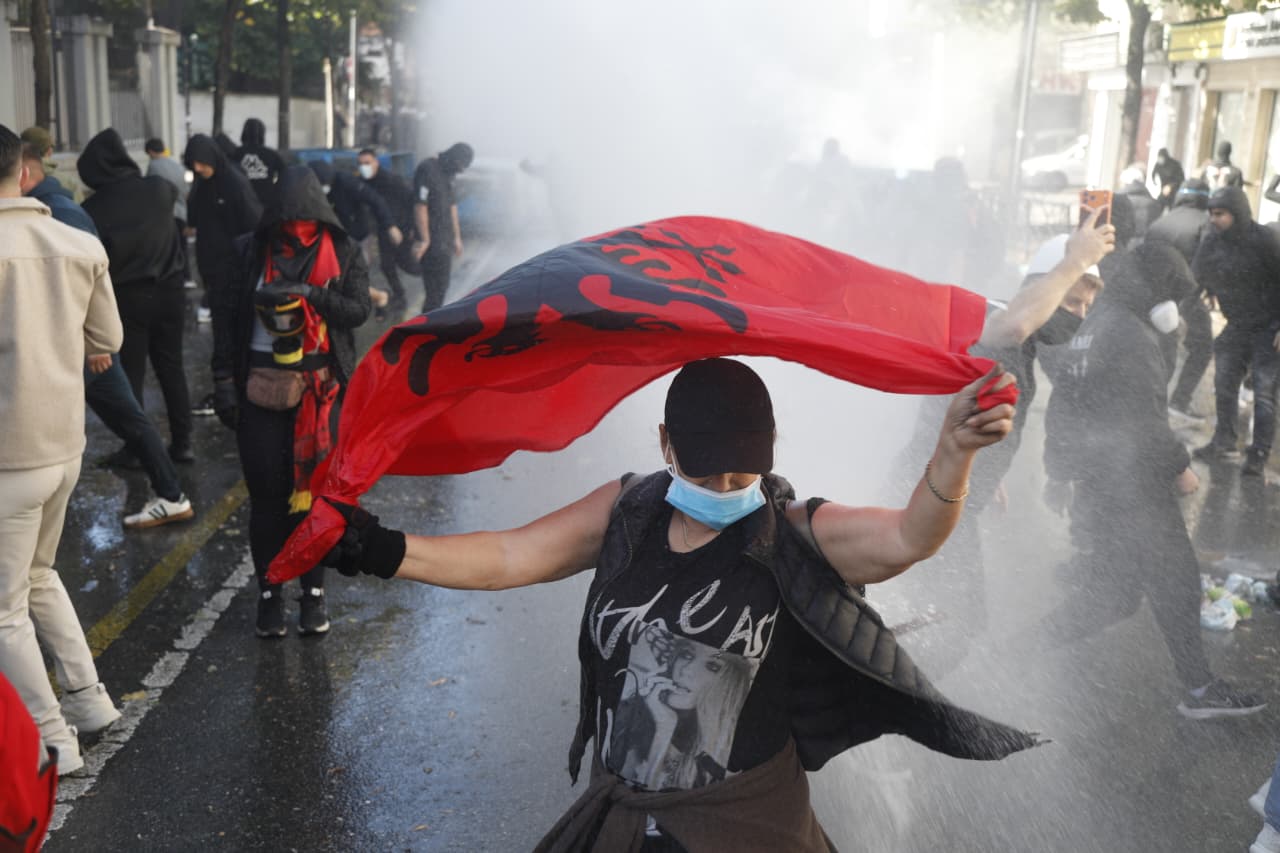
Photo: A young woman holds the Albanian flag during a protest in Tirana on October 14. Credit: LSA.
Albania’s European ambitions and its domestic politics told two very different stories on the same day. In Luxembourg, Chapter 20 on enterprise and industrial policy was provisionally closed on October 13, the fourth chapter Albania has closed, all in the second half of 2026. In Tirana, meanwhile, a student protest outside the Ministry of Education turned violent, with protesters throwing rocks and eggs and police using tear gas and water cannon. The escalation came after more than four months of peaceful protests against the government, known as the “Flamingo Revolution”, which began over a tourism project linked to Jared Kushner, son-in-law of US President Donald Trump. On October 14, clashes spread to the Prime Minister’s office, where protesters threw stones and Molotov cocktails at the building.
The protesters’ demands concern university conditions, the cost of higher education, financial support and job prospects after graduation. They have also demanded the resignation of Education Minister Mirela Kumbaro and Prime Minister Edi Rama, and by October 14 the calls for Rama to go had intensified, Reporter.al reported on Wednesday.
Against this backdrop, Rama framed the Chapter 20 closure on Tuesday as recognition of Albania’s reforms. The contrast with the street is sharper because Chapter 26, covering education and culture, was among the first three chapters provisionally closed in July. The EU’s own wording said that closure acknowledged Albania’s alignment with European education objectives, while students outside the ministry describe a system that is failing them.
Government officials, however, focused on the violence rather than the students’ grievances. In a statement on Facebook, Deputy Prime Minister Albana Koçiu said throwing stones and attacking institutions and the police is not how young people should express themselves, and described the violence as orchestrated. In a separate statement, Interior Minister Ervin Demo condemned the attacks on officers and urged participants to stay calm. He later said any claim of unlawful or disproportionate police force would be examined, with responsibility assigned individually on the basis of evidence. The Liberty Bulletin also contacted the Ministry of Education for comment, but it had not responded by the time of publication.
Calls for restraint also came from the head of state. On October 14, President Bajram Begaj said he was following the escalation with concern, called on all sides to show responsibility and restraint, and said peaceful protest is a foundation of democracy. He added that violence cannot express discontent and that police force must stay within the law and proportionality. His office, he said, remains open to dialogue with any young person or citizen.
The EU Delegation in Tirana took a similar line, with a sharper focus on police conduct. In a statement on October 14, it expressed concern about the violent escalation and about allegations of excessive force by police against protesters and journalists. It said it expects police action to be proportionate and the cases to be investigated as a priority. It added that constructive dialogue is the only way forward.
Press freedom groups were among the most vocal on the question of police conduct. In a press release, SafeJournalists condemned reported police violence against journalists, including the alleged assault of Dosja.al editor-in-chief Izmir Akulli while he filmed police force against a student. It called on the Interior Ministry, the Police Academy, prosecutors, Parliament and the Justice Ministry to investigate. The Association of Journalists of Albania also condemned the taking of a Euronews Albania journalist’s phone as obstruction of reporting. The Committee to Protect Journalists and partner organisations then sent an open letter urging an investigation and noted that journalist protection is part of Albania’s EU commitments.
The political and analytical reactions were more divided. Opposition leader Sali Berisha pledged the Democratic Party’s (DP) support for the students, and the party called Rama’s resignation the only solution. Commentator Fatos Çoçoli wrote for Gazeta Tema that violence is not protest and that vandalism does not serve the cause of the peaceful protest that has lasted more than four months. Journalist and analyst Lutfi Dervishi argued in an analysis that the police can disperse protesters but cannot extinguish the discontent that brought them out. He said the first violence came from protesters but that police intervention escalated it. Looking further ahead, a BIRN analysis published on September 30, before the violence, concluded that the summer’s protests would not jeopardise Albania’s EU prospects but would feed into a broader assessment of its democracy and rule of law.
That may be the central lesson of the recent protests. Chapters can be closed by diplomats and ministers, but the scenes on the streets of Tirana suggest that the quality of education, institutional accountability and a government’s willingness to answer its citizens will weigh just as heavily on how Brussels judges Albania’s readiness for membership.