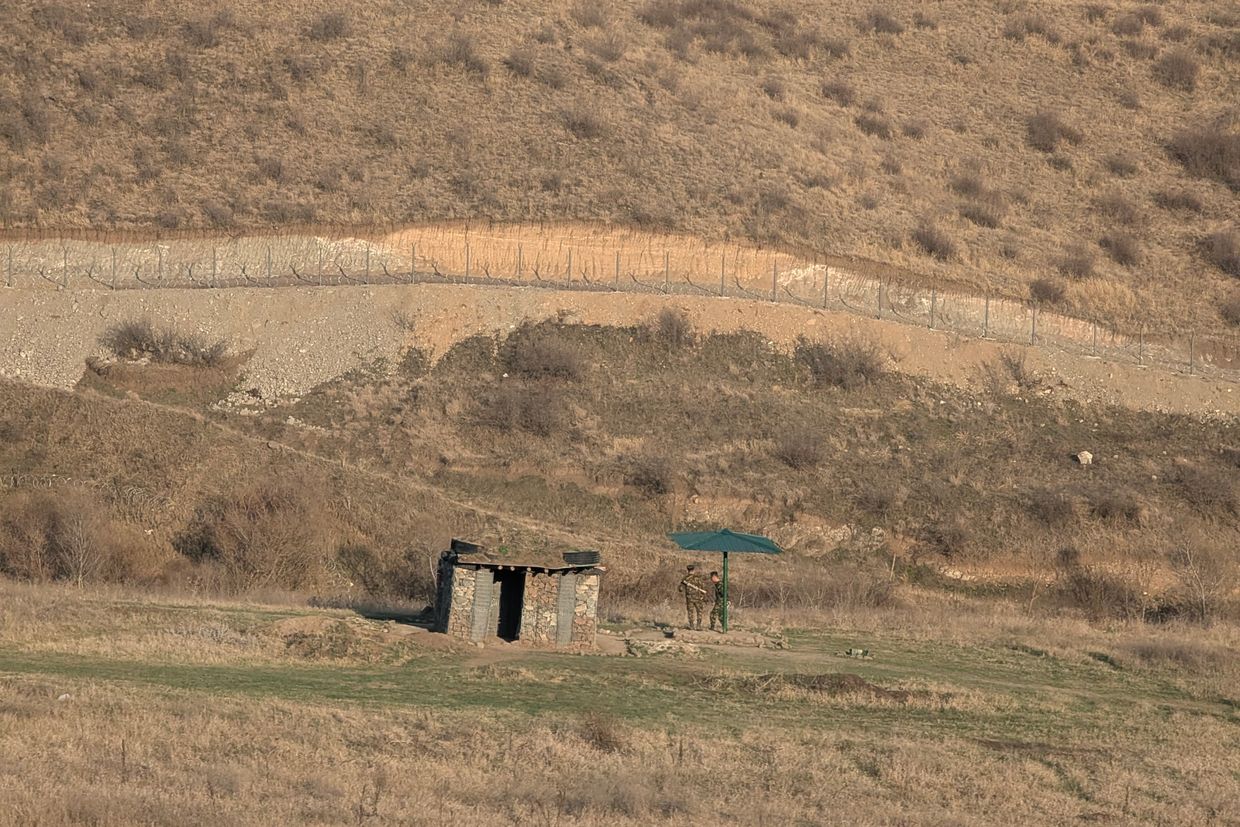
Armenian security service rejects reports that three Azerbaijanis entered Syunik village amid heightened border tensions
Armenia’s National Security Service has labeled online and media reports about three Azerbaijani nationals seen in the village of Kuris in Syunik as misinformation, even as local officials and reporters say an incident occurred overnight. The denial comes against a backdrop of recent cross-border tensions after Armenian authorities detained an Azerbaijani soldier accused of illegally crossing into Syunik and shooting an Armenian woman.
By Alexander Walter
815 views
Armenia’s National Security Service (NSS) has dismissed as misinformation recent reports that three Azerbaijanis dressed in civilian clothes were present in Kuris, a village in Syunik province near the contested Armenia–Azerbaijan border. The claims, which circulated on social media and were reported by local outlet 24News, said villagers sighted three people they believed to be Azerbaijani; the individuals allegedly fled when approached.
24News reported that Armenian and Russian border patrol officers mounted searches for the three people and used unidentified flying objects, presumed to be drones, in the operation. Kuris village head Davit Ohanjanyan told 24News there had been an incident overnight but did not confirm that the people were Azerbaijani or provide details on whether they were civilians or soldiers. OC Media contacted Ohanjanyan for further information but did not receive a response.
The NSS has pushed back on the accounts, telling several media outlets that the reports were false. In response, 24News characterized the Azerbaijani presence as 'alleged' but said Ohanjanyan’s statement that an incident occurred at night corroborated their earlier reporting. The competing accounts have highlighted information gaps and raised concerns in border communities already on edge.
The reports emerged a week after Armenian authorities detained an Azerbaijani soldier, identified as Nasimi Musayev, in Syunik on multiple charges. Armenian officials allege Musayev caused grievous bodily harm with a weapon, illegally carried a firearm, entered a private home without permission, illegally crossed the border and was involved in weapons smuggling. Armenian authorities say Musayev shot an Armenian woman, Ani Avetisyan, in the village of Shaki in Syunik province.
Social media posts had suggested that Musayev did not act alone but was part of a sabotage group, a claim that the NSS and Armenia’s Defence Minister Suren Papikyan have denied. Prime Minister Nikol Pashinyan has also said that Azerbaijan had not requested Musayev’s extradition. The conflicting narratives over the soldier’s actions and possible links to a wider group have contributed to a tense information environment and raised questions about cross-border security.
The alleged sighting in Kuris and the detention of Musayev underscore broader regional volatility along the Armenia–Azerbaijan line of contact that has persisted since the 2020 Nagorno-Karabakh war and subsequent skirmishes. Local residents in border provinces such as Syunik have frequently reported incursions, sightings and other security incidents, which authorities and media outlets sometimes report differently. The use of drones by Armenian and Russian border patrols in the search operation points to the involvement of multiple actors in monitoring and responding to potential border threats.
The woman shot in the Shaki incident, Ani Avetisyan, is an Armenian journalist with a background in multimedia reporting, podcast production and documentary filmmaking. She holds a master’s degree in media studies and has covered stories on migration and post-conflict transformation. Her alleged shooting has drawn attention not only because of the violence itself but also because of her professional profile and the broader implications for civilian safety in contested areas.
The NSS denial and the continued presence of unverified reports have implications for public confidence in official information as well as for the safety of communities along the border. With both Armenia and Azerbaijan closely watching developments, and Russia involved at least at the level of joint border patrols, the situation remains sensitive. Independent verification of the Kuris sighting has not been made public, and the differing accounts from local officials, national security services and media highlight the challenges of reporting and responding to security incidents in a contested border environment.