Armenian PM Pashinyan Says He Will Resign Whether Voters Back New Constitution; Opposition Calls It 'Aliyev's Constitution'
Prime Minister Nikol Pashinyan told lawmakers he is ready to step down regardless of the result of an impending referendum on a proposed new constitution that he says would close the chapter on conflict and make peace irreversible. Opposition parties immediately rejected the proposal, accusing Pashinyan of rewriting Armenia’s fundamental law to satisfy demands from neighboring Azerbaijan.
By Clémence Desjardins
819 views
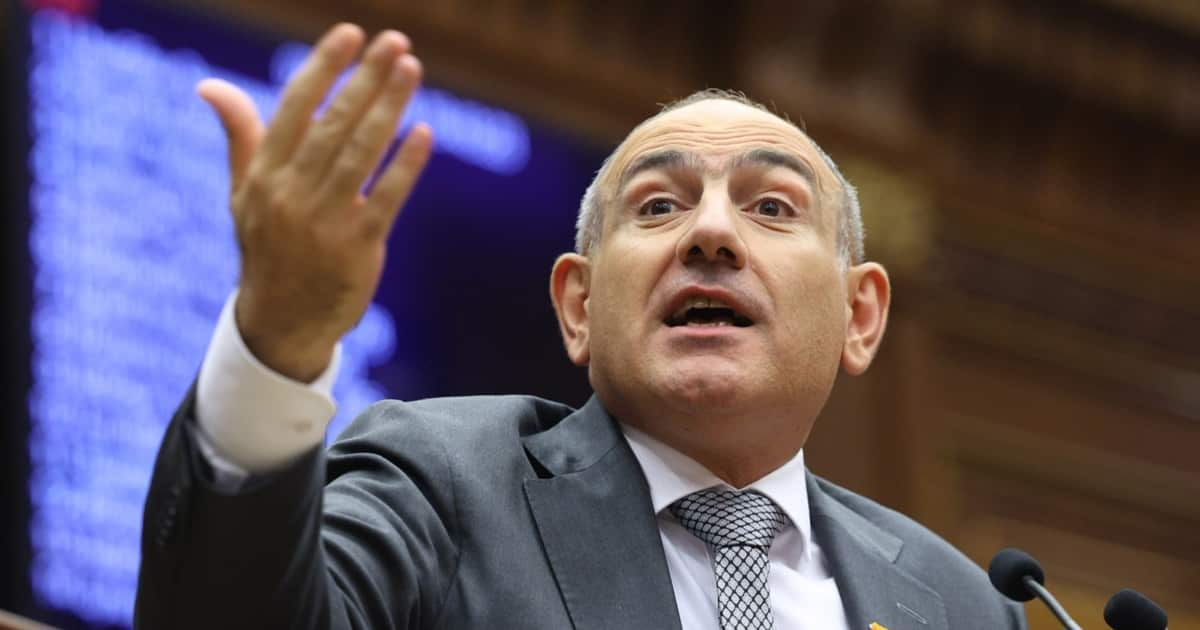
Armenian Prime Minister Nikol Pashinyan told parliament on November 18 that he would resign whether the public approves or rejects a proposed new constitution that he says is essential to cementing a lasting peace with Azerbaijan. Speaking in a question-and-answer session with deputies, Pashinyan framed the referendum as a clear choice between a peaceful, forward-looking state and continued, sustained regional conflict.
"The message of the new constitution is simple: it closes the pages on conflicts in every direction and makes peace irreversible," Pashinyan said, according to remarks reported by Radio Free Europe/Radio Liberty's Armenian service. He said the draft constitution will be published in the coming days and urged parliament to grant the necessary votes to put it to a national referendum.
Pashinyan went further, offering to step down regardless of the referendum result. "If the people do not vote for the new constitution, I will leave my post. If the people vote for the new constitution, I will sign and ratify the peace treaty [with Azerbaijan] and I will still leave," he told lawmakers, challenging opposition deputies who have sought to block the referendum to demonstrate their intent to remove him from power.
The prime minister also warned of wider political consequences if the opposition seeks to obstruct the referendum. He said he would initiate a process that would lead to snap parliamentary elections and suggested that the current opposition factions would be unlikely to return to the National Assembly under that scenario.
Opposition deputies immediately rejected Pashinyan's stance and accused him of undermining the constitution in response to demands from Azerbaijan. Anna Grigoryan, leader of the Hayastan faction, called Pashinyan's pledge a political ruse and denounced the constitutional project as what she and others call "Aliyev's Constitution," asserting that the president of Azerbaijan, Ilham Aliyev, is effectively dictating changes to Armenia's basic law. "Mr. Pashinyan, at least 50 percent of our people do not trust you," Grigoryan said, adding that they would not believe a voluntary resignation offer and would not accept what they perceive as outside interference.
Narek Karapetyan, the parliamentary leader of the Strong Armenia alliance, also dismissed Pashinyan's proposal. He criticized the influence of an external actor he implied was dictating Armenia's political choices and argued that the country needed competent and constructive partners rather than outside control of its governance.
Pashinyan's ruling Civil Contract party won a majority in the June 7 parliamentary elections but fell short of the two-thirds threshold — 70 of 105 seats — required to place constitutional amendments directly before the public. Civil Contract currently holds 64 seats in the National Assembly, meaning the party must secure support from other deputies to reach the supermajority necessary to send the draft constitution to a referendum.
A key point of contention is a demand from Baku that Armenia remove a reference in its constitution’s preamble to the 1990 Independence Declaration, which in turn includes language about a 1989 act between Soviet Armenia and the Nagorno-Karabakh Autonomous Oblast. Azerbaijan regards that historical reference as the basis for territorial claims and has made its removal a precondition in discussions tied to a final peace settlement. Armenian officials have said the forthcoming draft will omit any reference to the 1990 Independence Declaration.
The constitutional debate unfolds against a fraught backdrop of decades-long conflict over Nagorno-Karabakh. Tensions that escalated in the late 1980s and early 1990s led to Armenian forces taking control of the region and surrounding districts. After a 2020 six-week war and a one-day military operation by Azerbaijan in 2023, Baku restored control across the territory and much of its displaced population left the region. In August last year, a peace text was initialed in Washington in a process that U.S. interlocutors, including former President Donald Trump, helped facilitate; the paraph reportedly included mutual recognition of territorial integrity and provisions for withdrawing competing claims.
As Armenia prepares to publish the text of the proposed constitution, political tensions at home are intensifying. Pashinyan portrays the referendum as a necessary step to lock in peace and to ensure that future governments cannot reverse it, while opposition forces see the move as a capitulation that infringes on Armenia’s sovereignty and democratic processes. The outcome — whether the draft reaches a referendum, whether voters approve it, and whether Pashinyan carries through on his pledge — could reshape Armenia’s political landscape and affect the prospects for a definitive peace agreement with Azerbaijan.