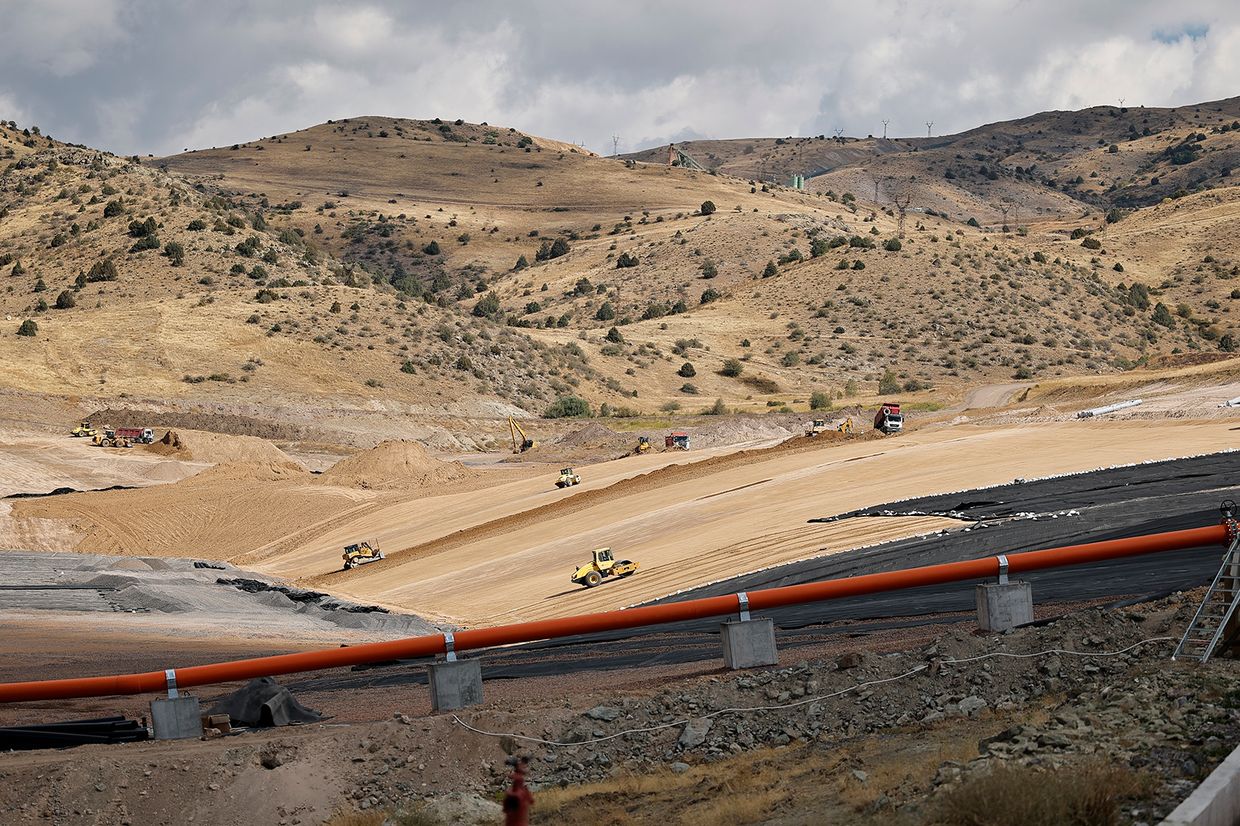
After more than a decade of protests, expert reviews and court challenges, Armenia’s Amulsar mine started producing gold on 10 October. The move, hailed by the government as an economic opportunity, has reignited disputes over water contamination risks, state involvement in the project and legal pressure on activists and journalists who opposed the mine.
By Alexander Walter
1,109 views
Armenia marked the reopening of the Amulsar gold mine on 10 October, an event the government described as a success while critics warned it risks serious environmental harm and undermines independent oversight. Amulsar, located on the border of Vayots Dzor and Syunik provinces in southern Armenia, is the country’s second-largest gold deposit. Officials and the operator say the project will create around 1,000 well-paid jobs and could yield roughly $860–$900 million in production value depending on global gold prices.
The extraction method planned for Amulsar—open-pit mining and cyanide heap leaching—has long been at the centre of opposition. Activists and independent experts have warned that cyanide and other contaminants could leach into groundwater, threatening the mineral-spring town of Jermuk just 13 kilometres from the mine. Jermuk depends heavily on tourism and bottled mineral water production, making water safety central to local livelihoods and public health concerns.
In 2019 the government, skeptical of Lydian’s own assessment, commissioned a review by Lebanese consultancy ELARD. That review flagged weaknesses in Lydian’s environmental assessment, noting poor data and unreliable modelling and concluding that groundwater contamination was a real possibility and that treatment systems could fail. Despite these concerns, the project moved forward after lengthy pauses, protests and legal disputes.
Lydian International, the Jersey-registered company that began construction in 2016, faced sustained local opposition. Villagers and environmental groups blockaded access to the site in 2018, and Lydian underwent insolvency proceedings in Jersey in 2020. Ownership of the Armenian subsidiary changed: Lydian Armenia is now fully a subsidiary of Lydian Canada Ventures, with financial backing from US-based Orion Mine Finance and Canada’s Osisko Gold Royalties. The European Bank for Reconstruction and Development (EBRD), which invested about €13 million in the project between 2009 and 2020, exited the project amid criticism.
The Armenian government’s role in recent years has shifted substantially. In 2024 authorities took a 12.5% stake in Lydian Armenia and became a formal guarantor for the company’s main loan, framing state co-ownership as a safeguard and pointing to expected fiscal benefits: an estimated 210,000 ounces of gold a year, around $130 million in annual taxes, duties and royalties, and a projected 1.5–2% boost to GDP. Officials also promised community payments to nearby towns and funding for Jermuk National Park. Critics argue the state’s financial involvement creates a conflict of interest, impairing the government’s ability to act as an impartial regulator and independent evaluator of environmental risks.
Legal and civil-society pressure has continued alongside commercial developments. In December 2024 Armenia’s Administrative Court partly upheld a 2015 lawsuit by residents and NGOs contesting the legal approvals for the mine. The Bern Convention Secretariat, responding to complaints lodged by Armenian groups and CEE Bankwatch, recommended halting actions that could harm protected habitats and in 2023 urged Armenia to revise its impact assessment. Despite these recommendations, the mine began operating in October 2026.
Campaigners against Amulsar also point to an aggressive pattern of legal action by the company. By 2020 Lydian had filed around 20 defamation suits against activists, experts, lawyers, media outlets and members of parliament. Critics and civil society have urged Armenia to adopt anti-SLAPP (strategic lawsuit against public participation) protections. In February 2026 Lydian Armenia brought new suits against lawyer Nazeli Vardanyan and journalist Tehmine Yenokyan seeking damages of 6 million drams (about $17,000) and public retractions.
The timing of the mine’s reopening—less than two weeks before Yerevan hosted COP17, the UN biodiversity conference—drew particular criticism. Opponents say the government used the moment to showcase an image of green mining while marginalising protests. Organisers kept demonstrators and other resistance activity out of sight of international delegates, and civil society groups demanded a halt to operations, a new environmental impact assessment and review of state support.
For now, the financial and environmental outcomes remain uncertain. The government approved a budget guarantee for up to $150 million in loans to Lydian Armenia from Armenian banks; an amended document named Ameriabank as lender. Officials have said total investment in the project is around $750 million, but they have not published a detailed breakdown. Environmental risks identified by the 2019 review have not yet been tested in full-scale operations, and some long-time activists say years of legal battles, the pandemic and the war have depleted their capacity to sustain protests. New citizen groups are forming, however, and litigation challenging state support and demanding accountability continues. How Amulsar will affect local water resources, public health, tourism-dependent livelihoods and the independence of Armenian institutions remains a subject of national debate and international scrutiny.