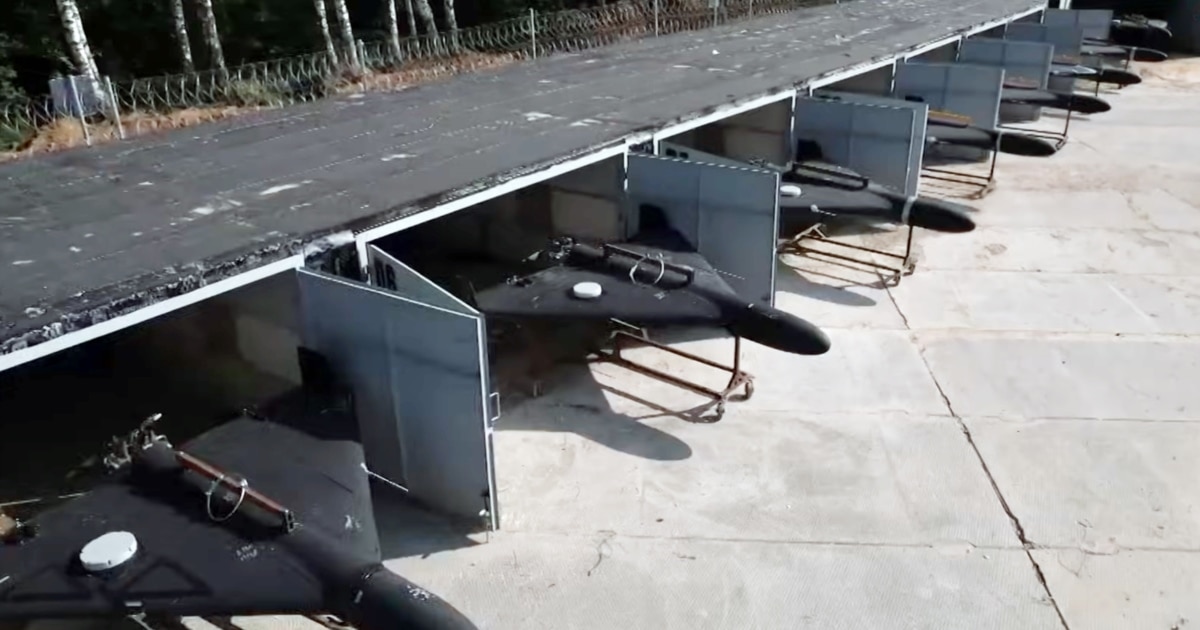
Airbase near Simferopol emerges as a military hub for long-range Shahed/Geran drone strikes on Ukraine
Since September 2023, Russian forces occupying Crimea have deployed Iranian-made Shahed kamikaze drones and later turbojet variants known as Geran or Geran‑5. Launch points have migrated from the Chauda training range to military airfields including Hvardiiske (Gvardeyskoye) near Simferopol, which analysts now describe as a consolidated hub for attacks that can reach deep into mainland Ukraine.
By Christopher Manley
1,106 views
Three years after Russian forces in Crimea first began employing Iranian-made Shahed 136/131 kamikaze drones, the pattern of launches and the infrastructure supporting them have shifted markedly, local and Ukrainian military sources say. Initially used from a helicopter pad at the Chauda training range near Feodosia, these drones spread to launch sites around Balaklava and to operating military airfields in the settlements of Hvardiiske (Gvardeyskoye), Kacha and Belbek. Over time, Chauda suffered major fires and detonations of ammunition storage in June 2024 and November 2025; by the summer of 2026, launches from Chauda had largely ceased.
Ukrainian and independent analysts report a recent intensification of activity at the airfield in Hvardiiske, located close to Simferopol. Ukrainian Air Force summaries repeatedly listed Hvardiiske among sites associated with drone operations in early September, and air-defence incidents on the nights of 7–8 September suggested coordinated launches that targeted Kyiv and regions including Kyiv and Odesa. The General Staff of the Ukrainian Armed Forces has also reported strikes against drone relays and radar installations in Crimea, signaling an ongoing contest over the peninsula’s drone infrastructure.
A notable incident underlining the expanded reach of drones potentially launched from Hvardiiske occurred on 20 August, when residents and local outlets in Rivne region reported a fast, quiet, turbojet-powered UAV over the regional centre and the town of Dubno. Traces of the vehicle indicated a flight path from the south across Odesa, Vinnytsia, Khmelnytskyi and Ternopil regions to the north, a route consistent with a launch from the Simferopol area. The straight-line distance from Simferopol to Rivne is approximately 860 kilometres, within the reported 1,000‑kilometre range of the Geran‑5 — the Russian designation for a turbojet variant of the Iranian Shahed.
Open-source technical descriptions cited by Ukrainian sources indicate Geran‑5 variants carry warheads of roughly 90 kilograms, can travel at speeds around 850 km/h, and are powered by Chinese-made turbojet engines. Guidance reportedly uses satellite links and 3G/4G modems. First known operational use of Geran‑5 was reported on 11 January 2026. Ukrainian Air Force communications officer Colonel Yurii Ignat told reporters that precise attribution of launch points requires intelligence work beyond radar detection, which typically records approaching targets hundreds of kilometres from coastal targets like Odesa.
Local military expert and Crimean native Vladislav Seleznev described Hvardiiske as a long-standing aviation garrison that the occupying Russian forces have adapted into a consolidated hub. Seleznev reminded that the site held a Soviet-era divisional headquarters and frontline bomber units, and that during the 2014 occupation Il-76 transport aircraft landed there carrying battalion tactical groups and special forces. According to Seleznev, the Russians have expanded hardstandings, storage and modular constructions, repurposed Soviet hangars to shelter drone components, and preserved fuel storage, making the site suited for assembling, fueling and launching long-range UAVs.
Seleznev and others say the Hvardiiske area is likely defended by layered air-defence systems — including S-300 and S-400 long-range systems and shorter-range systems such as Pantsir, Buk and Osa, alongside mobile anti‑aircraft teams and man-portable air‑defence systems. Despite these protections, Ukrainian forces have successfully struck Chauda, Belbek, Kacha and other sites in the past, and continue to target relay stations, radars and launch facilities across Crimea.
Analysts also point to logistical chains sustaining drone operations in Crimea. Some components for Russian Shahed variants are reported to be assembled at factories inside Russia — one plant is in Yelabuga, Tatarstan, another in Izhevsk — and personnel from Crimea may have undergone training there. Transport routes into Crimea for parts and fuel are thought to include the Kerch ferry crossings and road R-280 from mainland Russia to Simferopol, as well as transport aviation that continues to use airfields on the peninsula.
The militarization of Crimea as a staging ground for long-range UAV attacks has direct implications for civilians and infrastructure in mainland Ukraine, stretching the reach of explosive drones deeper into Ukrainian territory and complicating air-defence requirements. At the same time, strikes by Ukrainian forces on Crimea reveal the peninsula’s vulnerability and underline the contested nature of occupied territory as both a launchpad for attacks and a target for counter‑strikes. Reporting on these developments has itself been impeded by censorship: Russian communications regulator Roskomnadzor has sought to block access to local reporting outlets such as Krym.Realii, which published the original reporting under a pseudonym for the author citing safety concerns.
The evolution of launch sites and the introduction of turbojet Geran variants mark a significant tactical shift in the aerial campaign. As long as occupied Crimea hosts hardened and reconfigured airfields capable of assembling and launching long-range drones, Ukraine faces an enduring threat of strikes originating from the peninsula — a reality that continues to shape military planning and civilian protection efforts across a wide swath of the country.