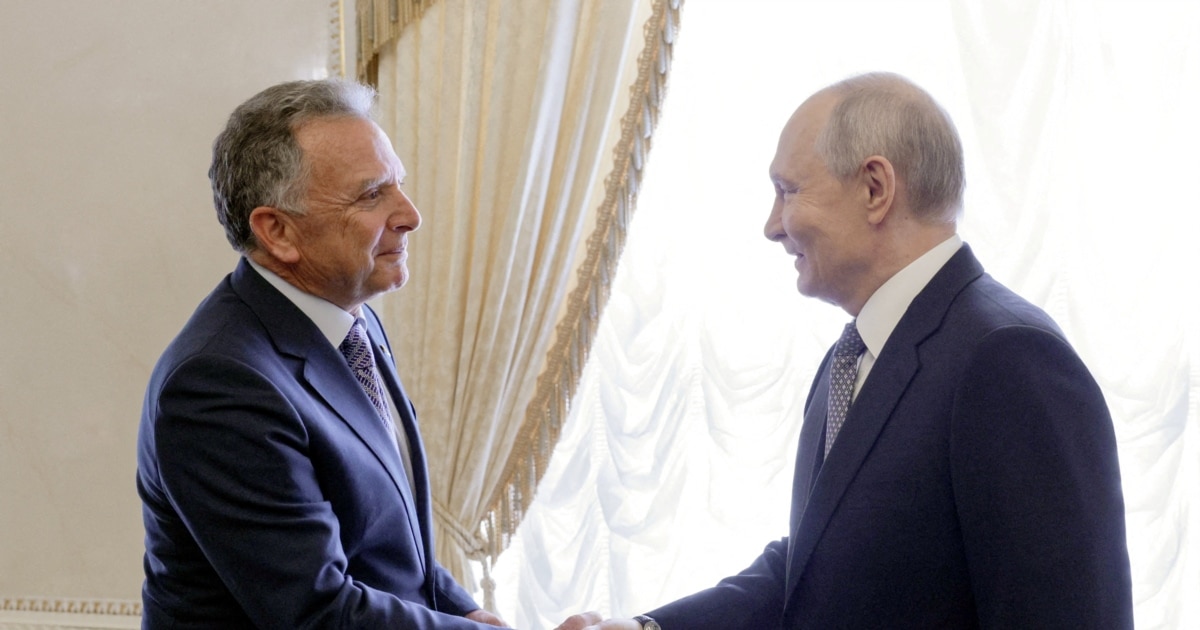
After three-hour meeting in St. Petersburg, Russia signals readiness for trilateral talks with US and Ukraine
Russian President Vladimir Putin met for about three hours in St. Petersburg with White House special representative Steve Witkoff, who delivered proposals from meetings in Oslo and proposed trilateral negotiations involving the United States, Russia and Ukraine. The Kremlin said Russia was "in general" prepared to resume three-way talks in the first ten days of November, while Ukraine insisted any discussion of its future must include Kyiv.
By Christopher Manley
872 views
A three-hour meeting in St. Petersburg between Russian President Vladimir Putin and White House special representative Steve Witkoff concluded with Moscow indicating it was prepared in principle to resume trilateral talks involving the United States, Russia and Ukraine.
According to Witkoff, who traveled to St. Petersburg from Oslo where he had met Ukrainian President Volodymyr Zelensky and European partners, he presented proposals developed in Oslo and offered to convene three-way negotiations aimed at advancing a peaceful settlement. During the meeting he also expressed gratitude to Russian authorities for a diesel fuel deal and for the release of an individual identified in reports as Steve Hubbard. Witkoff told Russian officials he saw potential for economic cooperation between Russia and the United States after the end of the war.
Kremlin foreign-policy adviser Yuri Ushakov, speaking after the encounter, said Russia was "in general" ready to resume trilateral talks with the United States and Ukraine in the first ten days of November. At the same time, Ushakov said that among the new approaches and proposals conveyed by Witkoff — reflecting positions reportedly advanced by Kyiv and the European Union — there was "not so much useful for settlement."
Ushakov also said Putin proposed that the White House consider a meeting in China involving U.S. President Donald Trump and Chinese President Xi Jinping. According to the Kremlin aide, Beijing is preparing the possibility of three-way talks between the United States, Russia and China and, "if circumstances are favorable," could include such a meeting in its program.
Witkoff’s trip followed a round of discussions in Oslo intended to identify elements of a possible peace settlement. Finnish President Alexander Stubb, speaking at a press briefing after the Oslo meetings, said participants had identified "some elements of a peaceful settlement" that would be presented in St. Petersburg, a reference to the talks that preceded Witkoff’s meeting with Putin.
President Zelensky, for his part, welcomed renewed U.S. intelligence sharing and the delivery of early warnings about Russian ballistic strikes. He told attendees in Oslo and later in media interviews that Ukraine is not losing the war but continues to pay a heavy human cost, underscoring Kyiv’s interest in finding pathways to peace while defending its people. Zelensky stressed that if other powers — including the United States, Russia or China — were to hold talks about the future of Ukraine, Kyiv must be at the negotiating table.
"I don’t know what such a three-way meeting would discuss — that’s their business. But, of course, if it is about Ukraine and our future, then we must also be at the negotiating table. That is absolutely obvious," Zelensky said in Oslo. In an interview with Fox News on October 21, the Ukrainian president reiterated his readiness to halt active hostilities along the current line of contact as part of a possible ceasefire arrangement.
The developments in high-level diplomacy come amid ongoing concern about restrictions on independent reporting in Russia. The news outlet that published the original dispatch, Krymr.Realii (Crimea.Realities), reported that the Russian communications regulator Roskomnadzor was attempting to block access to the site, and advised readers in affected areas to use mirror sites and virtual private networks to continue accessing its coverage. The regulator's actions underscore persistent press-freedom pressures in Russia even as diplomatic channels appear to be opening for talks involving the war in Ukraine.
Any movement toward formal trilateral negotiations or alternative multilateral formats would carry major implications for the conduct of the war and the diplomatic landscape. Putin’s reported openness to resumed three-way talks and to potential summits that could include China underscores Moscow’s interest in widening the set of interlocutors, while Kyiv’s insistence on being included highlights a core diplomatic and political condition that could shape whether such meetings are viewed as legitimate by Ukraine and its Western partners. Officials involved in the recent diplomatic exchanges said they would continue consultations in the coming weeks to determine whether and how negotiations could be convened.