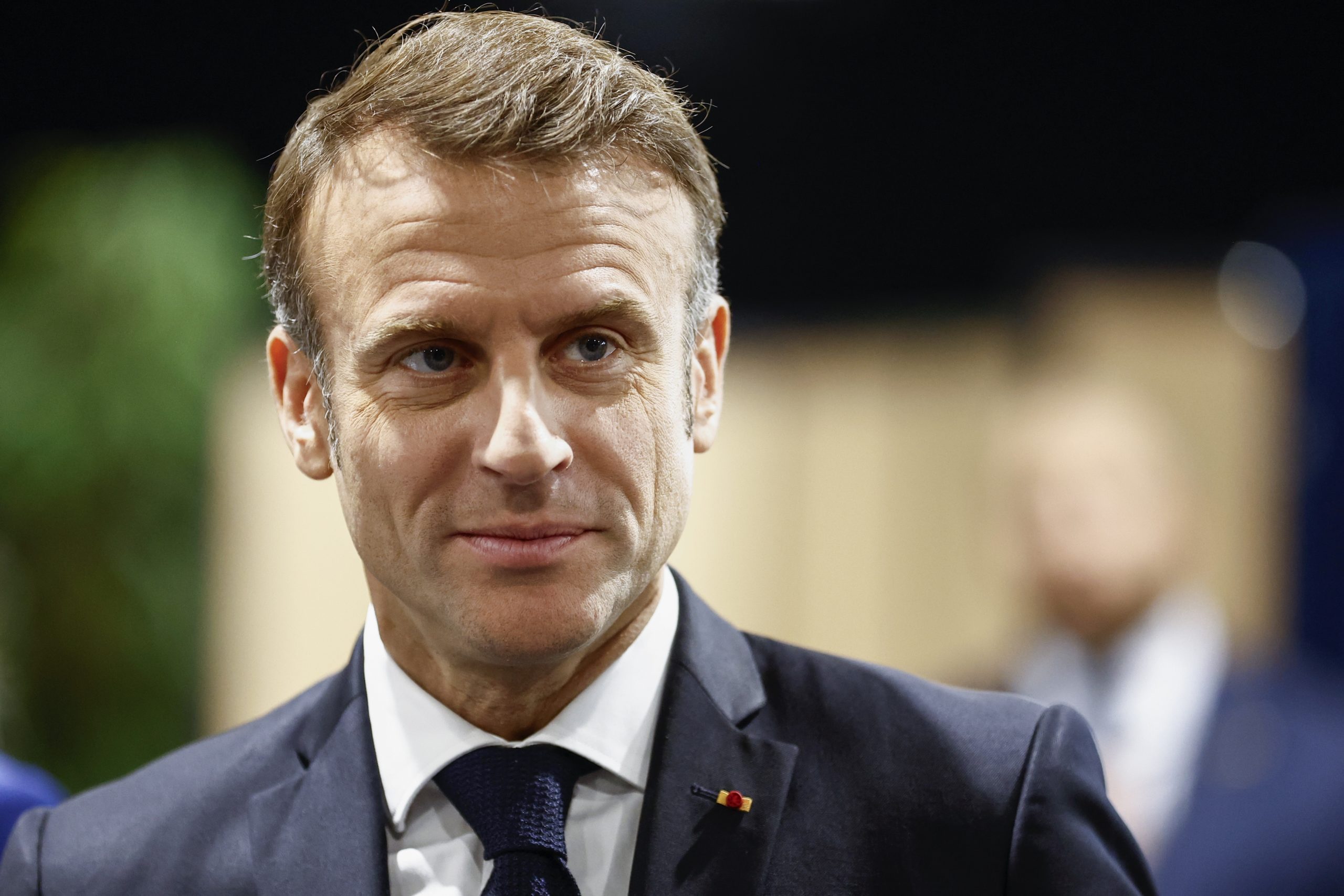
‘A world in disarray’: Europe’s moment of awakening
By Christophe Petit-Tesson/Reuters
917 views
‘A world in disarray’: Europe’s moment of awakening
Facing existential challenges on trade and security, the bloc has finally realised it has to grow up and go it alone – but the path ahead is a rocky one
Don’t get This Is Europe delivered to your inbox? Sign up here
Jon Henley Europe correspondent
Wed 11 Feb 2026 15.47 CET
Share
Prefer the Guardian on Google
Emmanuel Macron put it simply – and starkly. Confronted with “a world in disarray” and a double, potentially existential challenge from the US and China, he said: “Europe must become a power.”
The bloc is facing “a Chinese tsunami” on trade, Macron told several European newspapers, as the country most Europeans had for decades seen principally as an infinite export market transforms itself instead into a ferocious, low-price, hi-tech competitor.
And on defence, the US – which Europeans had thought “would guarantee our security forever” – was now “openly anti-European”, showed “contempt” for the EU, sought its “dismemberment” (and was “microsecond-level unstable” on trade, too).
“We are not moving at the right pace, and we are not operating on the right scale,” Macron said. “This must be the moment of awakening. It is time for Europe to wake up … If we do not decide for ourselves, we will be swept away.”
Stirring words, for sure. But this week there is a real sense that what Macron referred to as Europe’s “Greenland moment” – Trump’s attempted grab for the Arctic island, a semi-autonomous part of Denmark – may finally be focusing continental minds.
Two key events may give a hint of whether, and how, that focus translates into action. At a 16th-century chateau in rural Belgium on Thursday, Europe’s leaders will discuss urgent measures to reboot the EU’s sluggish economy and make it more competitive. And at the Munich Security Conference (MSC) on Friday and over the weekend, they will join other world leaders, military officials and experts to discuss European security and defence – and the future of the transatlantic relationship.
“We have the second largest economy in the world, but we are driving it with the handbrake on,” the European Commission president, Ursula von der Leyen, said before the gathering at Belgium’s Alden Biesen castle.
Leaders will discuss simplifying, loosening and scrapping regulations to cut red tape, remove barriers and deepen the single market; facilitating the flow of savings and investments; and keeping public money in the EU through a “buy European” rule.
The leaders will be addressed by two former Italian prime ministers, Enrico Letta and Mario Draghi – whose recommendations in 2024 reports on, respectively, the EU’s single market and EU competitiveness the bloc has so far struggled to implement.
IMF research shows EU internal regulatory barriers equate to a 44% tariff on goods, and 110% on services, and one thinktank found only 15% of Draghi’s 383 proposals – without which he said the bloc risked a “slow and agonising decline” – had been actioned.
Thursday’s talks centre on how the EU can hold its own economically in a world that von der Leyen last month described as having “changed permanently”. Friday’s will turn to the bloc’s other critical challenge: defence and security.
The MSC’s organisers were blunt in their pre-conference report: Europe had reached the “painful realisation” that it needs to be more assertive and militarily independent of a US administration it said was sliding into “competitive authoritarianism”.
Europeans have understood they simply cannot resist unfair trade deals or violations of other countries’ sovereignty, it said, if they are “heavily dependent on the military assistance of the country that is using coercive tactics and slashing existing norms”.
Speeches from von der Leyen, Germany’s chancellor Friedrich Merz and Nato chief Mark Rutte – who recently said Europe could “keep on dreaming” if it thought it could cope without US support – should provide at least an outline of the bloc’s response.
Europe’s citizens appear to have grasped the threat. A six-country poll by YouGov published this week found that opinion had turned radically against the US since the “Greenland moment”: between 62% and 84% of respondents expressed disapproval.