A day with Saint-Malo’s scallop divers in a post-Brexit Channel
Professional scallop divers off Saint-Malo harvest shellfish by hand in challenging underwater conditions, while France, Jersey and the EU work to balance sustainable fishing, resource management and post-Brexit disputes over access to Channel waters.
By Martin Bertrand
1,034 views
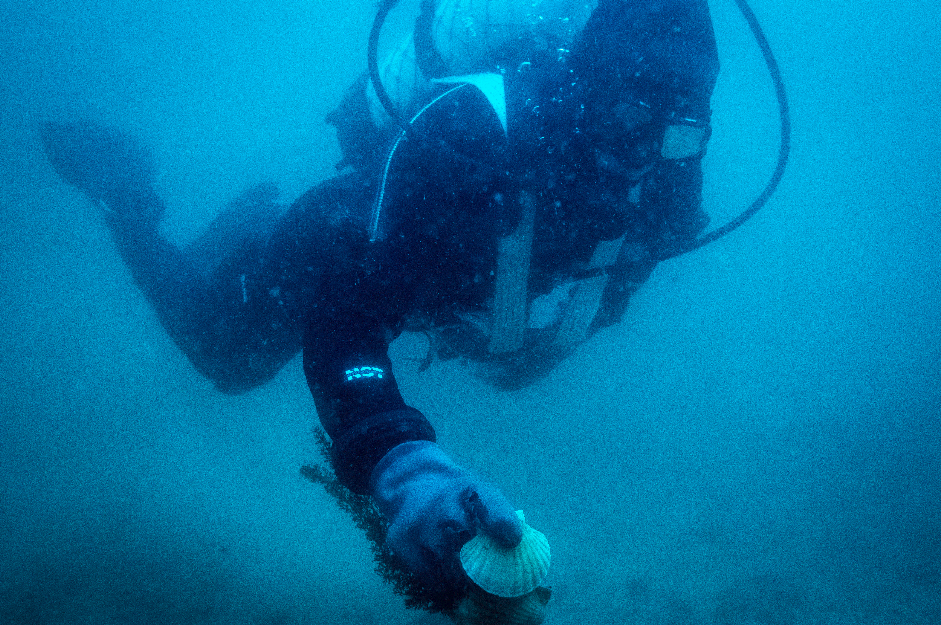
Photo: Underwater photography of a scallop fisherman scuba diving on the boat in the bay of Saint-Malo in the Ille-et-Vilaine department in the Brittany region of France on 29 April 2024.
The tide dictates the working day at Saint-Malo, on the northern coast of Brittany.
Laurent sets out in the morning with three other men for roughly six hours at sea. Their departure is timed around low tide, when there is less water between the surface and the scallop beds. Two men remain aboard while Laurent and Marco dive to collect the shellfish, sometimes at depths of twenty metres.
Their equipment is surprisingly basic compared with that used in recreational diving. Neither carries a buoyancy jacket or a spare regulator. Instead, they wear heavy weights to descend towards the seabed. Asked what happens if something goes wrong underwater, Marco, one of the older professional divers still working in the area at the time of the visit, replies simply: “Well, you go back up.” The answer is disarmingly straightforward, although the profession is strictly regulated. French commercial divers must hold specialist qualifications and undergo regular medical examinations.
For Laurent, the sea has been a familiar environment since childhood. Long before making a living from it, he spent much of his time underwater with fins, a mask and a snorkel. Today, the conditions are considerably less inviting. During the winter fishing season, little daylight reaches the seabed, while suspended sediment and poor visibility make the surroundings particularly austere. The bottom appears bare, with little relief or visible marine life, far removed from the colourful underwater landscapes often associated with diving. The wider Channel has also experienced decades of bottom trawling and dredging, fishing techniques known to disturb seabed habitats.
The job is physically demanding. Laurent and Marco search the bottom for scallops, collect them individually and fill their bags before returning towards the surface. The process is repeated throughout the trip, with intervals aboard between dives. Above water, there is little comfort on the small working boat. Everyone brings their own food, there are no toilets, and the crew remains at sea for the duration of the fishing trip.
On deck, the other two fishermen retrieve the bags and measure the catch. Undersized scallops are returned to the water. Only seven vessels are authorised to harvest scallops by diving on the Saint-Malo grounds, and no more than two divers can work underwater simultaneously. The minimum legal size for the scallops themselves is 10.5 centimetres.
Across the Channel, Jersey, a British Crown Dependency whose surrounding waters have long been worked by French fishermen, increased its minimum legal size for king scallops from 102 to 105 millimetres in December 2025, bringing it into line with French regulations. The change was designed to allow more scallops to reproduce and make fishing rules easier to enforce on both sides.
Other fishing rules have proved considerably harder to reconcile since Brexit. When the new arrangements took effect in 2021, French vessels wishing to continue fishing around Jersey had to obtain licences and demonstrate their previous activity in those waters.
According to Jersey's government, 41 vessels registered in Saint-Malo were among 222 French boats that applied for licences during the first half of that year. For some smaller fishermen, who lacked electronic tracking equipment, proving where they had historically worked became particularly difficult. The resulting disagreements over fishing rights brought France and Jersey into a prolonged diplomatic dispute.
On the boat in the Bay of Saint-Malo, the question of managing resources is already familiar. During the reporting trip, Laurent's main concern is not a shortage of scallops but their abundance. “It is harder to manage abundance than shortage, because abundance can make us do anything,” he explains. In Saint-Malo, fishermen have also spent more than twenty years supporting natural stocks by releasing young scallops produced at the Tindu hatchery. Around one million juveniles are seeded annually across the Saint-Malo grounds and the Rance.
Across the Channel, the UK and EU are now attempting to coordinate the management of this shared resource. In June 2025, they agreed to maintain reciprocal access to their respective waters until 2038, although Jersey retains its own licensing arrangements. British and European authorities are also developing a joint long-term strategy for king scallops in the Channel. Discussions have so far concentrated on scientific data, management objectives and possible technical measures, with larger questions about fishing effort and catches still to be resolved.
Meanwhile, the work continues. Laurent and Marco return from the seabed with their bags of scallops, leaving the other two men to sort and measure the catch. Around the small boat, the forts and rocky islands of Saint-Malo rise above the water, a striking landscape that contrasts with the cold, murky conditions below. After nearly six hours at sea, the fishing trip comes to an end. Every scallop brought back to port has been collected by hand, one at a time.